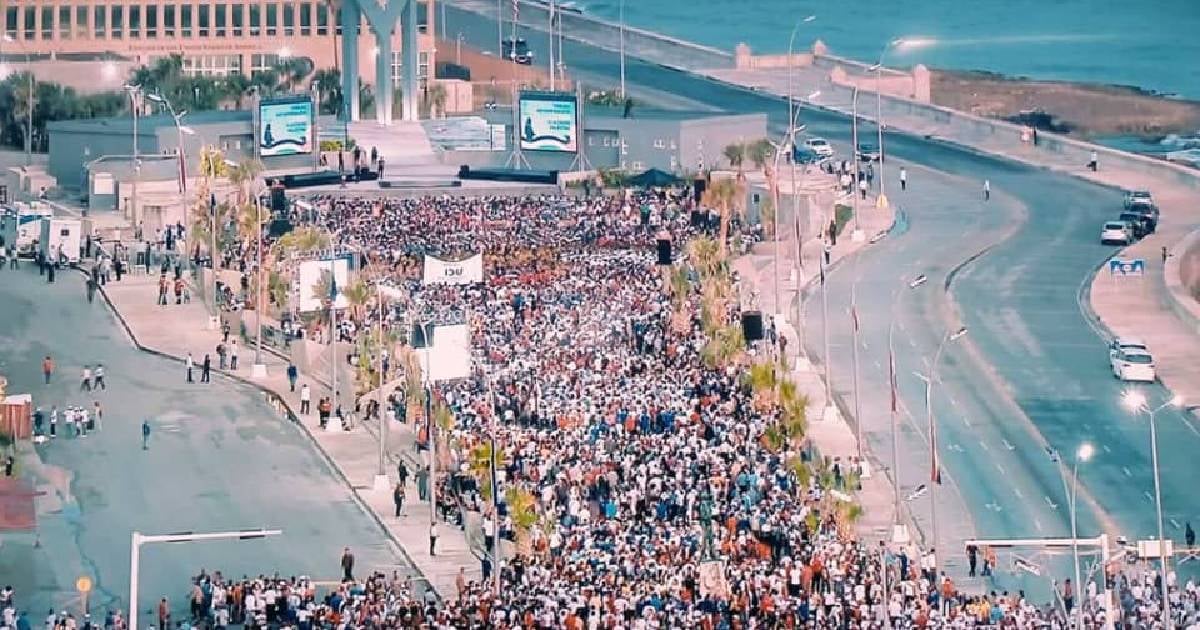
The Cuban regime announced this Thursday that over 100,000 residents of Havana attended a pro-government rally held at the José Martí Anti-Imperialist Platform, located in front of the United States Embassy in Havana. However, independent estimates derived from aerial images of the event suggest the actual number could be significantly lower, potentially between three to six times less.
On its official X account, the government stated: “More than 100,000 residents of Havana, on behalf of the people of #Cuba, raised their voices at the historic Anti-Imperialist Platform to denounce the genocide committed by the Zionist regime of Israel with the complicity of the United States in #Palestine.” Similarly, Granma, the official newspaper of the Communist Party, echoed this figure in its headline, emphasizing the presence of Miguel Díaz-Canel and top national leaders at the event.
Discrepancy Between Official and Independent Figures
Nevertheless, independent visual estimates based on a panoramic photograph of the rally contradict the government's account. An analysis utilizing Artificial Intelligence to evaluate crowd density estimates the space occupied by attendees spanned approximately 200 to 250 meters in length and 30 to 40 meters in width, totaling around 8,000 square meters.
Using international crowd density standards: high density (4 people/m²) suggests around 32,000 attendees, while medium density (2 people/m²) would indicate about 16,000 individuals. Based on these parameters, the actual turnout was likely between 15,000 and 30,000, a stark contrast to the 100,000 claimed by state media.
Propaganda and Image Control
The event, led by Díaz-Canel, included participation from young pioneers, Palestinian medical students in Cuba, and representatives of the so-called "socialist civil society." The government presented it as a demonstration of the "Cuban people's" support for the Palestinian cause and as a protest against the "Israeli genocide with U.S. complicity."
However, numerous observers and social media users questioned the spontaneity of the rally, noting that many such gatherings are orchestrated by workplaces, schools, and universities, with attendance often being mandatory.
The gap between official figures and independent estimates highlights once again the Cuban regime's manipulation of official discourse regarding popular participation. While the regime strives to project an image of unity and support, the images and objective calculations expose the disconnect between propaganda and reality.
Resource Allocation Amid Fuel Shortages
In a country plagued by fuel shortages, participants were gathered at the José Martí Anti-Imperialist Platform from early morning hours. Amidst a severe economic and energy crisis, characterized by frequent blackouts and halted public transportation in many regions, the event featured a significant deployment of state resources.
Numerous reports on social media highlighted the use of school and work buses to transport attendees, while thousands of citizens struggle daily to find transportation for their routine activities.
Key Questions About the Cuban Rally and Participation
What was the official attendance claim for the Cuban rally?
The Cuban government claimed that over 100,000 people attended the pro-government rally.
How do independent estimates compare to the official figures?
Independent estimates, based on aerial images, suggest the real attendance was likely between 15,000 and 30,000, significantly lower than the official claim.
What challenges are highlighted by the resource allocation for the rally?
The rally's organization underscored the ongoing fuel shortages in Cuba, as state resources were used to transport attendees while everyday citizens face transportation difficulties.