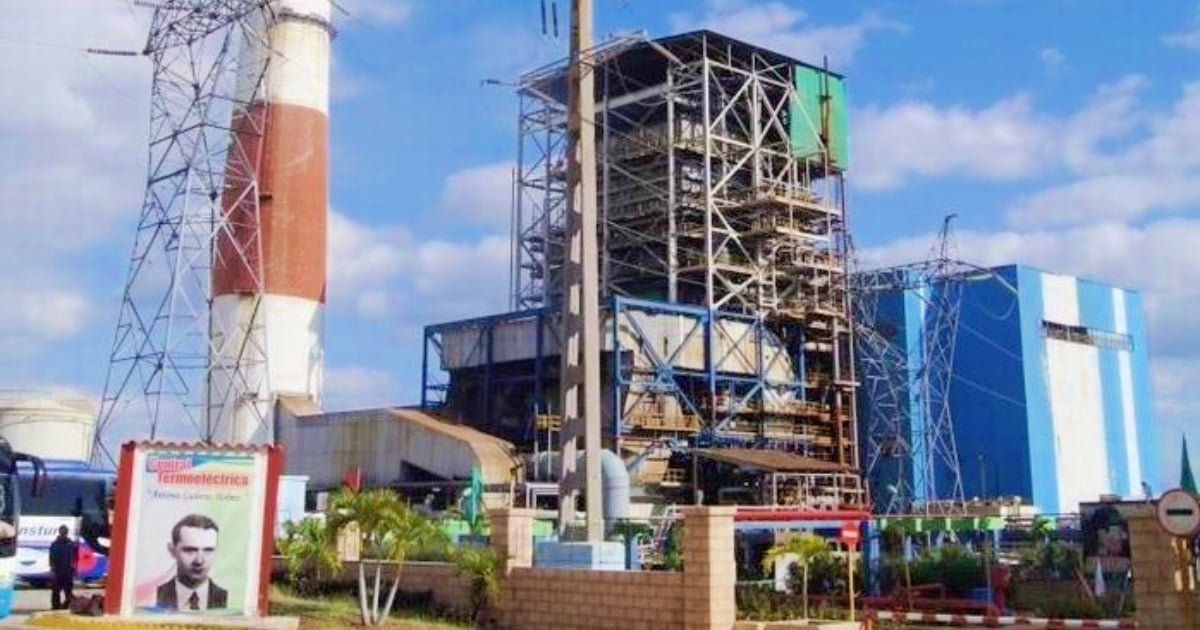
The Antonio Guiteras thermoelectric plant, Cuba's most critical power facility, unexpectedly went offline from the National Electric System (SEN) on Tuesday morning. This information was shared through a concise social media post by the Cuban Electric Union (UNE), which cited a "boiler failure" as the reason for the shutdown.
The malfunction occurred at 9:28 a.m. local time. As of the writing of this article, no additional details about the circumstances of this latest breakdown at Cuba's most vital thermoelectric plant have been disclosed.
Compounding the issue, just hours before the Guiteras plant's shutdown, the UNE reported another outage at 6:55 a.m. involving Energás Jaruco's Unit 6. This was attributed to "sargassum in the BC-4705 intake channel."
Escalating Power Outages
Prior to these incidents, the forecasted power outages for the day were already significant, projected at 1,740 MW. With the new malfunctions, the potential for electrical disruptions is expected to rise substantially. According to the UNE, service was disrupted for 24 hours the previous day and remained affected throughout the night.
The maximum deficit in generation capacity recorded yesterday was 1,765 MW at 7:40 p.m., surpassing planned demand levels. Meanwhile, 32 new photovoltaic solar parks contributed 3,271 MWh, with a peak output of 591 MW during midday.
Current Power System Status
As of 6:00 a.m., available capacity within the SEN was 1,680 MW, while demand reached 2,730 MW, resulting in a shortfall of 1,082 MW. An expected midday impact of 1,150 MW was also projected.
Before the Guiteras and Energás Jaruco Unit 6 outages, several other units were already offline: Felton CTE's Unit 2, Santa Cruz's Unit 3, Mariel's Unit 8, and Renté CTE's Units 3, 5, and 6. Units under maintenance included: Santa Cruz CTE's Units 1 and 2, and Carlos Manuel de Céspedes CTE's Unit 4 in Cienfuegos.
Fuel and Maintenance Challenges
Thermal limitations resulted in 307 MW being out of service, while fuel shortages affected 54 distributed generation plants, taking 270 MW offline, with an additional 229 MW unavailable due to a lack of lubricant, totaling 499 MW affected. For peak times, a recovery of 50 MW is anticipated from distributed generation engines currently offline due to fuel issues.
Projections for peak hours estimate a capacity of 1,730 MW versus a maximum demand of 3,400 MW, leaving a deficit of 1,670 MW. Should current conditions persist, a 1,740 MW impact is forecasted for these hours.
Blame on "The Blockade"
In late September, Cuban leader Miguel Díaz-Canel blamed the U.S. embargo for the prolonged blackouts affecting millions of Cubans. In a Facebook video, Rubén Campos, director of the Antonio Guiteras plant, claimed that the facility is the most impacted by the intensified blockade.
Díaz-Canel accompanied the video with a message asserting that the explanation was "simple, concrete, and graphic" in illustrating the harsh reality faced by Guiteras workers, attempting to directly link the electrical crisis to U.S. sanctions. Campos detailed significant changes in 2015 when General Electric, a U.S. multinational, acquired French company Alstom, which originally manufactured and maintained the plant. This acquisition left the Guiteras without critical parts support.
Specific examples included pumps and valves returned from Jamaica to France due to U.S.-origin components, $1 million speed regulators not delivered despite payment, and foreign specialists canceling trips to Cuba due to external pressures.
"You can have money, but if you don't have a bank to work with, it's as if you don't have it. It's very difficult. The empire constantly monitors us... This is the reality of the blockade, and believe me, I'm not exaggerating," concluded Campos.
Recurrent Official Narratives
Campos' comments and Díaz-Canel's post add to a longstanding series of official justifications. In May, Deputy Minister of Energy and Mines Argelio Jesús Abad Vigoa stated on the Round Table program that "the blackouts are a result of the criminal North American blockade, not just talk."
The director of the Electric Union acknowledged the system's "serious" state in the same forum, noting that circuit rotations were not possible due to the severity of the deficit. More recently, Díaz-Canel called for the "improvement of electrical scheduling" to distribute blackouts more equitably, admitting that some provinces endure over 25 hours of consecutive outages while others experience fewer interruptions.
Impact of the U.S. Embargo on Cuba's Power Crisis
How has the U.S. embargo affected Cuba's power plants?
The U.S. embargo has reportedly impacted Cuba's power plants by hindering access to critical parts and financial support. The acquisition of Alstom by General Electric in 2015 left facilities like Antonio Guiteras without necessary backup for essential components.
What are the main reasons for the current power outages in Cuba?
The main reasons for the current power outages include technical malfunctions, fuel shortages, maintenance issues, and the purported effects of the U.S. embargo, which complicates access to needed equipment and financial resources.
What is the Cuban government's response to the power crisis?
The Cuban government has primarily blamed the U.S. embargo for the ongoing power crisis while acknowledging system deficiencies and calling for improved management of electrical scheduling to equitably distribute blackouts across the country.