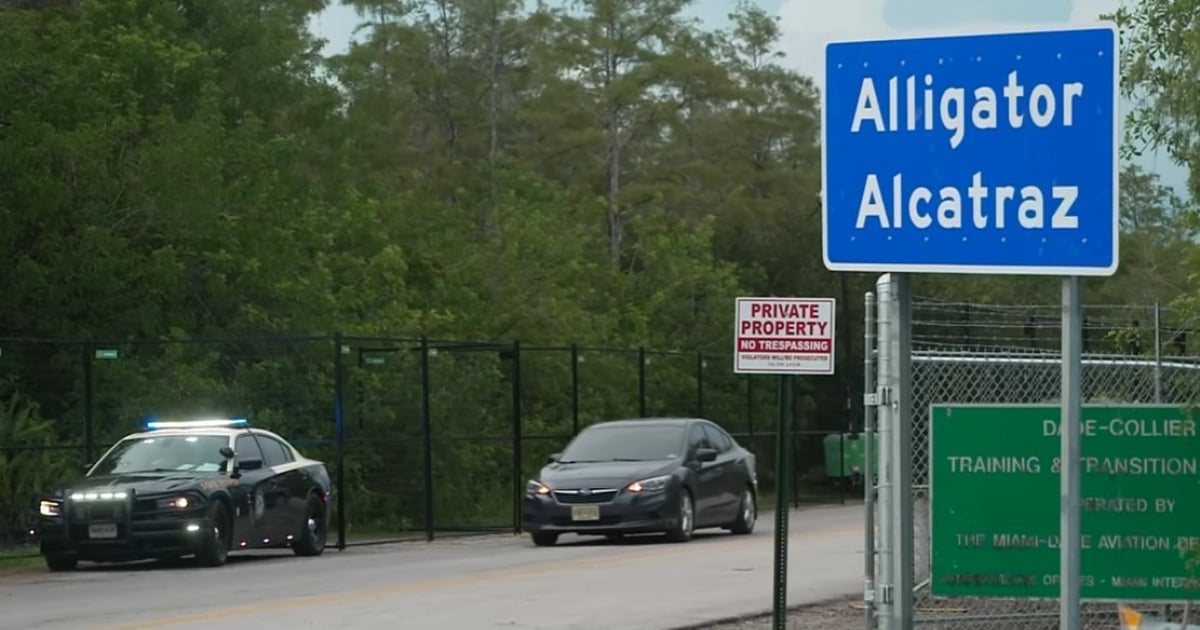
The United States government has admitted that the Everglades' immigration facility, commonly referred to as "Alligator Alcatraz," houses individuals who have never undergone formal deportation proceedings. This revelation stands in direct contrast to the claims of Florida Governor Ron DeSantis, who previously stated that every detainee had final orders for removal.
According to court documents reported by the Associated Press, Department of Justice (DOJ) attorneys acknowledged in a court submission that the center holds individuals at "all stages of immigration processing." This includes those not yet placed in removal proceedings or still awaiting a hearing. The DOJ document disclosed, "The facility accommodates detainees across all phases: those who have never been in deportation proceedings, those about to enter them, those with final orders, and those awaiting departure."
This disclosure directly contradicts Governor DeSantis's public remarks. In several appearances in July, he insisted that "all detainees at Alligator Alcatraz have been ordered to be removed from the country." During a press event outside the facility, the Republican governor asserted, "There is no one there without a final deportation order."
The issue emerged amid a lawsuit filed by civil rights organizations accusing state authorities of hindering detainees' access to adequate legal representation, potentially violating their constitutional rights. Federal government attorneys argued that the varying immigration statuses of detainees complicate certifying the case as a class action lawsuit.
Constructed on a former airstrip in the Everglades, the center opened in July under state control and is operated by private contractors. Since its inception, it has faced three federal lawsuits: one for civil rights violations, another for environmental damage, and a third for administrative irregularities.
In August, a federal judge in Miami ordered the center's closure within two months, citing that its construction lacked the necessary environmental permits. However, an appeals court temporarily suspended the order, allowing operations to continue while the decision is under review.
At its peak, the center housed over 900 detainees, although its full capacity is 3,000. It was promoted as a model of infrastructure by President Donald Trump, who visited in July and described it as "an example of how the United States can effectively manage the immigration crisis."
The federal government also approved a reimbursement of $608 million to Florida to cover the center's construction and operation costs. This decision drew criticism from environmental groups and immigrant advocates, who see the complex as emblematic of the current administration's harsh immigration policies.
Meanwhile, the legal battle continues in a Fort Myers courtroom, where plaintiffs demand that detained migrants be assured access to attorneys, private communications, and reviews of their legal processes.
Key Questions About "Alligator Alcatraz" Immigration Center
What is the current status of the "Alligator Alcatraz" immigration center?
The center remains operational after an appeals court temporarily suspended a federal judge's order to close it due to missing environmental permits.
Why are civil rights organizations suing the state authorities?
The organizations allege that state authorities are obstructing detainees' access to legal representation, which may violate their constitutional rights.
How did the federal government financially support the "Alligator Alcatraz" center?
The federal government approved a reimbursement of $608 million to Florida for the center's construction and operational expenses.