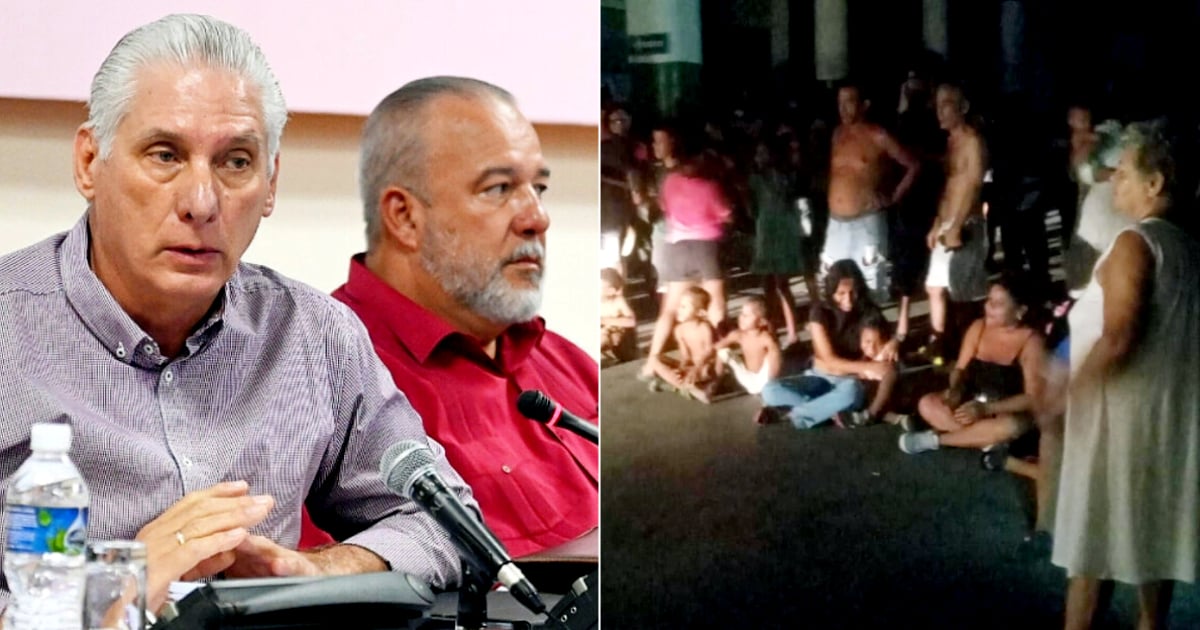
Cuban journalist José Raúl Gallego has called on citizens to focus their protests on the centers of state power. This comes as a counter to a message from the official account of the Cuban Presidency, which urged people not to block streets during demonstrations in Havana. "For the first time, we should heed Díaz-Canel's advice: direct protests there. To the Party, the Government, and police stations. Occupy these spaces that rightfully belong to the citizens, and ensure those who've usurped power for six decades and are responsible for Cuba's problems are removed," Gallego stated on social media.
His comment was a direct response to a tweet from the Palace's propagandists quoting leader Miguel Díaz-Canel saying, "The people's demands are legitimate, but they must be made in the established places: the Party, government, and state institutions," while also warning that "no one is authorized to block a public road."
The official message followed several days of protests and pot-banging in Havana neighborhoods, driven by prolonged blackouts, water shortages, and garbage accumulation. In reaction, Díaz-Canel held meetings with Communist Party leaders and military heads, ordering inspections of the private sector and imposing controls on electricity and fuel consumption.
Protests Targeting Power Despite Fear
Despite decades of state control and repression stifling any visible dissent, there have been several instances where Cuban citizens took their grievances directly to the seats of political or administrative power. Even under a system that punishes protest with imprisonment or violent repression, various social sectors—from mothers and self-employed workers to artists and activists—have challenged the fear and Communist Party control.
In March 2020, dozens of self-employed workers staged a protest in front of the Communist Party in Santa Clara, demanding labor rights and the reinstatement of licenses suspended by the Ministry of Labor. This demonstration was unprecedented in scale as it unfolded before a government institution, forcing a public response from the authorities.
On November 27, 2020, over a hundred artists, journalists, and young Cubans gathered outside the Ministry of Culture (MINCULT) in Havana, demanding freedom of expression, an end to censorship, and dialogue with the authorities. Known as 27N, the protest emerged following the violent eviction of the San Isidro Movement in Old Havana. It marked a turning point in Cuban civil society: for the first time in decades, a broad group of citizens peacefully protested outside a state institution.
That evening, the protesters managed to secure a dialogue with MINCULT officials, although the regime soon reneged on its commitments, launching a campaign of harassment and surveillance against the participants. The 27N remains a symbol of civic awakening, representing a generation that took its claims to the doors of power.
In February 2021, a group of young animal rights activists held a peaceful protest outside the Ministry of Agriculture in Havana, demanding the approval of the Animal Welfare Law promised by the government the previous year. The activists carried signs calling for transparency and citizen participation in drafting the decree and were briefly received by ministry officials before State Security intervened violently.
Despite the police crackdown, the protest set a precedent: it was the first time a group of young people openly challenged the state through civic activism, doing so at the entrance of a ministry, highlighting the lack of real channels for citizen participation.
In August 2022, rapper Omar Mena was detained in Santa Clara after appearing at the PCC headquarters to demand the release of political prisoners. Two months later, a group of mothers, desperate due to the lack of gas and electricity, lit makeshift stoves at the entrance of the Party building, turning domestic scarcity into a political act of denunciation.
There have also been documented protests outside municipal governments. In Manicaragua (Villa Clara) in October 2024, residents gathered outside the local government headquarters to demand food and electricity; in Camagüey in August 2025, a mother stood with her children outside the provincial Government building demanding social attention; and in Jagüey Grande in 2022, dozens protested outside municipal offices during a night of blackouts.
Even during the July 11, 2021 protests, when thousands of Cubans took to the streets, there were gatherings outside Communist Party headquarters in Holguín and Santiago de Cuba, with slogans directly blaming the political power for the crisis. These isolated but repeated episodes demonstrate that even under a state of surveillance and repression, citizens have begun to shift their grievances towards the true centers of power.
Party headquarters, municipal assemblies, and government institutions have gradually transformed from spaces of control to becoming stages for civil confrontation, challenging the political system that is considered untouchable.
Key Questions About Cuban Protests
Why do Cuban citizens protest at government institutions?
Cuban citizens protest at government institutions to demand change and hold the authorities accountable for the nation's problems, as these are the centers of power in the country.
What sparked the 27N protest in Havana?
The 27N protest was sparked by the violent eviction of the San Isidro Movement in Old Havana, leading artists, journalists, and youth to demand freedom of expression and an end to censorship.
How has the Cuban government responded to these protests?
The Cuban government has typically responded with repression, imprisonment, and surveillance of protestors, often reneging on any commitments made during dialogues with demonstrators.