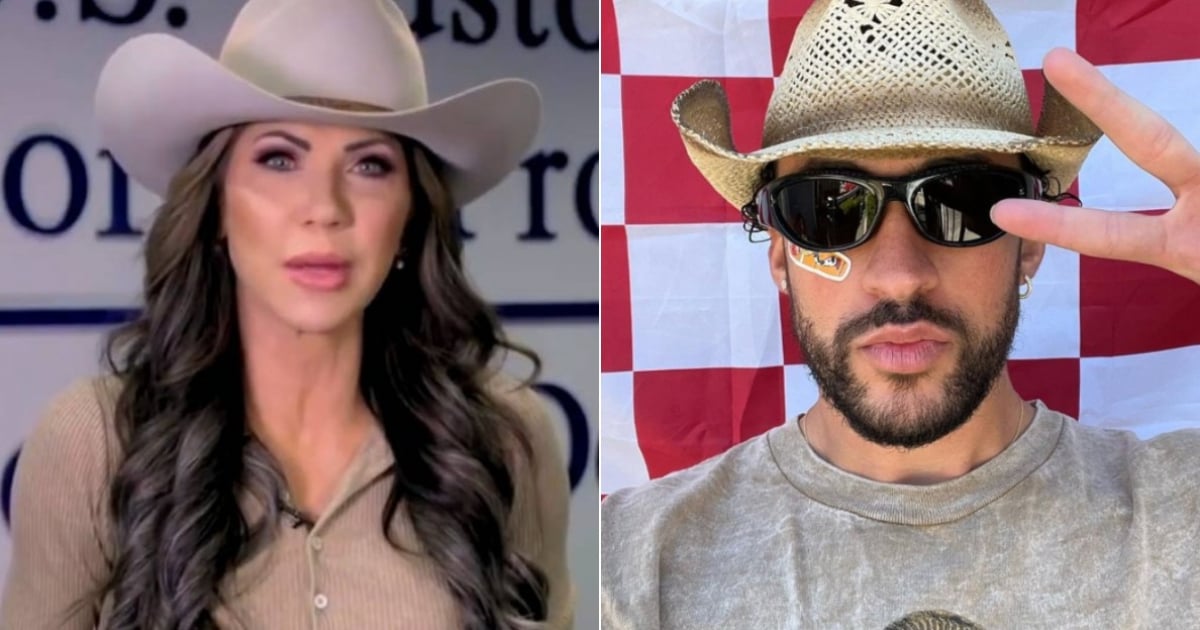
The announcement of Bad Bunny as the headliner for the Super Bowl LX halftime show in 2026 has sparked significant controversy, highlighting the stringent and divisive immigration policies championed by Donald Trump. Kristi Noem, Secretary of Homeland Security, issued a stark warning to those planning to attend the event, scheduled for February in New Orleans.
"We'll be everywhere. We're going to enforce the law. You shouldn't come to the Super Bowl unless you're a law-abiding U.S. citizen," Noem declared on conservative Benny Johnson's YouTube show. She emphasized her department's duty to ensure the event's security, promising a strong presence throughout the festivities.
"It's my responsibility to make sure everyone can attend the Super Bowl, enjoy it, and leave safely, which is what the U.S. stands for. So, yes, we'll be all over that place," she added.
When asked about the NFL's decision to select Bad Bunny for the halftime show, Noem responded critically: "They stink, we're going to win, God will bless us, we'll have a clear conscience, and they won't be able to sleep at night."
Latino and Migrant Community Concerns
The warning is seen as an intimidating message to the Latino and migrant communities, underscoring the administration's zero-tolerance policy towards undocumented individuals, even at major cultural and sporting events.
This tension ties back to Bad Bunny's decision to exclude the continental United States from his tour, due to fears of immigration raids outside his concerts. In an interview with i-D magazine, the Puerto Rican artist expressed concern over the presence of ICE agents outside his shows, opting to perform in Puerto Rico to safeguard both himself and his audience.
"All the shows have been successful. I've enjoyed connecting with Latinos living in the U.S. But there was the issue of ICE potentially being outside, and that worried us a lot," he stated.
Clash Between Latino Culture and Conservative Agenda
The backlash from conservative sectors against Bad Bunny was swift. Corey Lewandowski, advisor to the Department of Homeland Security and former Trump campaign manager, labeled the artist's selection a "disgrace," and warned that ICE agents would be present to apprehend and deport any undocumented migrants.
"There's no place in this country that provides a safe haven for those here illegally. Not at the Super Bowl or anywhere else," Lewandowski declared.
The controversy extends beyond surveillance, with Johnson and Lewandowski's comments infusing the debate with cultural and political undertones. They question whether a Spanish-speaking artist critical of migrant arrests and deportations can represent the U.S., even if he is, by virtue of being Puerto Rican, a U.S. citizen.
According to them, the choice of performer fails to align with supposed American identity standards and illustrates ideological interference in selecting artists for high-profile events.
Despite the criticism, Bad Bunny has embraced his Super Bowl role, sending a message of cultural pride to his community: "This is for my people, my culture, and our history. Go tell your grandmother, we'll be the HALFTIME SHOW AT THE SUPER BOWL."
Nevertheless, from the government apparatus, that narrative has been dismissed, reaffirming that immigration law enforcement will be uncompromising, even during one of the nation's most publicized and attended events.
This situation underscores the tension between U.S. immigration policy, which prioritizes vigilance and deportation, and cultural entertainment that celebrates diversity. Noem's warning and Lewandowski's statements place the 2026 Super Bowl at the heart of a debate that transcends sports, revealing how security, politics, music, Latino culture, and migrant rights intersect in the United States.
Key Questions about Super Bowl 2026 and Immigration Policies
What has Kristi Noem said about the Super Bowl 2026?
Kristi Noem has warned that there will be a heavy security presence at the Super Bowl 2026, emphasizing that only law-abiding U.S. citizens should attend, as her department will enforce the law rigorously.
Why is Bad Bunny's selection for the Super Bowl controversial?
Bad Bunny's selection is controversial due to his critical stance on U.S. immigration policies and the perception that his presence at such a high-profile event challenges conservative views on American identity.
How has the Latino community responded to the controversy?
Many in the Latino community view Bad Bunny's participation as a source of cultural pride and a representation of their heritage, despite the backlash from conservative sectors.