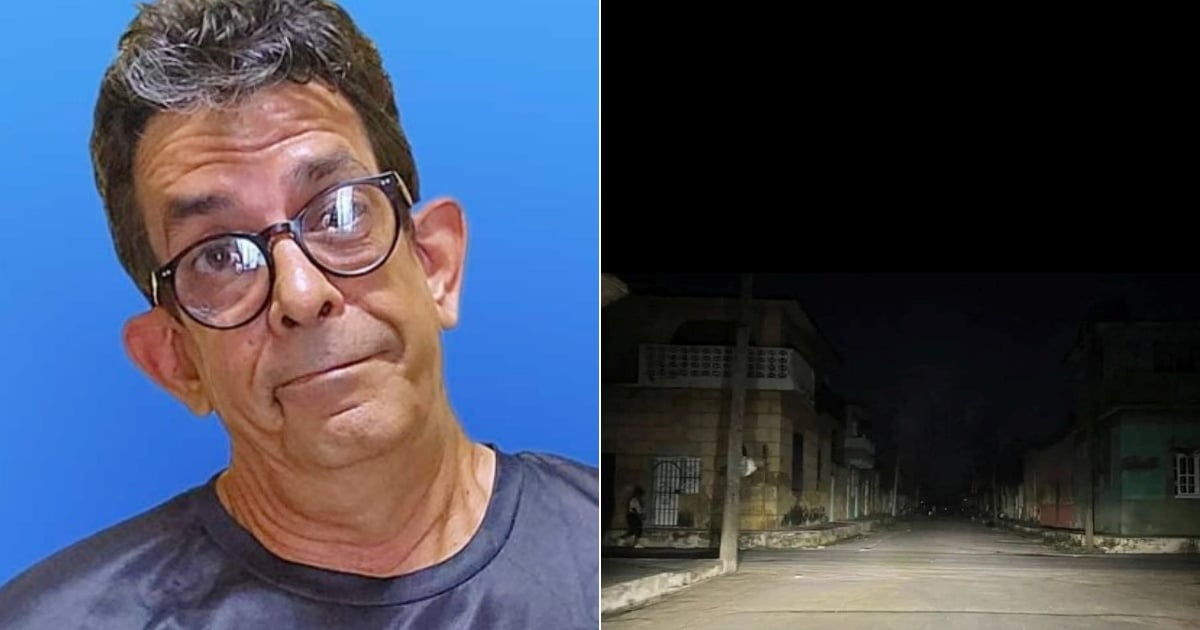
Renowned comedian Ulises Toirac has delivered a message that goes beyond mere opinion, resonating as a stark warning. Amid the extensive power outages that have characterized the Cuban summer, Toirac described the nation's situation as "walking on a razor’s edge," cautioning that the social exhaustion has reached a perilous point. "It's not logical to endure. It's simply human to erupt," he wrote in a lengthy Facebook post, blending his usual irony with a portrayal of the despair engulfing the entire country.
From Humor to Serious Warning
Toirac spoke not from anger, but with the clarity of someone who has long watched the country falter, coupled with the insights of an electrical engineering graduate. "Months before summer, observing the situation and applying a simple merchant's logic... I predicted a tough summer concerning electricity," he recalled. He insisted it wasn't prophecy but basic arithmetic: "In that field, 2+2 equals 4. Not four point two or three point eight." This statement underscored that the blackouts are neither surprising nor inevitable but rather the predictable outcome of an outdated system lacking maintenance.
The comedian highlighted that the National Electric System (SEN) is a reflection of Cuba itself—operating between patches, improvisation, and accumulated failures. "The system doesn't need much of a push to malfunction because it's ancient and hasn't received the necessary upkeep," he remarked with his characteristic sarcasm.
Citizens See Mosquitoes and Spoiled Food
Toirac illustrated how Cubans are no longer receptive to justifications or technical explanations. "People don't see processes or decisions, nor the blockade or embargo, nor where the oil comes from or its market price in New York. What they see are mosquitoes and spoiled food," he stated. This vivid and accurate description shows how the energy crisis has shifted from a technical issue to a human one, with individuals feeling the blackouts physically—in sweltering heat, disrupted sleep, or spoiled milk and meat.
"They also see things getting worse rather than better. It's obvious, they're not fools," he added, addressing both the authorities and those who underestimate the public's fatigue. The humorist, known for addressing issues with irony, left little room for jokes this time. His tone was grave, and his outlook bleak, emphasizing that the power shortage extends beyond homes to the collective morale.
The Fragility of the Electric System
In his analysis, Toirac precisely described the fragility of the electric grid: "The combination of low fuel levels and outdated facilities is a razor's edge to walk on because it forces overoperation." Each blackout, he explained, isn't just a power cut but an assault on the system itself. "Every time a circuit is closed and another is opened, boring phenomena occur that destabilize the system," he observed from a technical viewpoint. This "overoperation" is mirrored on a societal scale: the entire country lives strained, worn out, improvising to survive.
Despite the expertise and hard work of those who earn their livelihood in this field, a complete blackout could not be avoided, he acknowledged, stressing that individual efforts are insufficient to sustain a structurally broken system.
An Inevitable Eruption?
In his final warning, Toirac reached his most blunt tone. After recounting the lack of fuel, facility deterioration, and system overload, the comedian pinpointed the real issue: the people. "Political rhetoric doesn't kill mosquitoes or preserve the few foods that cost an arm and a leg for ordinary Cubans," he declared, making it clear that political speeches no longer quell hunger or frustration. On a national level, he warned, "Havana doesn't behave like a province; it's more of a powder keg than the rest."
With this warning, he suggested that the capital, where blackouts are perceived as an affront, could become the epicenter of social unrest. "It's not logical to endure. It's simply human to erupt," he concluded, warning that no people can live in darkness indefinitely, both literally and figuratively.
In Toirac's text, the National Electric System serves as a metaphor for the country: outdated, inefficient, patched together, sustained by individual effort, and condemned by a lack of investment and transparency. The prevailing feeling is that, regardless of the cause, everything continues to worsen. The entire nation walks on that "razor’s edge" mentioned by the comedian, with each blackout bringing them closer to the brink.
Increased Crisis, Increased Repression
Ulises Toirac's words come amid a time of growing social tension. Recently, President Miguel Díaz-Canel publicly warned that the government "will take measures" against those protesting or blocking streets in Havana. "The population's demands are legitimate, but they must be made in the established places: in the Party, in government and state institutions. No one is authorized to block a public road... measures will be taken. Public disorder is inadmissible," he stated during a meeting addressing the crisis in basic services.
This message, issued after several days of blackouts, water shortages, and piles of garbage in Havana neighborhoods, marks a repressive turn in response to growing public discontent. Díaz-Canel acknowledged that the problems are "significant" and "won't be resolved over a weekend," but he emphasized control over solutions: ordering inspections of non-state sector facilities to verify compliance with electricity consumption plans and warning that "any place not complying will be shut down."
The official discourse criminalizes protest—a safety valve in a context of shortages—and shifts the focus away from the root issues: prolonged blackouts, intermittent water supply, and waste accumulation. Alongside his warning, Díaz-Canel led an extraordinary meeting of the Communist Party's Provincial Committee in Havana, joined by ministers, military leaders, and top Political Bureau officials.
There, he announced the formation of mixed teams with officials and mass organizations to "directly address" neighborhood demands, but he also mobilized personnel from the Revolutionary Armed Forces (FAR) and the Ministry of the Interior (MININT), bolstering the military presence in crisis management. Toirac's warning and Díaz-Canel's response together paint a portrait of a nation on the edge: a population exhausted by blackouts and a government responding to desperation with threats.
Understanding Cuba's Electricity Crisis
What has Ulises Toirac warned the Cuban government about?
Ulises Toirac has warned the Cuban government about the growing social unrest and exhaustion due to prolonged blackouts, suggesting that the situation is reaching a dangerous point where an eruption of public frustration is inevitable.
How does Toirac describe the current state of Cuba's electric system?
Toirac describes Cuba's electric system as outdated, inefficient, and poorly maintained, likening it to a "razor’s edge" that the nation is precariously walking on, with each blackout bringing them closer to a breaking point.
What measures has President Díaz-Canel proposed in response to the crisis?
President Díaz-Canel has proposed measures to control public protests by emphasizing that demands must be made in official channels and warned that public disorder is inadmissible. He also ordered inspections and mobilized military forces to manage the crisis.