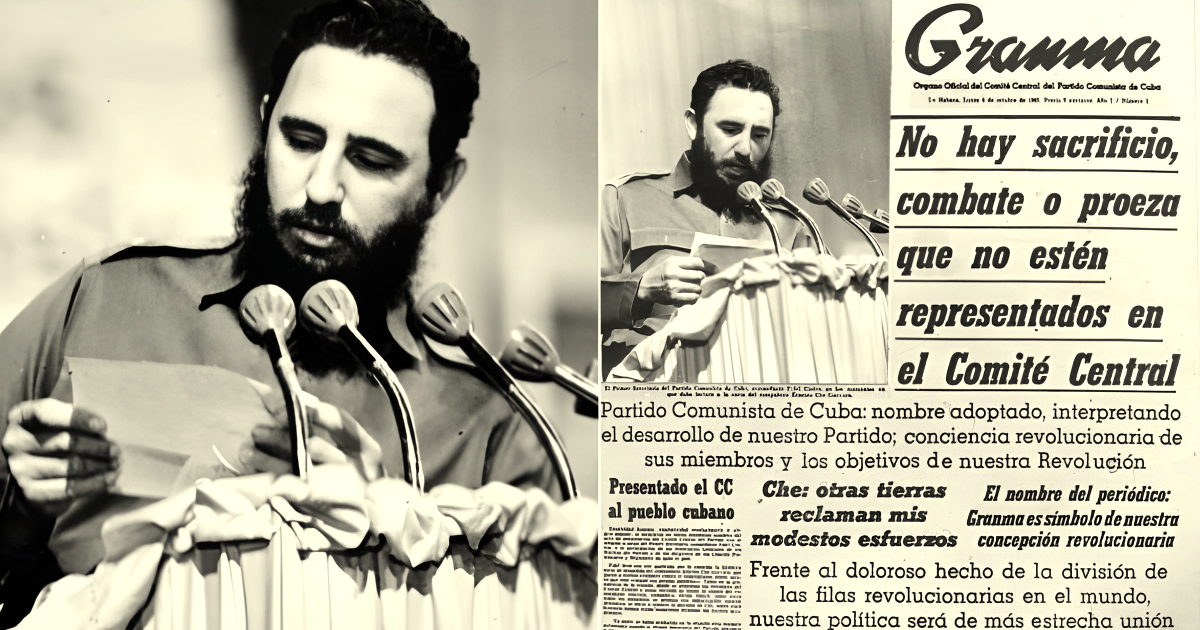
As the Cuban regime commemorates the "founding of the Communist Party of Cuba" (PCC) in October 1965, its propaganda machine perpetuates a narrative meticulously crafted to mask a political maneuver of absolute control: the enforced dissolution of revolutionary plurality and the formation of a single-party state grounded in compliance. The official rhetoric and state media herald the PCC as the product of the "unity of the revolutionary forces." However, the documented and contrasting history reveals that this "unity" was achieved through exclusion, denunciation, and internal repression.
The establishment of the PCC did not stem from a natural ideological convergence among the July 26 Movement, the Revolutionary Directorate March 13, and the Popular Socialist Party (PSP). Instead, it was the culmination of political betrayals and internal purges orchestrated to ensure that only one will—Fidel Castro's—reigned supreme at the pinnacle of power.
The Foundational Lie: A "New" Party on Old Ruins
The Communist Party did not originate in 1965. It had been in existence since 1925, founded by Carlos Baliño and Julio Antonio Mella as the Communist Party of Cuba (a section of the Communist International), later renamed the Popular Socialist Party (PSP). This party endured through the republic, faced repression under Gerardo Machado and Fulgencio Batista, yet also negotiated with both at different times, particularly in the 1940s when Lázaro Peña and Blas Roca advocated a pro-Soviet and syndicalist line amid the global alliance of the U.S. with Stalin's Soviet Union to defeat Nazism.
At the victory of 1959, the PSP was weakened but possessed an organizational structure and ideological cadres that the July 26 Movement lacked. Nonetheless, Castro distrusted the old communists, viewing them as bureaucrats, subservient to Moscow, and lacking in heroism or patriotism. Still, he needed them to lend some Marxist ideological legitimacy to his revolution and to manage their political capital in the future alliance he sought with the USSR, which ultimately turned the island into a Soviet satellite, while solidifying his totalitarian power.
From ORI to PURSC: The Lab of Total Control
In 1961, Castro established the Integrated Revolutionary Organizations (ORI), an experiment to merge the M-26-7, PSP, and the Directorate. The official narrative spoke of "revolutionary coordination," but in practice, it was the first step toward ideological centralization. The PSP, with its organizational experience, played a significant role in the ORI under the leadership of Aníbal Escalante, a seasoned and efficient communist. However, Escalante's mistake was acting autonomously.
In March 1962, Castro publicly accused him of "sectarianism" and "personal ambition," expelled him, exiled him, and dismantled his network of cadres. This marked the first internal purge of the new regime, with a clear message: no one should hold power outside the control of the Comandante en Jefe.
The Ordoqui Case and the "Microfaction": When the Revolution Devoured Its Own
The myth of the Party as the "synthesis of the best of the Revolution" collapses in light of the internal purges of the 1960s. The Joaquín Ordoqui case, in 1964, was a turning point. Ordoqui, a general and veteran of the PSP, was accused of covering up espionage and treason. He was removed, detained, and silenced. His wife, Edith García Buchaca, a cultural leader and communist of the old guard, was also purged. Neither was given a public trial; both were erased from the official narrative.
The Ordoqui case was a prelude to the "microfaction" process (1967–1968), the largest ideological purge in PCC history. Dozens of militants—including intellectuals, officials, and former PSP members—were accused of maintaining "ties with foreign powers" and conspiring against Castro's leadership. The real goal was not to eliminate conspiracies but to obliterate any remaining autonomy within the Party. With the "microfaction," Castro eradicated the last vestiges of pre-1959 Cuban communism and solidified a party molded in his image: militarized, hierarchical, and personalistic.
From Political Party to Instrument of Absolute Power
On October 3, 1965, at the Chaplin Theater (now Karl Marx Theater), Castro announced the creation of the Communist Party of Cuba. During the same event, he read Che Guevara's farewell letter, appointed the first Central Committee, and introduced the new official newspaper, Granma. The stage was meticulously set: the Party was presented as the legacy of the Revolution, though it was actually its authoritarian reformulation.
Since then, the PCC has become the backbone of the State, without electoral legitimacy or political competition. Pluralism was abolished, independent press banned, and dissent reduced to treason. In the name of "unity," a single-minded ideology, monitored by State Security, was established.
The 1976 Constitution enshrined what had been a reality since the 1960s: the PCC would be the "superior leading force of society and the State." A phrase that encapsulates six decades of one-party dictatorship.
Unity as a Pretext for Terror
The story of Castro's PCC is the story of how a plural revolution turned into a control machine, and how a charismatic leader transformed the promise of social justice into an ideological dictatorship. The "revolutionary unity" was not an ideal, but a tool of power. Under its guise, purges, executions, censorship, and silencing were carried out. Parties were destroyed, unionists persecuted, intellectuals crushed, and society disciplined. Unity was, and remains, the official name for fear.
The rhetoric of so-called "continuity" supposedly led by Miguel Díaz-Canel celebrates that "the essences are the same," but conceals an uncomfortable truth: the Communist Party was not born of unity, but of submission. It was the triumph of silence over diversity, and of one strongman over all others.
Understanding Cuba's Political Landscape and Its History
What led to the creation of the Communist Party of Cuba?
The Communist Party of Cuba was officially established in 1965, following a series of political maneuvers by Fidel Castro to consolidate power. This included the dissolution of revolutionary plurality through exclusion, denunciation, and internal repression, culminating in a single-party state.
How did Fidel Castro consolidate control over Cuba's political system?
Fidel Castro consolidated control through a series of strategic purges and the integration of existing revolutionary groups into a single-party system. This included the expulsion of opposition and the centralization of authority, ensuring that all power was concentrated under his command.
What role did the ORI and PURSC play in Cuba's political transformation?
The ORI (Integrated Revolutionary Organizations) and PURSC (United Party of the Socialist Revolution of Cuba) were instrumental in the ideological centralization of Cuba's political system, facilitating the merger of key revolutionary groups into a single-party structure under Castro's control.