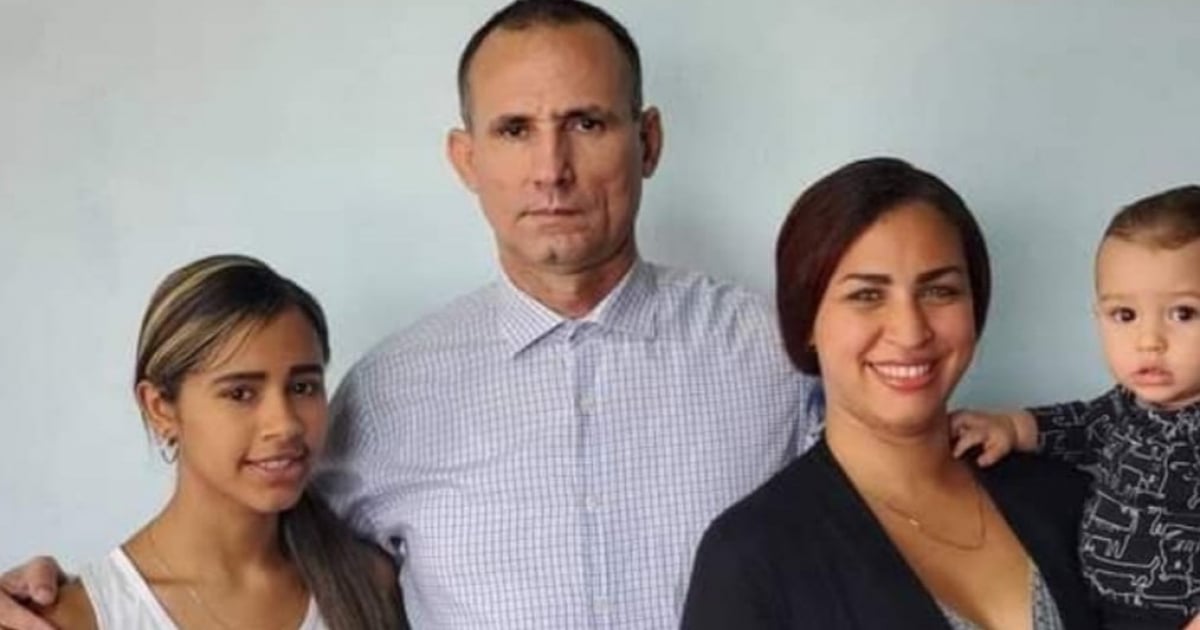
Nelva Ismaray Ortega, the wife of opposition leader José Daniel Ferrer, has accused the Cuban regime of preventing his departure from the country while subjecting him to severe psychological torture. In an interview with Mario J. Pentón for Martí Noticias, Ortega stated that the UNPACU founder is under "psychological pressure and systematic torture" after agreeing to the forced exile imposed by the regime.
"He made this decision for the safety of his family and because of the horrors he has endured in prison. He has been beaten, humiliated, threatened, and deprived of food and medicine, surviving in inhumane conditions, alongside common criminals and under the watch of state officials," Ortega asserted.
She further explained that for months the family has been "waiting for a departure date, but they keep our documents and pressure him to make favorable statements about dialogue between the regime and the United States, something he will not accept."
"Everything has been dirty, a ploy to tarnish our dignity. Even under these conditions, he remains steadfast in his principles and will not surrender," she added.
Enduring Harsh Prison Conditions
Ortega also described her husband as "pale, with many torture marks and bedbug bites," adding that rain has flooded his cell. "He would rather die than surrender, but the situation is critical. This week, the regime must decide whether to allow him to leave the country; if not, he will choose to remain in prison," she stated.
"They have taken almost everything from us, but not our morale," she concluded.
The Painful Choice of Exile
This week, from Mar Verde prison in Santiago de Cuba, Ferrer revealed that he has accepted exile, a painful decision made under extreme pressure from the regime and driven by the need to protect his family. In a handwritten letter dated September 10, 2025, Ferrer denounces a series of systematic abuses and reaffirms his commitment to the fight for Cuba's freedom.
"For years, I have been subjected to brutal beatings, torture, humiliation, and even death threats, along with other cruel, inhuman, and degrading treatment," the letter begins, written by hand and shared by his family on social media. "My family has also been the target of ruthless persecution," he adds, attributing this violence to the regime's attempts to force him into exile or abandon his activism.
A Decision Influenced by Frustration
Ferrer explains that he decided to leave the country before the raid on his home on April 29, when he was returned to prison after his conditional release was revoked. "Even before the last raid on my home on April 29 of this year, I had decided to go into exile to ensure the safety of my wife and children," he states. "I made this decision for my family's safety and out of frustration upon realizing the disunity, sectarianism, and ineffectiveness of the opposition within and outside Cuba."
He also mentions that State Security has demanded he use his exile to discredit the fight for freedom, including manipulating his image. "They have been making videos and recordings intending to publish material that questions our commitment to the struggle (...), videos and audios to portray us as supposed agents of tyranny."
Ferrer claims they pressured him to marry on a date symbolic to the Castro regime: "They exerted strong pressure to have my marriage with my beloved partner, Nelva Ismarays Ortega, performed on the anniversary of the deceased dictator's birth." He also alleges they wanted him to ask the United States and the Catholic Church to resume negotiations with the regime. Ferrer is adamant: "I want to make it clear that if my life and my family's life depend on asking for such things, I prefer to die in this Nazi-style concentration camp (...). I am ready to die, but not to live without honor or dignity."
Living in Extreme Conditions
The opposition leader details living in extreme conditions: "I survive among common criminals capable of any crime and under the orders of the prison chief Vladimir Pineda, who hates me brutally, and the political police." He claims to suffer from "theft of my food and hygiene products, ordered by the regime's henchmen," and that threats against his wife and children "have been greater than ever during my imprisonment."
These claims align with recent statements from his sister Ana Belkis Ferrer, who reported that in prison, his food and hygiene packages are stolen, he is kept ill without medical attention, and forced to share a cell with violent prisoners and infiltrated agents. "Only the immense love I feel for my family and my commitment to non-violent struggle has made it possible for me to remain calm, gather patience, and not defend myself (...) in the ways any human would under such extreme circumstances," Ferrer wrote.
Exile: Not an Escape but a Strategy
Despite lamenting the deterioration of the opposition and the complicity of the free world, Ferrer insists that his departure will not be a surrender: "I only leave Cuba with my dignity and honor intact and not for long." He sends a symbolic and patriotic warning: "I was going to leave as Maceo and many mambises did, to return at the right time as Martí, Gómez, and Maceo did. But I will not leave under the pressures and dirty games of the regime's henchmen."
Although he admits losing faith in many opposition members, he states, "I still have faith in the good fighters that remain." He concludes with an unwavering promise: "I will continue fighting until victory is achieved or die trying to see Cuba free."
Ferrer was released in January 2025 under a conditional release regime, which he refused to sign, considering it illegitimate and incompatible with his commitment to the fight for Cuba's freedom. "I do not accept those conditions; add 30 more years of sanctions (...). Leave me in this concentration camp," Ferrer declared at the time, reaffirming that he would not accept any measure that implied surrendering or legitimizing the regime. "I have sacrificed my life and my family, whom I deeply love, to fight for my people. I will never abandon the struggle," he assured after his release, before being imprisoned again three months later.
On April 29, 2025, the People's Supreme Court revoked his release and sent him back to prison. The return was justified by alleged failures to appear before the court, although various observers have denounced the process as politically motivated.
Ferrer’s case has sparked growing international concern. The U.S. State Department has demanded his immediate release, while Amnesty International has identified him as a prisoner of conscience subjected to torture.
Key Questions About José Daniel Ferrer’s Situation
What are the conditions José Daniel Ferrer is facing in prison?
José Daniel Ferrer is reportedly enduring extreme conditions in prison, including living among violent criminals, being deprived of food and hygiene products, and facing threats against his family. He has also been described as pale with signs of torture and bedbug bites.
Why did Ferrer agree to exile?
Ferrer agreed to exile to protect his family from the regime's persecution and because of the extreme pressures he has faced. However, he views this decision as a strategy, not a surrender, to continue the fight for Cuba's freedom.
Has Ferrer received international support?
Yes, Ferrer has received international attention, with the U.S. State Department calling for his immediate release and Amnesty International recognizing him as a prisoner of conscience who has been tortured.