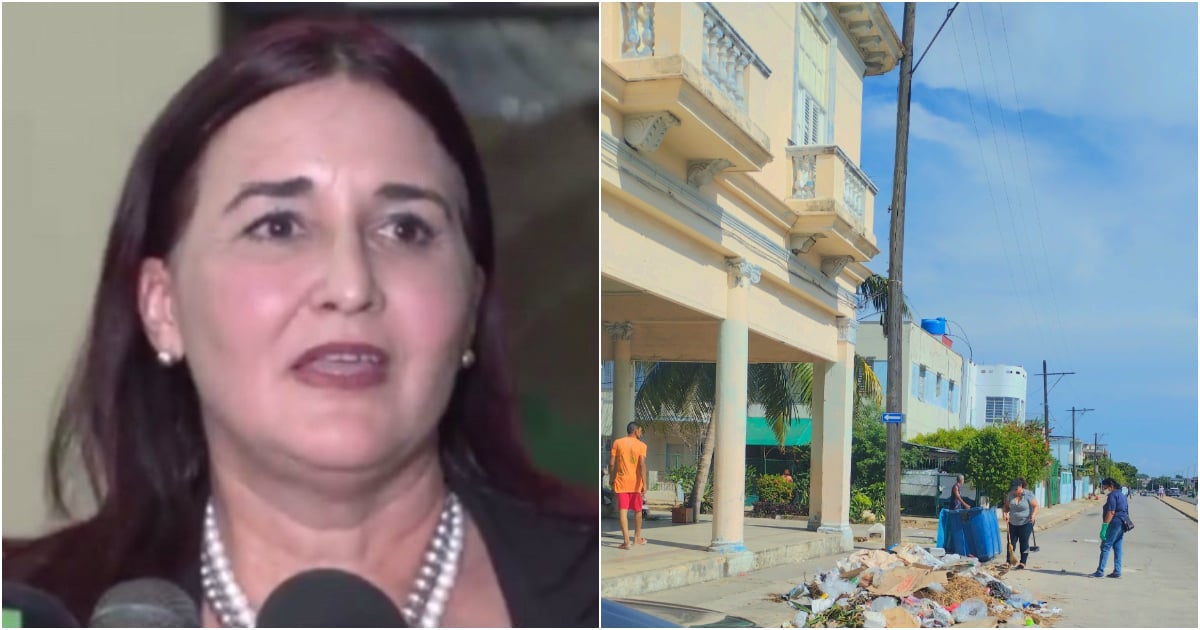
Johana Tablada, the Deputy Director General for the United States at the Cuban Ministry of Foreign Affairs (Minrex), took part in a voluntary cleanup effort in Havana today. She shared photos and reflections from the event, marking a shift from her previous stance in August when she downplayed the country's trash problem.
"Today, many colleagues from the Ministry joined in voluntary work to clean up areas of the city. I'm very glad to have felt useful," Tablada wrote on her Facebook page. She described how Minrex officials cleaned part of avenue 31 in the Playa municipality. In her post, she admitted that her neighborhood has had a "large garbage pile on the corner for months" and that the garbage truck "does not come as frequently as needed," making it difficult for residents to maintain cleanliness.
Changing Perspectives on Havana's Waste Problem
The contrast is notable: back in August, during an interview on the Alma Plus video podcast, Tablada had downplayed the issue of trash accumulation, stating, "Cuba is not the country with the most garbage in the world." At that time, she blamed independent media and U.S. policies for "demonizing" the topic, asserting, "It's true there is trash on the streets, but we're not the only city with hygiene problems."
Her recent participation in the cleanup comes amid a hygienic and environmental crisis impacting Havana, with micro-dumps, uncollected waste, and overflowed sewers plaguing numerous neighborhoods. Despite numerous citizen complaints, authorities have insisted the situation is more about "social indiscipline" than structural failures in the sanitation system.
Government Response and Public Reaction
Tablada's post, featuring "before and after" photos of a particularly dirty corner, sparked mixed reactions. While some praised the initiative, others reminded her of the need for the Communal Services Company to perform its duties on non-volunteer workdays. Tablada herself emphasized, "Exactly, and that is what's mostly failing besides the bad habits of people who throw waste anywhere."
Regardless, Tablada seems to have transitioned from justifying the trash issue to actively addressing it with a broom instead of mere rhetoric. President Miguel Díaz-Canel recently led an emergency meeting with top Communist Party and Armed Forces officials to discuss the energy crisis, trash accumulation, and water supply issues, which have fueled public outrage.
In response, authorities declared a "sanitation day" on Saturday, mobilizing recruits, police, and state workers to clean a city overwhelmed by garbage. Recently, Armando Rodríguez Batista, the Minister of Science, Technology, and Environment (Citma), publicly acknowledged the severe sanitation collapse in the capital, admitting that "the trash is not contained; it's spread all over Havana."
Official journalist Ana Teresa Badía bluntly stated, "Havana smells like trash," in a Facebook post criticizing the accumulation of tons of waste on streets and corners without timely collection. In her brief reflection, Badía argued, "There is a rampant institutional indifference. Let's not blame the blockade alone; there are things like empathy, work, and respect for citizens that don't depend on any blockade."
Understanding Havana's Waste Crisis
What motivated Johana Tablada to participate in the cleanup effort?
Johana Tablada joined the cleanup as a demonstration of civic commitment, contrasting her previous downplaying of the trash issue. Her participation reflects a shift from rhetoric to action.
How has the Havana waste situation been officially acknowledged?
Armando Rodríguez Batista, Minister of Science, Technology, and Environment, has publicly admitted the severe sanitation collapse, acknowledging that waste is scattered throughout Havana.
What actions are being taken to address the waste problem in Havana?
Authorities have declared a "sanitation day," mobilizing recruits, police, and state workers to tackle the overwhelming waste problem in the capital.