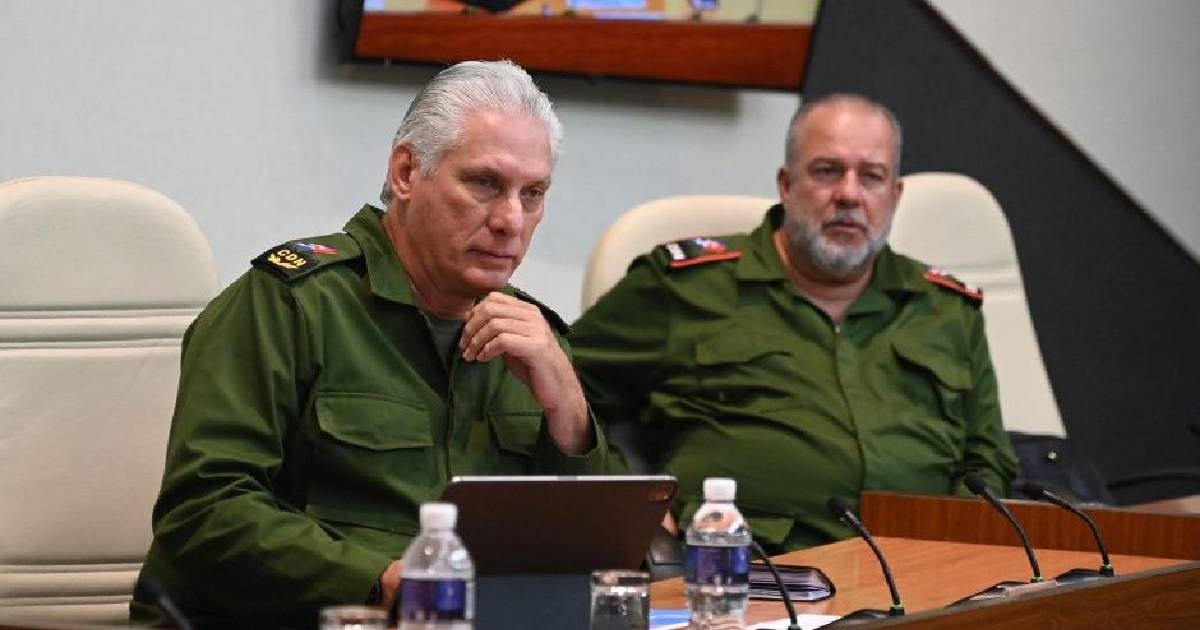
In response to recent protests and demonstrations in Havana, Miguel Díaz-Canel, the First Secretary of the Communist Party of Cuba (PCC), led an emergency meeting at the PCC's Provincial Committee in the capital. He was joined by ministers, military leaders, and top officials of the Political Bureau. The gathering addressed escalating public grievances concerning power outages, garbage accumulation, and water supply issues—factors that have fueled widespread public discontent in recent days, according to the PCC's digital outlet.
The Cuban leader announced the formation of task forces, comprising local authorities and mass organizations, to "directly address" neighborhood demands. Concurrently, Díaz-Canel mobilized resources and forces from the Revolutionary Armed Forces (FAR) and the Ministry of the Interior (Minint), effectively increasing military presence in crisis management efforts.
Among those present were Prime Minister Manuel Marrero Cruz, FAR Minister Álvaro López Miera, PCC's Organization Secretary Roberto Morales Ojeda, and Secretary of the Council of Ministers José Amado Ricardo Guerra, highlighting a unified front in response to the social upheaval.
The government reiterated the need for communities to take an active role, led by youth and mass organizations, as part of an "integrated system" to tackle the capital's challenges. On the night of October 2, protests erupted in Central Havana, with residents banging pots, chanting "Freedom!", and even lighting street fires. Several intersections were peacefully blocked, involving even children, following one of the most severe days of power cuts, with outages exceeding 12 hours across much of the city.
Public discontent is largely directed at the government's inadequate management, with a lack of fumigations, medicines, and potable water, compounded by the spoilage of food due to insufficient refrigeration. Residents in areas like Regla and Central Havana have taken to the streets after enduring weeks without water supply.
Recently, the Minister of Science, Technology and Environment (CITMA), Armando Rodríguez Batista, publicly acknowledged the severity of the sanitary collapse in Havana, admitting that "the trash isn't contained: it's scattered throughout Havana." Similarly, official journalist Ana Teresa Badía emphasized that "Havana reeks of garbage" in a Facebook post, criticizing the accumulation of waste on streets and corners without timely collection.
In her brief commentary, Badía pointed out that "there is rampant institutional indifference. We shouldn’t blame everything on the blockade; empathy, work, and respect for citizens don't depend on any blockade." Weeks earlier, torrential downpours turned the streets of Central Havana, Diez de Octubre, and Vedado into rivers of trash swept along by the currents, while a citywide blackout plunged the city into darkness.
Residents shared images of dumpsters adrift and contaminated waters flooding entryways and homes, underscoring that the garbage issue is not merely a matter of urban aesthetics, but a direct threat to the health and safety of hundreds of thousands of Havana residents.
Understanding the Havana Crisis
What led to the recent protests in Havana?
The protests in Havana were sparked by widespread dissatisfaction with ongoing power outages, garbage accumulation, and water supply issues, which have intensified public frustration.
How has the Cuban government responded to the protests?
In response to the unrest, the Cuban government has convened emergency meetings, deployed military forces, and formed task forces to address community demands directly.
What role do communities play in addressing Havana's issues?
Communities in Havana are expected to take an active role, with leadership from youth and mass organizations, as part of an integrated system to tackle the city's problems.