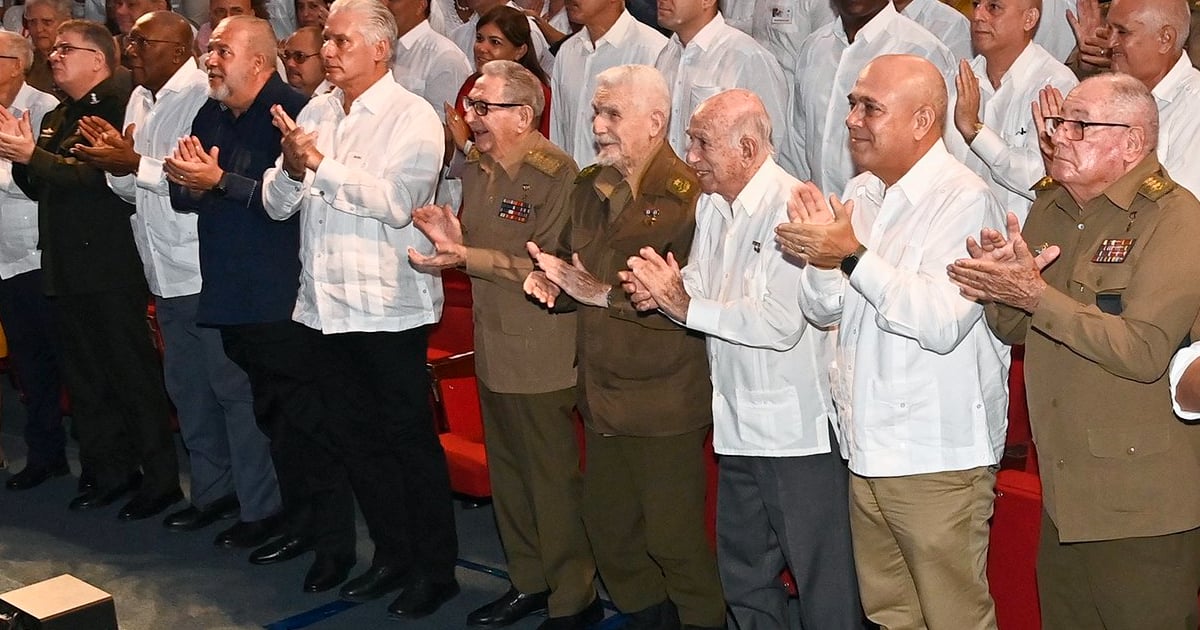
Retired Army General Raúl Castro Ruz emerged in public at an official event in Havana this Friday, breaking nearly two months of absence that had sparked widespread rumors about his health across social media and digital platforms. The 94-year-old former leader joined current Cuban President Miguel Díaz-Canel during the commemoration of the 60th anniversary of the creation of the first Central Committee of the Communist Party, the reading of Che Guevara's farewell letter, and the founding of the newspaper Granma.
The ceremony, held at the Universal Hall of the Revolutionary Armed Forces, gathered historical figures of the regime such as Ramiro Valdés Menéndez and José Ramón Machado Ventura. The Cuban Presidency shared images of the event on social media platform X, highlighting Castro's attendance alongside Díaz-Canel during what was described as a day filled with emotions.
Castro's reappearance comes after an extended absence that fueled speculation about his health, amid a backdrop of official secrecy and a crisis of credibility for state-run media.
The Silence from Birán
Prior to this event, Raúl Castro's last confirmed public appearance was on August 13 in Birán, during the commemoration of dictator Fidel Castro's 99th birthday. On that occasion, the general appeared visibly frail, requiring assistance from aides for mobility.
Following that event, state media mentioned him only indirectly, as the sender of floral offerings or protocol messages, without any public sighting. His absence from the funeral of Vice Prime Minister Ricardo Cabrisas on September 17 further fueled health speculation. While other top officials, including Díaz-Canel and Valdés Menéndez, attended the funeral at the Council of Ministers, Castro merely sent a floral tribute, with the lack of direct mentions or images reinforcing rumors of deteriorating health.
From Death Rumors to Propaganda Response: "Raúl is Raúl"
Rumors of Raúl Castro's alleged death began on September 22 when a Facebook account named "Ignacio Giménez Cuba" falsely reported his hospitalization in Havana. Without evidence or verifiable sources, this misinformation was picked up by Periódico Patria 1892 and echoed by other media and users citing it as an "unofficial source."
The turning point occurred when a parody page of CiberCuba circulated a graphic montage announcing his "death," turning the initial lie into a viral hoax that persisted for several days. The disinformation chain concluded on September 26 when the rumor's originator admitted to fabricating it to test media reactions, thus confirming its manufactured nature.
In response, on September 27, the regime launched a massive digital campaign under the slogan "Raúl is Raúl," intended to counteract the hoax's impact and reaffirm the general's symbolic vitality. Ministries, state media, and security-associated profiles flooded social media with images of Castro in military uniform, captions like "With a Foot in the Stirrup," and coordinated hashtags (#RaúlEsRaúl, #YSigueAquí). The campaign's visual uniformity—same colors, typography, and messages—revealed a centralized propaganda effort aimed at projecting political continuity and neutralizing the discredit generated by Castro's prolonged silence.
A Symbolic Reappearance
Castro's presence at Friday's event carries significant political and symbolic weight. Beyond the historical homage, his reappearance serves as a staged effort to quell rumors and reinforce the regime's narrative of "unity and continuity." In his speech, Díaz-Canel referred to the Communist Party's creation as the "synthesis of the best of Cuban society" and called for "maintaining revolutionary unity against the media war."
While his message focused on commemorating Guevara and the Party's founders, the mention of an "atrocious campaign of defamation" — quoted by the official Presidency account — was interpreted as a veiled reference to the speculation about the aging general's health.
The event also paid tribute to Granma on its 60th anniversary, at a time when the official newspaper faces declining influence and credibility among Cubans. Díaz-Canel urged it to "return to being the flagship of Cuban journalism" amid what he termed an "intensified media war."
Between Myth and Fragility
Through this appearance, Raúl Castro attempts to convey his ongoing presence, though his image reflects the passage of time and the fragility of a retiring political generation. He remains a pillar of legitimacy for the power structure, which needs to project stability amidst economic turmoil and growing public discontent.
This reappearance temporarily closes one of the most intense waves of health rumors since his formal retirement. However, it also underscores the regime's increasing reliance on past symbolism to sustain an increasingly uncertain present. In a nation where citizens count blackouts more than daylight hours, the old general returns not so much as a political actor but as a symbol of an enduring totalitarian regime.
Raúl Castro's Health and Public Perception
What sparked the rumors about Raúl Castro's health?
The rumors were fueled by his prolonged absence from public view and were exacerbated by a false report of his hospitalization that circulated on social media.
How did the Cuban regime respond to the rumors of Castro's death?
The regime launched a digital campaign under the slogan "Raúl is Raúl," featuring images and coordinated hashtags to counter the misinformation and affirm his symbolic presence.
What was the significance of Raúl Castro's public appearance?
His appearance was significant for its political and symbolic value, aiming to dispel rumors and reinforce the narrative of unity and continuity within the regime.