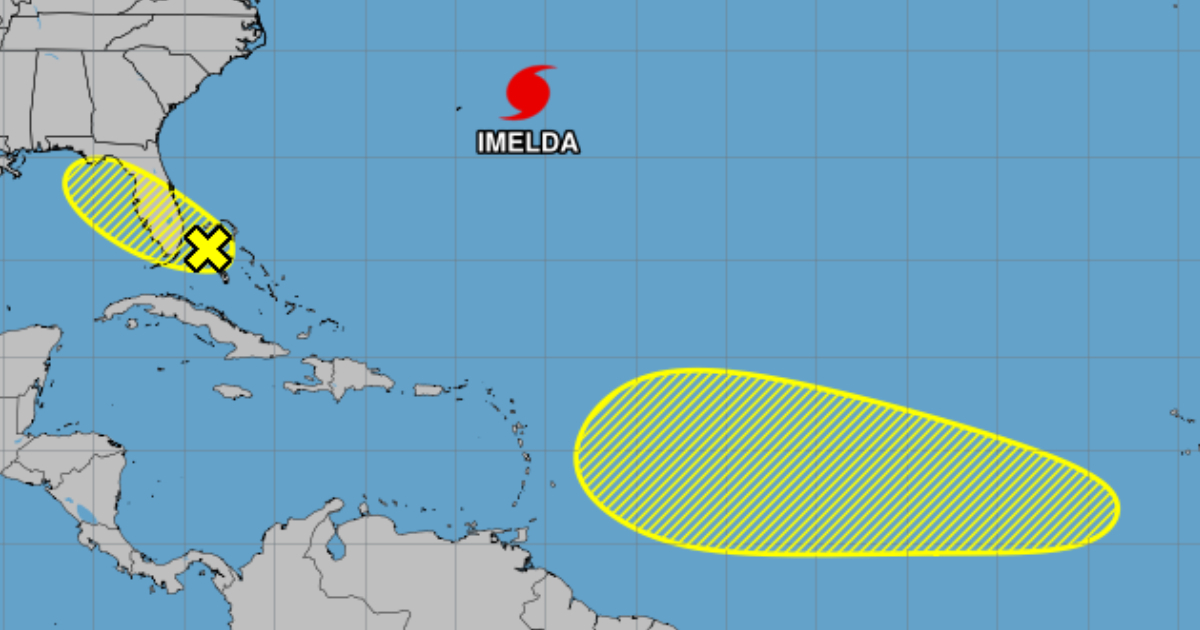
The National Hurricane Center (NHC) is currently keeping an eye on two tropical disturbances in the Atlantic Ocean. Despite their presence, both systems have a low likelihood of developing into cyclones.
The first disturbance is situated in the central tropical Atlantic. A tropical wave is expected to emerge from the African coast in the coming days. This wave could potentially merge with an existing disturbance in the area, creating a combined system that might develop slowly as it moves west-northwest at speeds between 15 and 20 miles per hour (24 to 32 km/h), as reported in the latest update from the NHC. The chance of formation within the next 48 hours is 0%, while the chance over the next seven days is 20%.
Meanwhile, the second system being watched is located in the southwestern Atlantic. Here, a low-pressure area might form along a lingering front near the northwest Bahamas and southern Florida in the next couple of days. Any potential development of this system is expected to be gradual as it travels over the Florida peninsula towards the Gulf of Mexico. The probability of development within 48 hours is 10%, and it remains at 10% over the next seven days.
This system has already caused heavy rainfall in eastern Cuba, leading to tragic incidents where two fatalities were reported in Santiago de Cuba province due to house collapses during the downpours. While these systems do not pose an immediate threat, meteorologists advise staying informed on their progress, particularly given the favorable conditions in the Atlantic during October's latter half of the hurricane season.
Additionally, Hurricane Imelda, which had been moving east of Bermuda, has weakened and transformed into an extratropical cyclone on Thursday morning, as per the latest NHC bulletin. As of 11:00 a.m. (AST), Imelda was positioned at 33.2°N and 59.5°W, with maximum sustained winds of 75 miles per hour (120 km/h) and moving east-northeast at 29 miles per hour (46 km/h).
FAQs on Tropical Disturbances and Hurricane Imelda
What is the likelihood of the tropical disturbances developing into cyclones?
The first disturbance has a 0% chance of developing into a cyclone within 48 hours and a 20% chance within the next seven days. The second system has a 10% chance of formation within both 48 hours and seven days.
Where are the tropical disturbances located?
The first disturbance is in the central tropical Atlantic, while the second is in the southwestern Atlantic near the northwest Bahamas and southern Florida.
What impact have these disturbances had so far?
The second system has caused heavy rains in eastern Cuba, resulting in two fatalities in Santiago de Cuba province due to house collapses.
What happened to Hurricane Imelda?
Hurricane Imelda has weakened and transitioned into an extratropical cyclone, moving east-northeast beyond Bermuda.