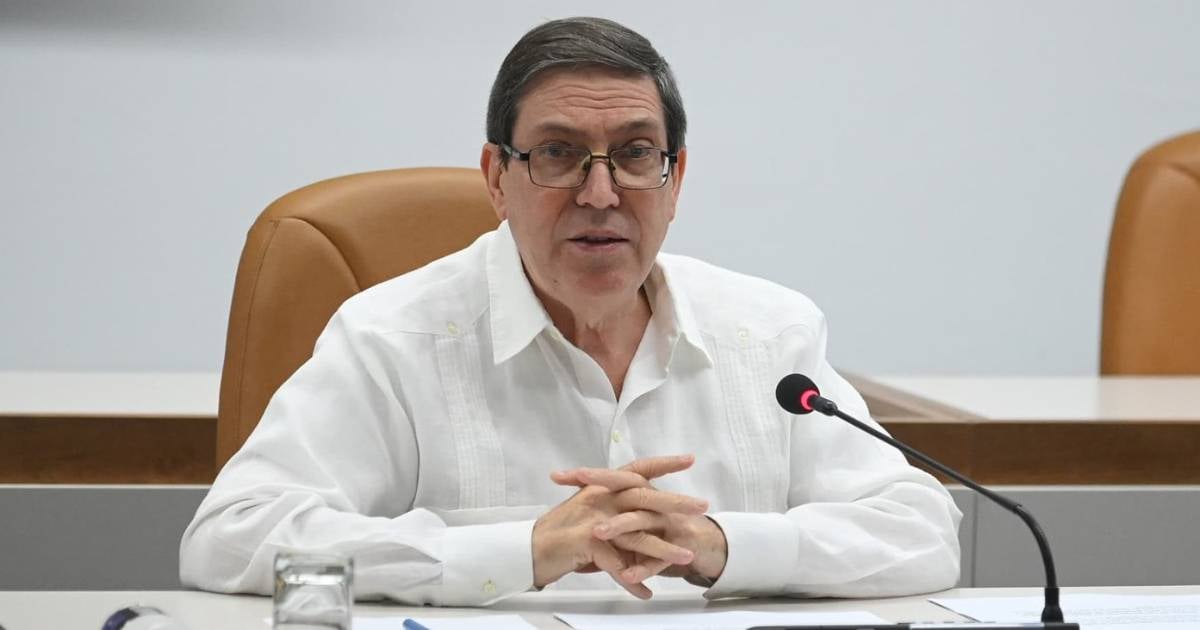
In a recent interview with CNN, Cuba's Foreign Minister, Bruno Rodríguez Parrilla, expressed unwavering support for the Venezuelan government, describing it as a response to what he labeled a "direct threat" from the United States to regional stability. However, when asked if this support could extend to military intervention in the event of a U.S. attack, Rodríguez sidestepped the question.
“Cuba fully supports the Government of the Bolivarian Republic of Venezuela,” Rodríguez asserted during the interview held in New York, coinciding with the United Nations General Assembly. Yet, he dodged the pivotal question about whether Havana would come to Caracas's defense in the case of a military invasion, dismissing it as a hypothetical scenario. “When you inform me that a U.S. military intervention has taken place, I'll tell you,” he responded.
Tensions Rise in the Caribbean
Rodríguez's remarks come amid the deployment of U.S. military forces, including warships, nuclear submarines, F-35 fighters, and over 7,000 American troops across the Caribbean. This represents the largest military operation of its kind since the 1980s. While Washington claims this action is aimed at combatting drug trafficking, Venezuela accuses the U.S. of threatening its sovereignty.
President Donald Trump announced a "new phase" in operations following lethal strikes on vessels in Caribbean waters that left more than a dozen dead, without conclusive evidence of narcotics links. The focus has shifted to land routes. “We had a lot of drugs coming in by water (...). We hit several boats, and since we did that, we have absolutely no drugs coming into our country by sea, because it was lethal. And now we're going to look at the cartels. We're going to look very seriously at the cartels coming by land,” he stated.
According to sources cited by NBC News, the Pentagon is considering drone strikes on criminal leaders and laboratories within Venezuela, though no final authorization has been issued. In response, Venezuelan President Nicolás Maduro declared a “state of external commotion,” granting him extraordinary powers to mobilize the armed forces and control strategic sectors. Vice President Delcy Rodríguez stated the measure aims to prepare the country for a potential “aggression” from the United States.
Bilateral Relations and Conditional Dialogue
Rodríguez accused the U.S. of attempting to "revive the policy of gunboat diplomacy" and reimpose the "Monroe Doctrine with the empire of arms." He emphasized that the U.S. military presence poses “a direct threat to regional peace, stability, and security.”
The Cuban foreign minister reiterated Cuba's willingness to engage in dialogue with the United States, even under the Trump administration, but stressed that it must happen "without preconditions." He insisted that such dialogue should be grounded in international law, respecting the independence and sovereignty of each nation.
Relations between the two countries have soured in recent years. Washington has placed Cuba on the list of state sponsors of terrorism, strengthened the economic embargo, and reinstated restrictions on American tourism. Secretary of State Marco Rubio has declared he has “nothing to discuss” with Havana, accusing the Cuban government of exacerbating the regional migration crisis.
Cuba Distances Itself from Military Conflict
Recently, Deputy Foreign Minister Carlos Fernández de Cossío clarified in New York that Cuba will offer "full political support" to Maduro, but without military involvement. “Cuba will not go to war with the United States,” he asserted.
He warned that a U.S. attack on Venezuela would be “a threat to the entire region.” He also criticized Washington's attempts to "disconnect Cuba from the global economy," exacerbating the island's internal crisis, marked by blackouts, shortages, and inadequate basic services.
Escalating Risks in the Region
The ongoing debate about a possible intervention in Venezuelan territory keeps the region on edge. Analysts warn that such an attack could bolster the Chavista narrative of "defending sovereignty" and lead to harsher internal repression. Meanwhile, Trump insists on using "all elements of American power" to curb drug trafficking.
Sources consulted by NBC indicate that military operations on Venezuelan soil could commence within weeks, although no final decision has been made. In this complex scenario, Cuba finds itself in a delicate position: offering diplomatic support to its key regional ally while avoiding entanglement in a military confrontation with its longstanding adversary.
Key Issues in the U.S.-Cuba-Venezuela Tensions
What is Cuba's stance on supporting Venezuela militarily?
Cuba has expressed full political support for Venezuela but has clarified that it will not engage in military conflict with the United States on behalf of Venezuela.
How has the U.S. military presence in the Caribbean affected regional stability?
The U.S. military deployment in the Caribbean has heightened tensions, with Washington claiming it aims to combat drug trafficking while Venezuela views it as a threat to its sovereignty.
What are the implications of the U.S. considering drone strikes in Venezuela?
The Pentagon is evaluating drone strikes against criminal leaders and laboratories in Venezuela, which could escalate tensions and provoke a significant regional conflict.