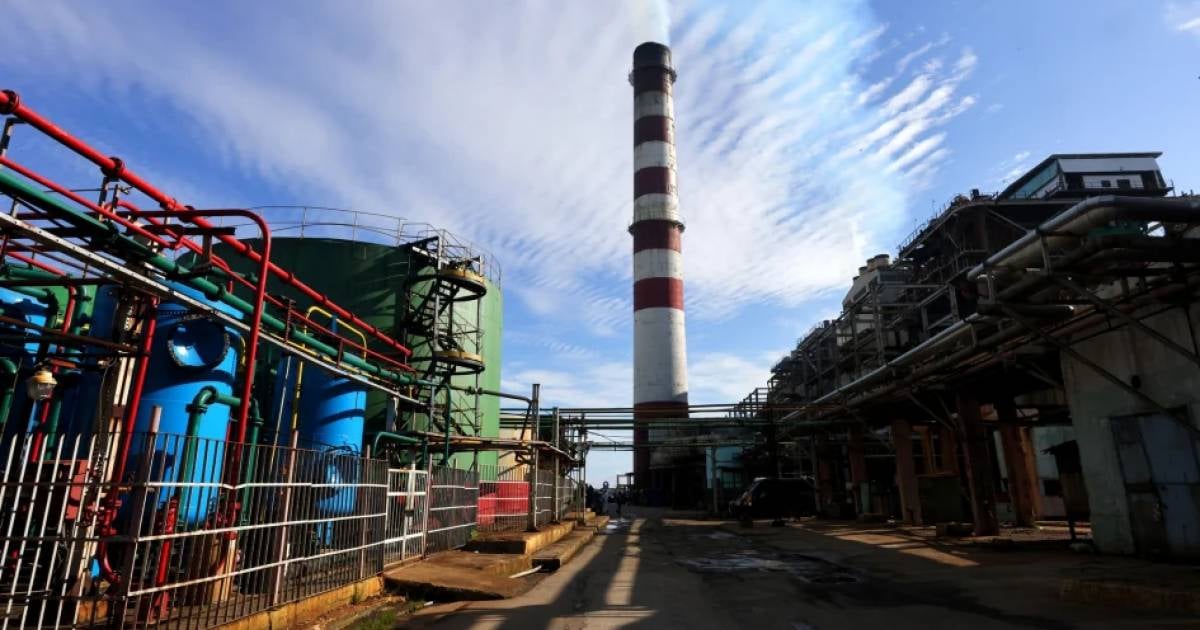
The Cuban Electric Union (UNE) announced on Tuesday at 2:30 PM that Unit 6 of the Máximo Gómez Thermal Power Plant in Mariel has been disconnected from the electrical grid. This incident occurred due to significant oscillations in the power networks, triggered by a trip on one of the 220 kV lines linking Mariel with Havana. This marks the second time in a matter of days that this generating unit has been taken offline. Just last Friday, September 26, operations were halted because of oil contamination and vibrations in the feedwater pump.
The official statement did not provide specifics about the extent of the new breakdown or the repair efforts that will be undertaken. There was also no indication of when the unit might return to the National Electric System (SEN). These unplanned outages exacerbate the already precarious energy situation in Cuba. Recurring technical failures at major thermal power plants, coupled with fuel shortages, have led to extended blackouts across the nation.
September's Energy Crisis: Blackouts and Protests
As September concludes, Cuba's National Electric System (SEN) is facing a critical shortfall, with outages reaching up to 1,840 megawatts (MW) during peak times. On Tuesday morning, the SEN began with a deficit exceeding 1,100 MW. According to UNE's official report, Monday's maximum impact reached 1,798 MW at 8:00 PM, with disruptions persisting throughout the day and into the early hours. At 6:00 AM, SEN's availability stood at 1,670 MW against a demand of 2,840 MW, leaving over 1,196 MW of consumption unsupported.
The report highlights ongoing issues with Unit 2 of Felton, Unit 5 of Nuevitas, and Units 3 and 5 of Renté. Meanwhile, maintenance is underway for Units 1 and 2 of Santa Cruz and Unit 4 of the Carlos Manuel de Céspedes in Cienfuegos. Additionally, thermal limitations have resulted in another 385 MW being out of service. The fuel shortage further complicates matters, with 43 distributed generation plants offline (398 MW) and 181 MW unavailable due to the lack of lubricants, resulting in a total loss of 579 MW.
While 31 solar photovoltaic parks supplied 3,006 MWh on Monday, peaking at 597 MW, this contribution falls short of meeting the increasing demand. UNE anticipates that during Tuesday's peak hours, availability will be merely 1,780 MW against a demand of 3,550 MW, leading to a deficit of 1,770 MW and potential blackouts of up to 1,840 MW if conditions persist.
In Havana, the Electric Company reported on social media that Monday saw service disruptions for over 23 consecutive hours, with a peak interruption of 170 MW at 8:50 PM. Although rotational cuts by blocks were planned, all six blocks were affected, preventing the established schedule from being adhered to. As of the report's closure, 40 MW remained out of service, with the company reminding that these outages depend on SEN's overall conditions and do not always align with planned schedules.
Extreme Vulnerability Exposed
Official data confirms that September was the most challenging month of the year for the SEN. The first week alone saw blackouts nearing 2,000 MW, with outages extending throughout the day and night. On September 8, a partial collapse left much of the eastern region without power. Just two days later, on September 10, a nationwide blackout disconnected the entire island.
The fifth SEN collapse in less than a year took days to resolve, highlighting the system's extreme vulnerability. Yet, Cuban leader Miguel Díaz-Canel boasted about re-establishing the SEN in "record time." Throughout the month, daily deficits frequently exceeded 1,700 MW, with constant 24-hour disruptions. Incidents included fires and breakdowns at key thermal plants: Antonio Guiteras in Matanzas, Felton in Holguín, Renté in Santiago de Cuba, Máximo Gómez in Mariel, and Carlos Manuel de Céspedes in Cienfuegos.
Each incident removed hundreds of megawatts from service, forcing reliance on distributed generation, which also faltered due to diesel shortages. The declining electrical service has sparked protests in various provinces. Residents in Havana, Santiago, and Holguín took to the streets demanding restoration of power following outages exceeding 20 hours.
The sound of banging pots, street blockades, and cries of "We want power!" were widespread during the most critical nights, under heavy police surveillance. Repression was swift, with arrests and typical State Security threats occurring in places like Gibara.
A System on the Brink
As September ends, the SEN is teetering on the edge of technical and social collapse. The repeated general and partial blackouts, escalating deficits, and inability to keep major thermal plants operational showcase a system with no immediate recovery prospects. The population, increasingly burdened by darkness, faces the certainty that blackouts will continue to define daily life in Cuba as the energy crisis deepens without clear solutions in sight.
FAQs on Cuba's Ongoing Energy Crisis
What caused the latest outage at the Mariel thermal power plant?
The outage was caused by significant oscillations in the power networks, triggered by a trip on one of the 220 kV lines linking Mariel with Havana.
How has the energy crisis impacted Cuba in September?
September has been the most challenging month for the National Electric System, with outages nearing 2,000 MW and widespread protests due to extended blackouts.
What measures are being taken to address the energy crisis?
While maintenance efforts are ongoing, the system remains strained due to recurring technical failures and fuel shortages, with no immediate solutions apparent.