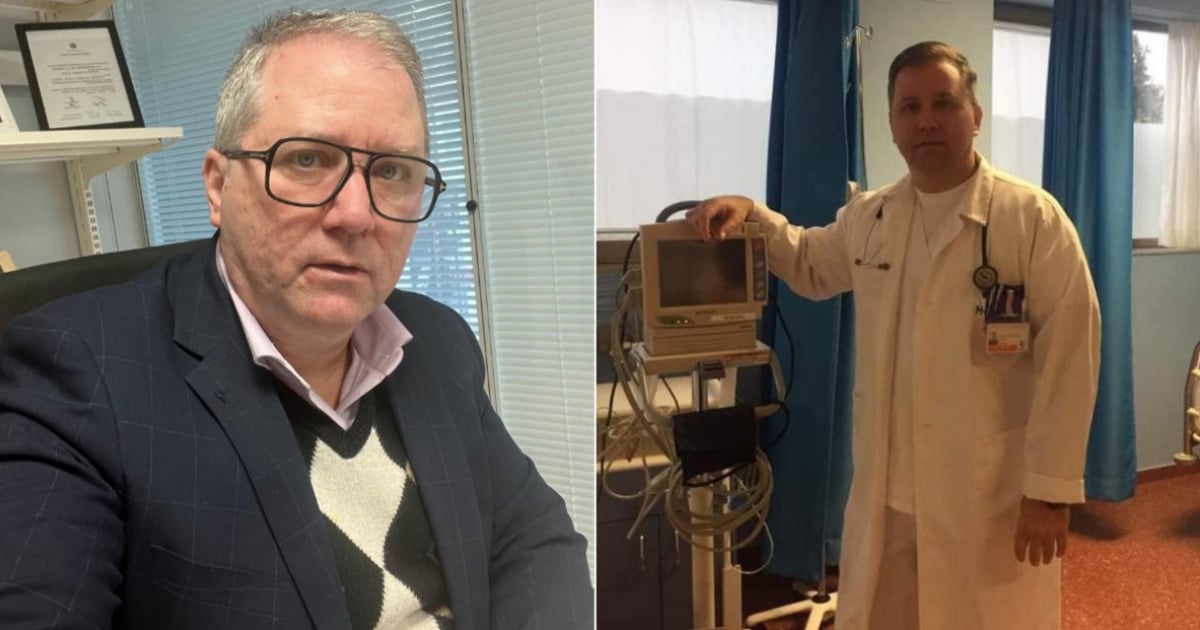
Dr. Lázaro Elieser Leyva García, a Cuban physician specializing in Internal Medicine with academic training in Spain, has openly challenged the official narrative portraying Cuba as a "medical powerhouse." With a career deeply rooted in teaching and hospital work in Villa Clara, he argues that this portrayal is nothing more than propaganda, far removed from the truth.
In a Facebook post, Dr. Leyva criticized how, despite rigorous medical training and the dedication of many doctors who have supported the system with personal commitment, the official propaganda uses this dedication to mask the harsh reality. He highlighted that Cuban doctors have been exploited for decades under a narrative of greatness that does not reflect their everyday experiences.
During his tenure in Cuba, Dr. Leyva worked as an internist at the Arnaldo Milián Castro Hospital in Santa Clara, where he served as the Head of the Internal Medicine Department from 1997 to 2010. Despite holding significant responsibilities, his monthly salary was equivalent to just 32 euros. "That was the system's acknowledgment of years of study, responsibility, and sacrifice," he recounted. Historically, low wages have forced doctors to endure living in poverty.
Dr. Leyva also described the declining conditions in Cuban hospitals, where there is a lack of medications, basic equipment, and even essential supplies like syringes or gloves. Patients, he noted, must bring their own resources to receive care, while externally, the image of an exemplary system is promoted.
He emphasized that the true foundation of this so-called "medical powerhouse" lies in the business of international missions, where thousands of professionals are sent abroad under restrictive contracts, salary retention, family separation, and political control. "This is not solidarity; it's exploitation," he stated.
According to Dr. Leyva, medicine in Cuba has been transformed into a political tool: domestically, as a justification to silence demands, and internationally, as an export product generating revenue for the regime. "The power is only in the propaganda narrative, not in everyday reality," he asserted.
Originally from Manacas, Villa Clara, and currently managing a medical service in Valencia, Spain, Dr. Leyva insisted that the true greatness of Cuban healthcare always resided in its doctors, but it was betrayed by a system that used them as ideological and economic tools.
Insights into Cuba's Healthcare System
What are the conditions like in Cuban hospitals?
Cuban hospitals face severe shortages of medications, basic equipment, and essential supplies such as syringes and gloves, forcing patients to bring their own resources for treatment.
How are Cuban doctors compensated for their work?
Despite holding significant responsibilities, Cuban doctors often receive very low salaries, with some earning as little as 32 euros a month, which does not reflect their years of study and dedication.
What is the role of international missions in the Cuban healthcare system?
International missions are a major component of Cuba's healthcare system, where doctors are sent abroad under restrictive conditions, serving as a source of revenue for the regime rather than a genuine act of solidarity.