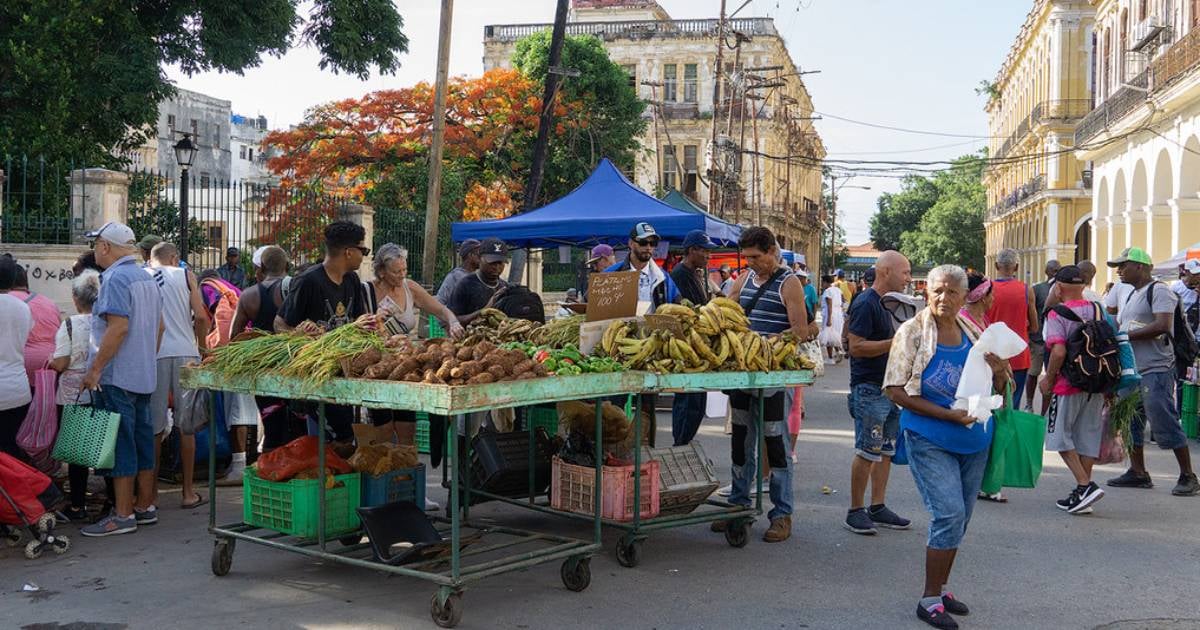
The Havana government has introduced a new regulation setting maximum prices for agricultural products in the capital, with different price caps depending on the type of market. This measure, touted as an effort to "protect consumers," effectively allows for higher prices in venues where most of the population shops, such as supply and demand markets, cooperatives, and street vendors.
According to the official newspaper Tribuna de La Habana, the resolution signed by Governor Yanet Hernández Pérez establishes three tiers of pricing: for state-run and leased markets, agricultural fairs, and supply and demand markets.
Varying Price Caps for the Same Product
In state-run markets, retail prices remain relatively low, with sweet potatoes and cassava priced at 30 pesos per pound, colocasia taro at 60, xanthosoma taro at 85, plantains at 35, and dry onions at 250. On the other hand, in supply and demand markets, cooperatives, and among street vendors, these caps are significantly higher. Sweet potatoes and cassava reach 45 pesos, colocasia taro 75, xanthosoma taro 110, plantains 50, common beans up to 285, consumer rice 155, and dry onions 250.
In agricultural fairs, intermediate prices are authorized: sweet potatoes, cassava, and plantains at 25 CUP, colocasia taro at 55, xanthosoma taro at 75, papaya at 40, beans between 196 and 285, rice at 155, and dry onions at 200.
The disparity illustrates that the same product can double or triple in price depending on the market, creating uncertainty and affecting consumers who rely on street vendors and supply and demand markets, generally better stocked than state-run markets.
Price Regulation Follows Police Crackdowns
This new pricing structure comes shortly after police crackdowns on street vendors in several Havana municipalities, as part of the IV National Exercise for Crime Prevention and Confrontation. These operations resulted in confiscations, hefty fines, and arrests of street vendors, drawing public criticism for targeting people who make a living selling produce on the streets.
"The police rounded up people struggling to earn their daily bread by selling produce and cigarettes that the government cannot provide," lamented a Havana resident on social media. The crackdown was described as part of efforts to combat illegal activities, but it coincided with the announcement of these new prices, reinforcing the perception of increased state control over the informal economy.
State Control Over Relief Measures
The resolution repeals previous regulations, including the 69th of April 2025, and standardizes prices across the province. The authorities aim to centralize control amid inflation, blackouts, scarcity, and growing social discontent.
The irony is evident, as while informal vendors—who offer alternative access to food—are targeted, the official prices in the most frequented markets are higher than in state-run ones, leaving Havana residents caught between repression and the rising cost of basic goods.
For many, street vending remains the only way to access produce and grains without paying exorbitant prices, despite the risk of fines or having their merchandise confiscated.
Frequently Asked Questions on Havana's New Price Controls
What are the new price caps in Havana for agricultural products?
Havana's government has established new price ceilings for agricultural products, with different caps for state-run markets, agricultural fairs, and supply and demand markets. Prices vary significantly depending on the market type.
Why did the government impose these new price controls?
The government claims the new price controls are intended to protect consumers, though they allow for higher prices in markets where most people shop, leading to a perception of increased state control over the informal economy.
How do these price changes affect street vendors?
Street vendors face higher risks as the new price controls coincide with police crackdowns on informal sellers, making it harder for them to offer alternative access to affordable food without facing fines or confiscation.