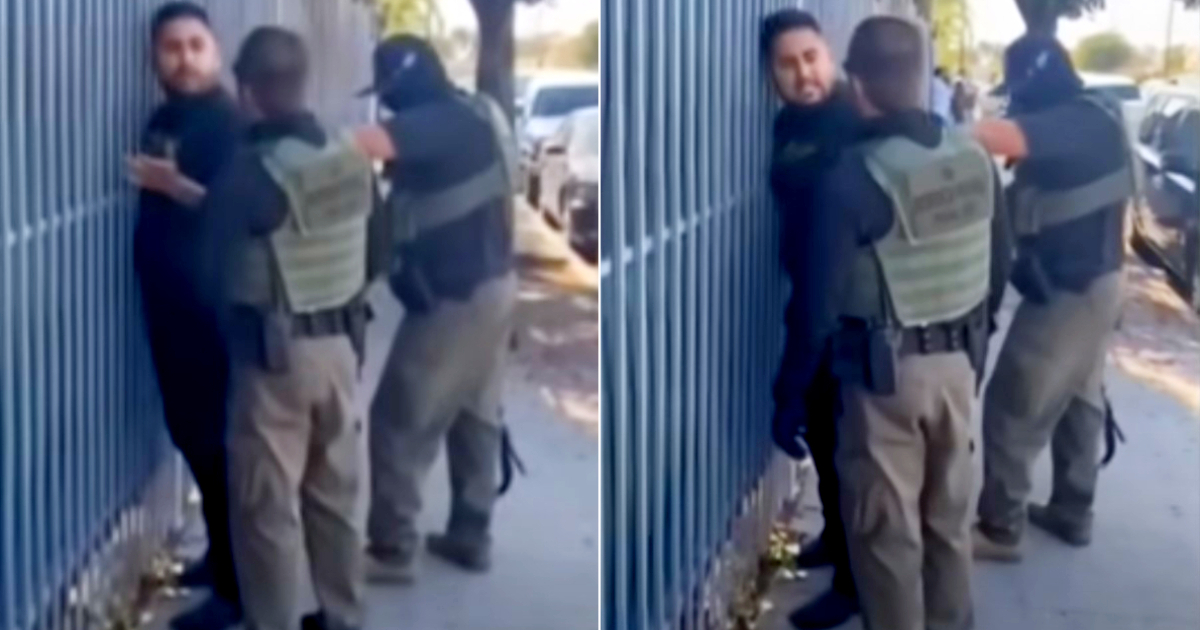
Under the administration of President Donald Trump, immigration raids have unexpectedly targeted U.S. citizens, predominantly Latinos, who have been detained or even held on the suspicion of being in the country illegally. This alarming situation was brought to light by an extensive report from The New York Times on Monday. After reviewing legal documents and personal accounts, the report found that since January, at least 15 citizens have faced arrest or questioning by immigration officers.
In numerous instances, those detained immediately asserted their American citizenship, only to be disregarded by officers and taken to detention centers, where some were held for hours or even days without access to legal representation or the ability to make phone calls. Among the most notable cases is that of Kenny Laynez-Ambrosio, an 18-year-old born in West Palm Beach, Florida, who was detained during a traffic stop in May. Despite repeatedly stating, "I am from here," he was held for six hours.
Escalating Tensions and Legal Battles
In California, Jason Brian Gavidia, 29, another U.S. citizen, was forcefully subdued at his classic car business in Montebello. Similarly, Julio Noriega from Chicago spent 10 hours in custody after ICE officers handcuffed him while he was handing out his resume.
The Department of Homeland Security (DHS) has defended its operations as "highly selective," though no federal records exist to document the arrest of citizens. However, these actions have prompted legal actions: the American Civil Liberties Union (ACLU) has filed a lawsuit against the government, claiming these detentions violate the Fourth Amendment by disproportionately targeting Latinos.
Judicial Responses and Public Impact
Despite a Los Angeles federal judge's order to halt the practice, the Supreme Court suspended the ruling, allowing ICE agents to continue these activities, as highlighted by the New York newspaper. The gathered testimonies indicate a pattern of increasingly aggressive raids, where officers demand immediate proof of citizenship in public spaces, workplaces, and even schools. In response, some citizens have taken to carrying their passports daily out of fear of detention.
The Cato Institute, a libertarian think tank, noted that one in five ICE arrests involves Latino residents without criminal records or deportation orders. For many individuals, these encounters have resulted in psychological distress. "I can't work without anxiety anymore. I'm always on edge," lamented Leonardo García Venegas, who was detained twice in Alabama despite presenting valid identification.
During his campaign, Trump vowed to conduct the largest deportation operation in history, reminiscent of the 1950s' "Operation Wetback." Now, with the Supreme Court's endorsement, his agents have even broader authority to detain anyone under suspicion.
Legal and Social Implications of ICE Raids
How has the ACLU responded to ICE's actions?
The ACLU has filed a lawsuit against the government, arguing that these detentions violate the Fourth Amendment by disproportionately targeting Latinos.
What impact have ICE raids had on U.S. citizens?
ICE raids have led to the detention of U.S. citizens, causing psychological distress and prompting some to carry their passports daily for fear of being detained.
What is the stance of the Department of Homeland Security on these operations?
The DHS defends its procedures as "highly selective," although there is no federal documentation to support the arrest of citizens.