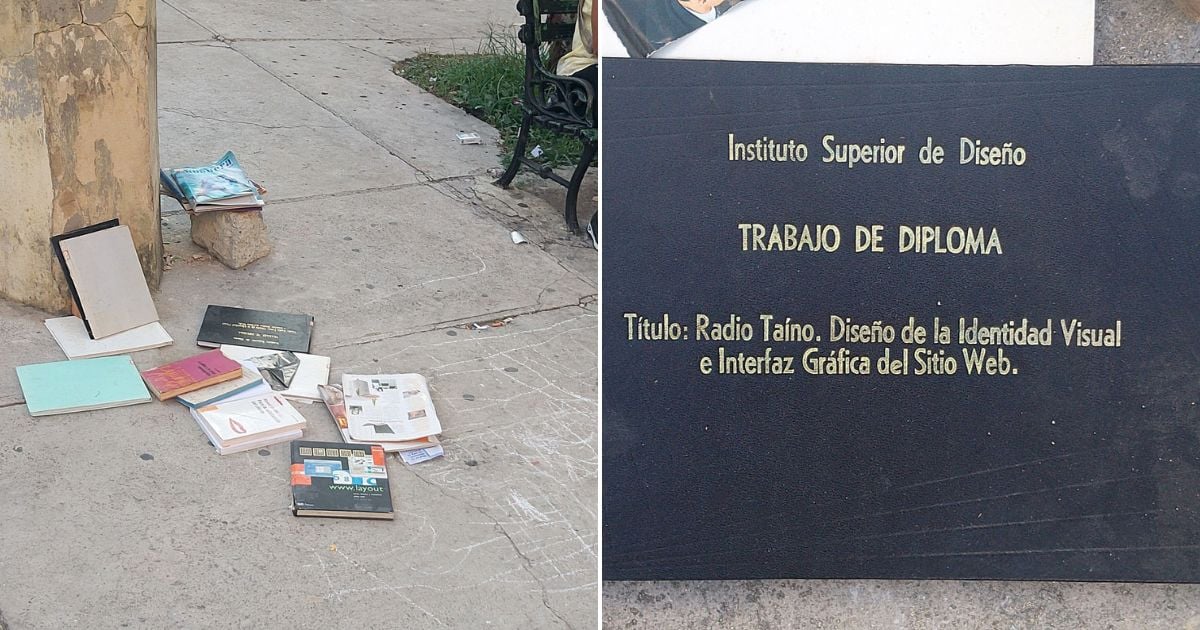
In a shocking discovery, thesis projects, research papers, books, and catalogs, all part of the academic legacy of the Higher Institute of Industrial Design (ISDI), were found discarded like trash in Carlos J. Finlay Park, Havana. This incident has sparked outrage among alumni, industry professionals, and cultural heritage advocates.
On Monday, designer Esteban Aquino, who graduated from ISDI three decades ago, reported the incident. He shared a series of images on Facebook showing historical documents, diploma work, and specialized literature scattered on the ground, treated as mere waste. "Carlos J. Finlay Park is currently used as a dumping ground for the archives and library of this academic institution, whose building has been quietly decaying for so long," he stated.
Aquino explained that the discarded materials symbolize decades of effort by professors, mentors, and students who have contributed to the development of industrial design and visual communication in Cuba. These documents served as crucial historical and technical references for training generations of designers. "The work of those who are now excellent design exponents ends its useful life scattered like garbage," he lamented.
A Cultural Disregard
In his post, Aquino highlighted that even Decree 88, in its article 4.1, defines design as "a strategic problem-solving activity that promotes innovation, leads to a better quality of life, and contributes to enhancing the culture of the population." He argued that the careless disposal of these archives reveals a lack of cultural appreciation for this field in the country.
"Ignorance does not equate to insensitivity. Not knowing is not synonymous with disrespect," Aquino added, questioning how individuals educated in principles of respect for social property, education, and culture could discard such valuable documentary heritage. "I wonder what values drive these people. What exactly are we talking about?" he wrote.
The post spurred a wave of comments from netizens expressing sadness upon recognizing significant academic contributions and documentary bases among the discarded items. For some, this incident highlights not only institutional neglect but also the broader abandonment of education and culture in the country.
The ISDI's Decline
This event adds to other reports of the degradation ISDI has suffered over the years, to the extent that the building that housed the prestigious program is now in a state of ruin and abandonment. The sight of theses and books strewn about the streets not only symbolizes the deterioration of the Cuban educational system but also reflects a disregard for the collective memory of an institution that trained professionals who are now design leaders both within and outside the country.
The ISDI faces one of the most critical phases of its recent history. The collapse of part of its Centro Habana premises marked the beginning of an unstoppable decline, following years of ignored warnings about structural failures. Despite being propped up since 2022, the building remained in use until institutional inaction succumbed to its precariousness.
The day after the collapse revealed even more devastating scenes. A section of the building completely crumbled, injuring an elderly woman and leaving four families homeless. Members of the academic community described the event as emblematic of the nation's state: "the collapse of ISDI is also the collapse of Cuba," wrote an alumnus on social media, amid a wave of indignation that resonated both inside and outside the university sphere.
A New Beginning or More Uncertainty?
Instead of finding solace in their authorities, students and graduates soon denounced the authoritarianism of the dean, accusing him of ideological repression and a disconnect from technological realities. His claim that "the internet is not needed for design" was met with widespread backlash and seen as a symbol of a leadership out of touch with the present and the needs of an increasingly precarious community.
In an effort to overcome both the physical and symbolic collapse, ISDI announced its relocation to the former Pablo de la Torriente Brau Polytechnic in Playa. The original site was officially declared uninhabitable, marking the end of over four decades at the heart of Havana. Authorities have promised a period of reconstruction, but doubts linger about the center's future and the institutional ability to address years of neglect that have left deep scars on the memory of Cuban design.
Understanding the ISDI Crisis
What led to the current state of ISDI?
ISDI's current state is the result of years of neglect, ignored structural warnings, and a lack of support for maintaining its premises, culminating in a collapse that highlighted the broader issues of neglect in Cuban education.
Why is the disposal of ISDI's documents significant?
The disposal of ISDI's documents is significant because it represents a disregard for the academic and cultural contributions of the institute, undermining the historical and educational value of the work produced by generations of designers.
What are the future plans for ISDI?
ISDI plans to relocate to the former Pablo de la Torriente Brau Polytechnic in Playa, as its original site has been declared uninhabitable. Authorities have promised a phase of reconstruction, though the effectiveness of these efforts remains uncertain.