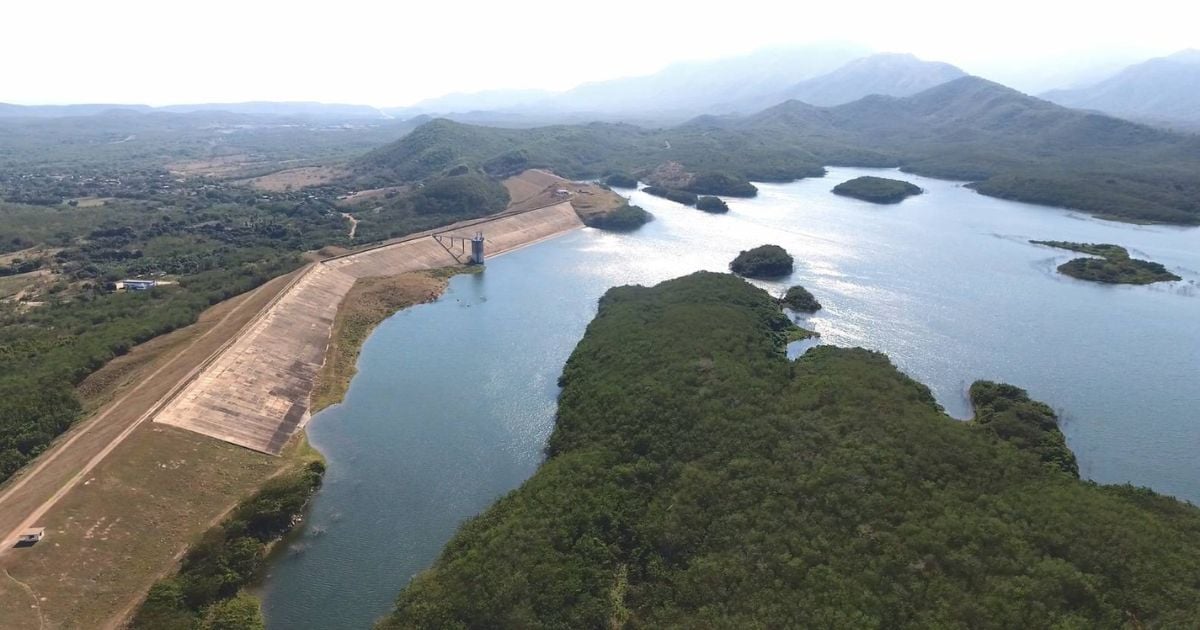
The Charco Mono reservoir, previously suffering from severe drought in Santiago de Cuba, has shown remarkable improvement following heavy rainfall in the area. Within just 24 hours, it surged from a dead volume to reach 55.1 percent of its total capacity.
As confirmed by the Hydraulic Utilization Company and reported by the state-run provincial media TV Santiago, the reservoirs across the province collectively increased by 10.6 million cubic meters in the past day, accumulating a total of 18.8 million cubic meters over two days. This increase offers a much-needed relief amid the prolonged water crisis experienced in this eastern region of Cuba.
Significant Reservoir Gains Amidst Weather Challenges
Among the reservoirs, the Protesta de Baraguá stands out with an impressive 99.8 percent capacity (249.47 million cubic meters), followed by Carlos Manuel de Céspedes at 65.7 percent (159.569 million) and Chalons at 46 percent (0.438 million). Others, such as Mícara at 58.3, Joturo at 52.1, Hatillo at 53.6, and La Majagua at 52.4 percent, also showed notable increases. However, reservoirs like Gota Blanca (19.6), Parada (14.3), and Gilbert (15.9) remain at low levels.
Overflows continue at Canasí and La Campana, as reported in the official update released this Sunday.
Stormy Conditions and Meteorological Warnings
Meteorologist Raydel Ruisánchez cautioned on Facebook about the ongoing challenges in the eastern part of the country. Intense convective systems have resulted in cumulative rainfall of 494 millimeters in Haitibonico (Guantánamo), 340 mm in La Campana, and 257 mm in La Gran Piedra within a span of just 48 hours. These downpours have led to flooding, river surges, and landslides, the specialist emphasized.
The rains are linked to the extensive circulation of tropical depression nine, which continues its slow movement north of the eastern region. Similarly, the Cuban Institute of Meteorology (INSMET) issued Tropical Cyclone Advisory No. 3, updating the status of tropical depression nine. Although the system remains largely unchanged structurally, it has caused heavy rains and thunderstorms over eastern Cuba.
During the nighttime and early morning hours, the depression focused its most active areas over the provinces of Guantánamo and Santiago de Cuba, resulting in numerous showers and electric storms that were severe and locally intense in some areas. The significant rainfall accumulations have led to flooding, particularly in low-lying and mountainous regions.
Key Insights on Santiago de Cuba's Water and Weather Conditions
What caused the sudden increase in reservoir levels in Santiago de Cuba?
The sudden increase in reservoir levels was caused by heavy rainfall associated with tropical depression nine, which brought significant precipitation to the region.
How did the rainfall impact Santiago de Cuba?
The rainfall led to flooding, river surges, and landslides, particularly affecting low-lying and mountainous areas in the eastern part of Cuba.
Which reservoirs showed the most significant changes?
The reservoirs with the most significant changes include Protesta de Baraguá, which reached 99.8 percent capacity, Carlos Manuel de Céspedes at 65.7 percent, and Chalons at 46 percent.