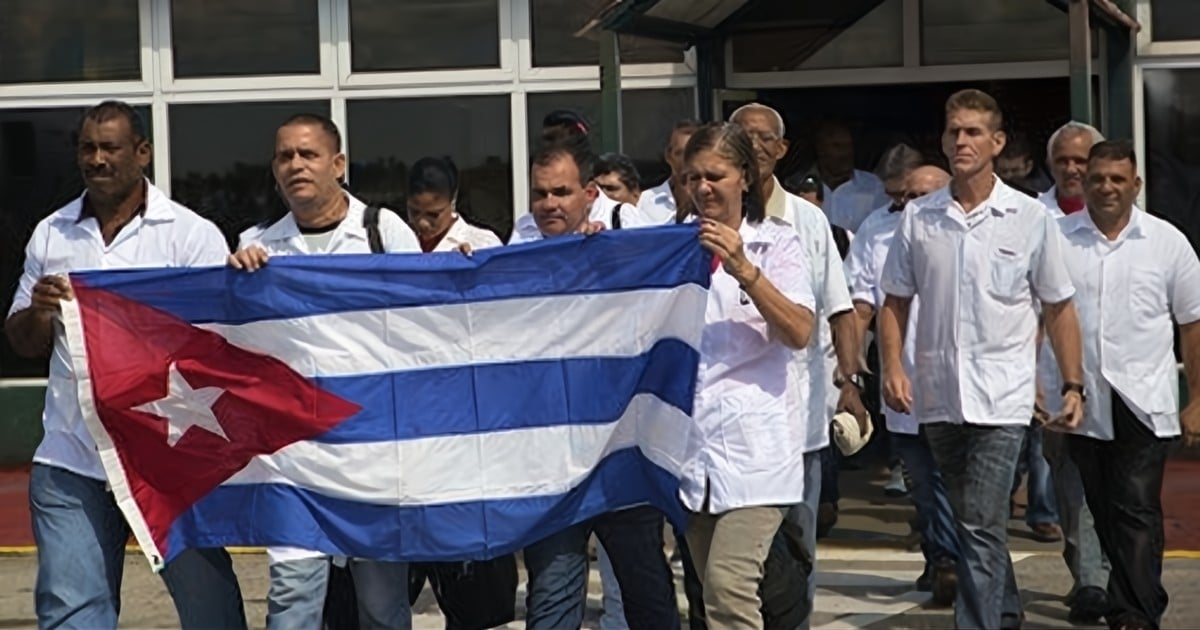
The fate of the Cuban medical brigade in the Bahamas has reached a pivotal moment. The Caribbean island's government is awaiting the United States' approval to establish a system for direct contracts with Cuban professionals, bypassing the Cuban state agency that has long taken the majority of their earnings, as reported by Caribbean Life. Health Minister Michael Darville confirmed that Washington requested to review the proposed agreements, which have already been submitted for evaluation. Should they receive the green light, Cuban doctors currently working in the Bahamas would sign directly with the local Ministry of Health, ensuring they receive their full salaries.
Until now, these medical professionals have received less than 15% of the $12,000 monthly payment that the Bahamas provided for each one; the remainder was retained by the Comercializadora de Servicios Médicos Cubanos (CSMC). Several former collaborators have alleged that even when payments were made directly to the bank, they were compelled to transfer the funds to accounts controlled by the Cuban regime, a setup described by Washington as "forced labor" and "human trafficking."
The Pressure from the U.S. and the Bahamian Crossroads
This shift is a response to pressure from the United States, which under the administration of Donald Trump and with the current Secretary of State, Marco Rubio, has intensified criticism of Havana's medical export model, valued at over $4.9 billion annually. High-ranking U.S. officials have warned of potential immigration sanctions, including the revocation of visas for Caribbean officials linked to the program, if abuses are not addressed. The Bahamas, along with Antigua and Guyana, was among the first countries to acknowledge the need to revise the system.
"We are very proud of the Bahamian efforts… Everyone deserves to receive their wages directly without government intervention," stated Kimberly Furnish, U.S. Chargé d'Affaires, as cited by Caribbean Life.
Cuban Doctors Caught in a Three-Way Struggle
In June, the Nassau government announced the termination of existing contracts with Cuban medical brigades, although they offered direct agreements to those wishing to stay. Currently, only 35 healthcare professionals—comprising ophthalmologists, nurses, lab technicians, and physical therapists, among others—are employed in the country. Most have expressed a desire to remain in the Bahamas, where they are crucial to a healthcare system that suffers from staffing shortages. However, their future remains uncertain, contingent on Washington's decision and under the looming threat of possible reprisals from Havana.
"Cuban doctors want to stay, but we depend on what the United States decides," admitted Minister Darville in previous statements to the local press. With the potential to sign contracts free from the Cuban government's wage confiscation, doctors in the Bahamas see a historic opportunity on the horizon. One that could signal the beginning of the end for a model that has been identified as one of Havana's most visible forms of labor exploitation.
Questions About U.S. Approval for Cuban Doctors in the Bahamas
What is the current status of Cuban doctors working in the Bahamas?
Cuban doctors in the Bahamas are awaiting U.S. approval to sign direct contracts with the Bahamian Ministry of Health, which would allow them to receive their full salaries without Cuban government intervention.
How has the U.S. influenced the situation with Cuban doctors in the Bahamas?
The U.S. has pressured the Bahamas to change the current system by threatening immigration sanctions and criticizing the Cuban medical export model, considered by some as forced labor and human trafficking.