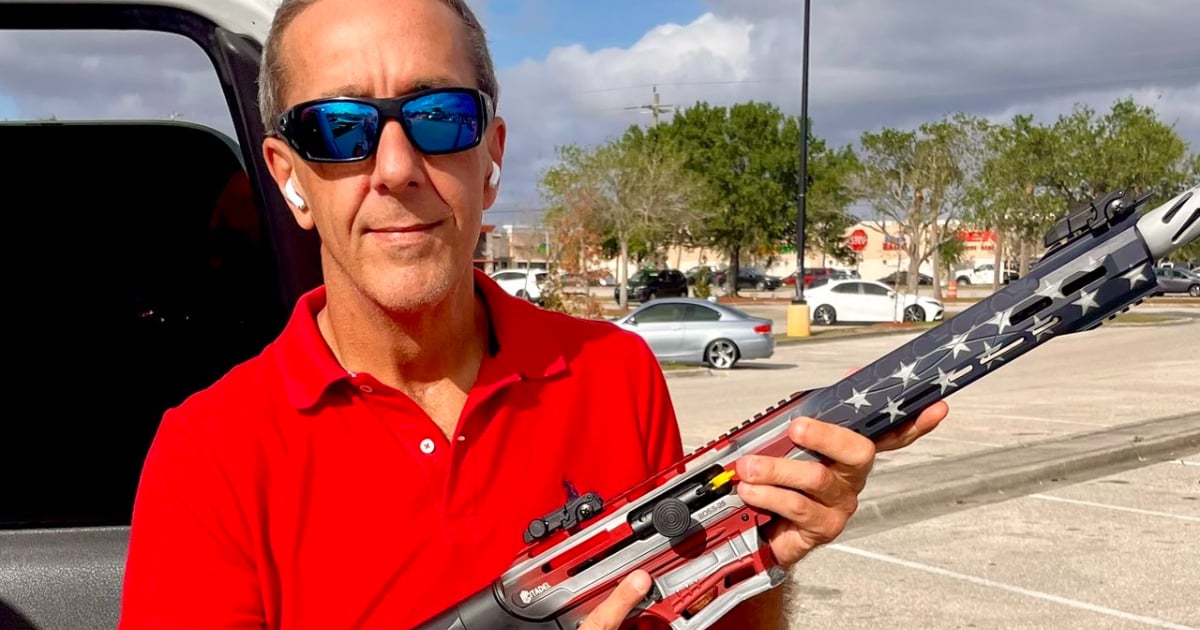
On Thursday, Florida enacted a law allowing the open carry of firearms in public spaces, following a ruling by the First District Court of Appeals declaring the state ban unconstitutional. This shift, supported by Republican Governor Ron DeSantis, enables residents to visibly carry pistols and revolvers in public, with specific exclusions for schools, courthouses, airports, and private properties.
Official Support and Historical Context
Governor DeSantis defended the legislation, asserting it would not significantly alter the daily lives of Floridians. At an event at Florida International University, he likened the measure to policies in most states, including those led by Democrats, claiming that "the sky isn't going to fall" due to open carry.
According to data from Ammo, over 35% of Florida's population owns a firearm, and this decision aligns state law with much of the nation. Previously, the ban was among the strictest, comparable only to California, Connecticut, and Illinois. The ruling stemmed from the 2022 case of a man arrested for publicly carrying a gun while live-streaming. The court found the state law incompatible with the Second Amendment of the U.S. Constitution.
Restrictions and Exclusion Zones
Although the new regulation permits firearms to be openly displayed in public areas, it does not allow carrying guns on private properties that prohibit them, nor in businesses, bars, airports, schools, courthouses, and government buildings. The Pinellas County Sheriff's Office and other local agencies have reiterated these restrictions to the public, while Monroe County officials have released internal guidelines on enforcing the ruling.
Florida Attorney General James Uthmeier emphasized that while open carry is now a constitutional right, carrying a weapon in a threatening or reckless manner remains illegal and could lead to arrest. The practical implementation continues to raise questions, as several police departments are still reviewing protocols and require additional training for their officers.
Public Reaction and Political Debate
The law has sparked mixed reactions. Some residents celebrate the decision as a reinforcement of personal defense rights, while others, like South Florida's Alan Greenstein, express disapproval: "I don't like the idea, but there's nothing I can do about it. That's what the courts decided," he told Local 10.
This debate extends into state politics: while DeSantis has promoted tax incentives for tax-free gun purchases and legislation facilitating public firearm carrying, some Republican senators and the Florida Sheriffs Association have voiced concerns. Moreover, the Legislature might need to clarify details in new legislation to harmonize the law with constitutional exceptions and rights.
Impact on Safety and Gun Culture
Experts caution that the open carry implementation could increase risks without adequate training and clear regulations. Currently, Florida has about 2.4 million concealed carry licenses, though participation in safety courses has decreased by 64% compared to the previous year.
This new measure marks a historic shift, as Florida transitions from being one of the few states with near-total open carry restrictions to aligning with the majority of the U.S., where this practice has been commonplace for decades. The ongoing debate over safety, individual rights, and gun control continues across the state, with lawmakers, authorities, and citizens assessing how to adapt to this new reality in daily life.
Key Questions About Florida's Open Carry Law
What does Florida's open carry law allow?
The law permits residents to openly carry pistols and revolvers in public spaces, with exceptions for specific locations such as schools, airports, courthouses, and private properties where firearms are prohibited.
Who supported the open carry law in Florida?
The law was backed by Republican Governor Ron DeSantis, who asserted that it aligns Florida with other states and would not drastically change everyday life for Floridians.
Are there any concerns about the new law?
Yes, concerns have been raised about potential safety risks if the law is not coupled with proper training and clear guidelines. Some lawmakers and law enforcement associations have also expressed reservations.