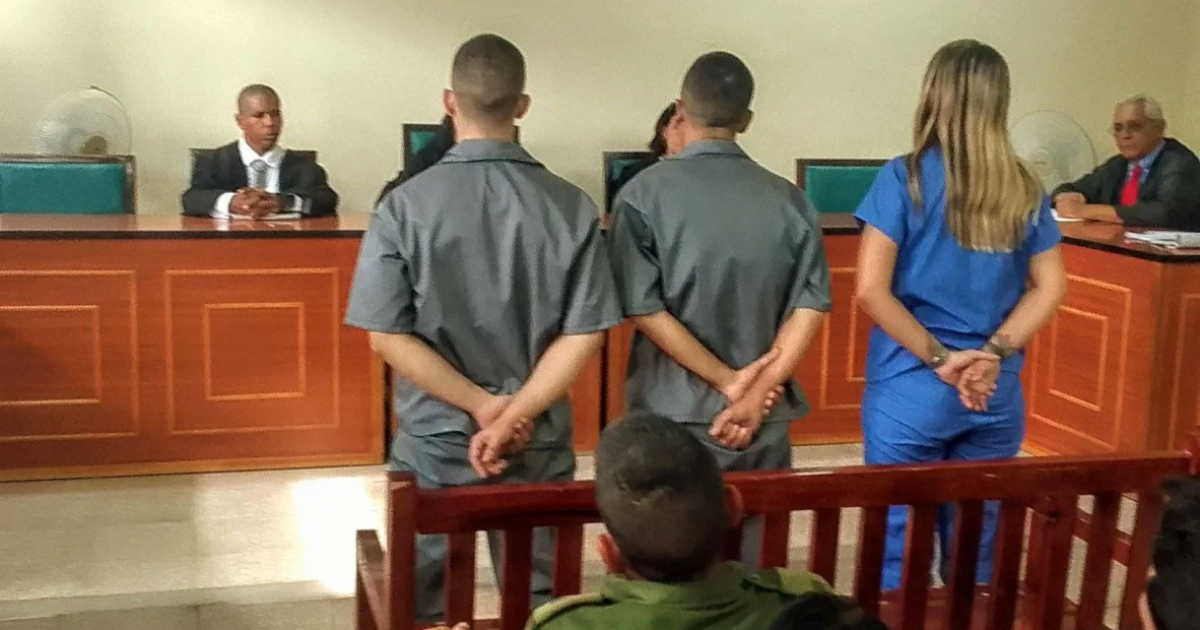
In a recent decision by the Provincial People's Court of Holguín, three individuals—Beatriz Reyes Mederos, Alexis Alberto Hernández Pupo, and Ismael González Medina—were sentenced to prison terms ranging from six to eight years due to charges involving drug possession, trafficking, and use. The ruling, delivered at the judicial headquarters in the Banes municipality, was portrayed by state media as a "model trial" aligning with the Cuban regime's zero-tolerance policy.
According to local broadcaster Radio Banes, González Medina was handed an eight-year sentence, while Reyes Mederos and Hernández Pupo each received six years. In addition to their prison terms, they were stripped of public rights, banned from leaving the country, and had their seized possessions confiscated during the proceedings.
Propaganda in the Courtroom
The court claimed that the trial adhered to all "legal guarantees," emphasizing that the prosecution's case was backed by testimonial, documentary, and expert evidence. As is often the case, this trial became a propaganda tool for the regime. State media highlighted its "educational" nature, echoing the government's narrative that portrays these sentences as part of a national crusade against the rise of drug use.
Official sources emphasized the "preventive and prophylactic" focus of the Holguín trial, even discussing the punishment of individuals with "criminal potential." Such rhetoric contradicts modern principles of criminal law, revealing how Cuban courts function more as instruments for social control rather than independent judicial bodies.
A Nationwide Campaign
The case in Banes is part of a broader series of mass trials with a similar approach. In Havana, on September 22, the Provincial Court sentenced José Alberto Ducá Valón to 15 years for selling cocaine and synthetic drugs. In Matanzas, another young man awaits sentencing after admitting to buying and reselling narcotics, despite having no prior criminal record, with the prosecution seeking a seven-year sentence.
These proceedings are part of a nationwide zero-tolerance campaign against drug trafficking, a judicial offensive aimed at demonstrating toughness against the consumption and trafficking of drugs, particularly synthetic cannabinoids known colloquially as "químico" or "papelillo."
The Other Side: Rising Drug Use and Police Ineffectiveness
Despite the harsh sentences, the problem continues to escalate. The Ministry of the Interior (MININT) disclosed that over 1,500 individuals have been arrested in the past year for drug-related incidents, and synthetic drug use is reaching unprecedented levels in Cuba, especially among the youth.
These severe punishments highlight the failure of the government's repressive approach. The administration responds with harsh judicial processes but fails to address the underlying causes: social crisis, lack of opportunities for young people, and corruption that facilitates the growing drug trade.
While the regime turns each trial into a public spectacle to instill fear and discipline the populace, the reality in neighborhoods and cities reveals that the so-called zero-tolerance policy does not halt the growth of drug trafficking or use. The issue continues to spread, with an ever-increasing cost to Cuban families.
Understanding the Drug Policy in Cuba
What are the penalties for drug-related offenses in Cuba?
Penalties for drug-related offenses in Cuba vary, but they can include long prison sentences, deprivation of public rights, travel bans, and the confiscation of property.
How does the Cuban regime use drug trials for propaganda?
The Cuban regime often uses drug trials as propaganda by showcasing them as "educational" events, reinforcing the government's narrative of a national fight against drug use and trafficking.
Are there underlying causes for the rise in drug use in Cuba?
Yes, the rise in drug use in Cuba is attributed to a combination of social crisis, lack of opportunities for youth, and systemic corruption that allows drugs to circulate more freely.