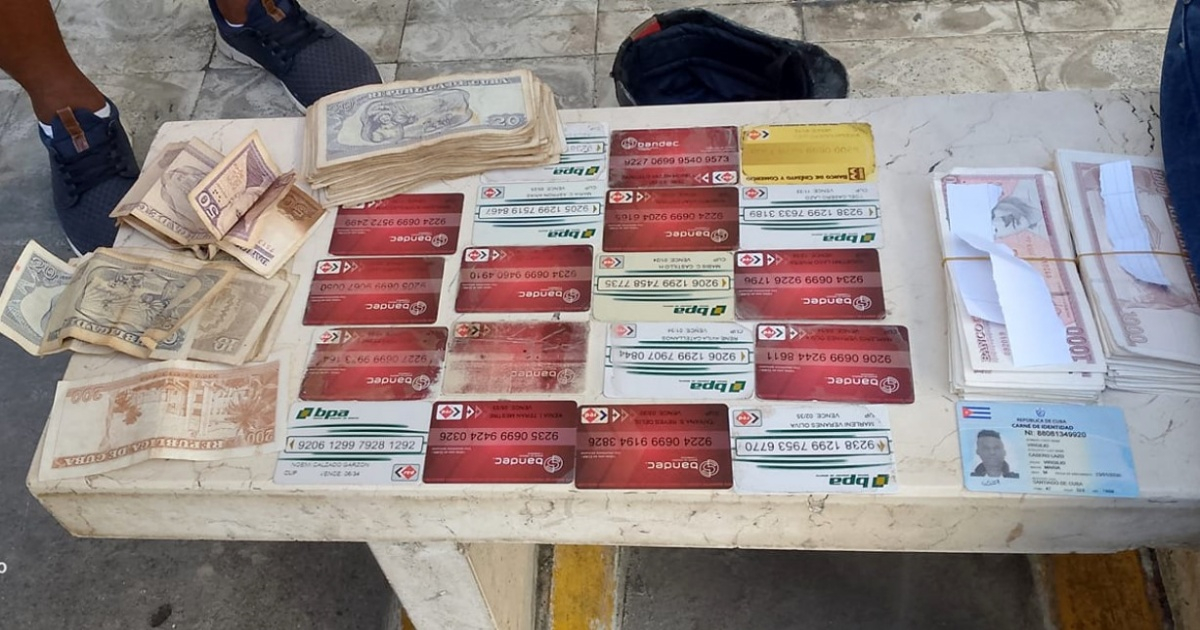
In Santiago de Cuba's main municipality, officers from the Revolutionary National Police (PNR) apprehended two men allegedly involved in an informal network that exchanged bank transfers for cash, pocketing a 15% commission. The operation, reported by the pro-government Facebook page "Heroes of Moncada," highlights not only a widespread practice but also a glaring indication of the collapse of Cuba's financial system.
The individuals arrested, named Leodan and Yunior, were caught at the ATM of a building known as “18 Plants of Garzón.” According to sources, they offered cash to those waiting in line in exchange for electronic transfers. At the time of their arrest, they were found with over 250,000 Cuban pesos and several magnetic cards allegedly used to facilitate their operation.
The official source strongly denounced such activities and urged the public to report individuals who “profit from the needs and sacrifices of others.”
The Cash Business: How It Worked
Among Cubans, particularly in the comments on the official post, one question persists: How did they manage to acquire so much cash?
Although unofficial, the explanations are consistent:
- Deals with bank employees: Many suggest there is collusion with ATM operators and bank staff who permit larger withdrawals for a fee.
- Trips to Havana: Some claim the suspects traveled to the capital to withdraw large sums of cash, which they then transported back.
- Connections with private businesses (mipymes): It is speculated they obtained cash through small and medium-sized private enterprises that accumulate cash from sales and then "resell" it to these operators.
These two suspects seem to be part of a larger criminal network where private interests, corrupt state employees, and desperate citizens intersect.
Context: Cashless Banking with No Backing
This incident is not isolated but part of a broader structural problem: the severe cash liquidity crisis in the Cuban economy. For years, state banks have struggled with a shortage of bills, forcing citizens to wait in long lines to access their own funds.
Despite government efforts to promote "bankarization" by incentivizing electronic payments, cash remains essential in everyday life for transportation, food purchases, medications from private sellers, and transactions with businesses that refuse electronic transfers.
Economy Minister Joaquín Alonso Vázquez recently admitted that only 10% of Cubans control 60% of the cash circulating outside the banking system, indicating a parallel economy where money circulates beyond state oversight.
Reactions: Division Among Public Opinion
Comments on social media reflect a divided public opinion. Here's a summary of the main perspectives:
- State Criticism and Justification of the Practice: Some say, “Without them, we couldn't buy food or medicine”; “Thanks to these transactions, we have cash to work or meet basic needs”; “What they do is no different from a loan with interest, developed countries also charge commissions”; “Banks don't provide money, and individuals don't accept transfers, what other option do we have?”; “The government caused this problem, not these men.”
- Demand for Justice and Condemnation of Exploitation: Others argue, “This is taking advantage of the working people's needs”; “They exploit especially retirees who earn a pittance”; “This must be punished firmly, they cannot operate with total impunity”; “There should be a crackdown on those who profit from others' money”; “This should be done at all ATMs, not just one.”
- Recognition of Deeper Problems: Some note, “There's no way that much cash comes from a single ATM, this involves bank employees and small businesses”; “This is just a link in the chain, the real culprits are in the offices”; “Bank workers themselves are part of the business”; “The State created this situation with forced bankarization and no cash backing”; “Authorities know this happens at all ATMs, it's not new.”
- Proposals for Structural Solutions: Suggestions include, “Forcing small businesses to accept electronic payments and deposit cash in the bank”; “If banks worked properly and ATMs had money, this wouldn't happen”; “Institutions allowing this chaos must be thoroughly reviewed”; “The solution isn't to repress the last link, but to change the model that makes this possible.”
A Symptom of a Failed System
This case uncovers more than an isolated criminal act. It exposes the failure of an economic model that fails to provide basic financial services for its citizens, forcing thousands to rely on informal networks to get what the system doesn't offer.
Instead of acknowledging its responsibility, the State criminalizes those who fill this void, even if they do so by charging abusive commissions. While these operators are repressed, the root of the problem remains untouched: the lack of cash in banks, the inefficiency of the financial system, inequality in resource access, and the absence of transparent mechanisms to channel demand.
Solution or Temporary Fix?
The arrest of Leodan and Yunior may seem like a blow to informality. However, if the cash shortage isn't addressed, if private businesses aren't required to operate electronically, if banks and their employees aren't audited, and if workers aren't allowed free access to their salaries, these businesses will continue to flourish.
The "cash business" wasn't invented by these two men. It is the result of a strangled economy that has turned the simple act of withdrawing money from a bank into a daily ordeal for millions of Cubans.
Understanding Cuba's Cash Crisis
What led to the arrest of Leodan and Yunior?
Leodan and Yunior were arrested for their alleged involvement in an informal network exchanging electronic bank transfers for cash, charging a 15% commission.
Why is cash still essential in Cuba despite electronic payment initiatives?
Cash remains crucial because many transactions, such as transportation, food purchases, and payments to businesses, rely on cash, and electronic payments are not universally accepted.
What are the main criticisms of the Cuban financial system?
The Cuban financial system is criticized for its cash shortage, inefficiency, and lack of access to basic financial services, which forces citizens to rely on informal networks.