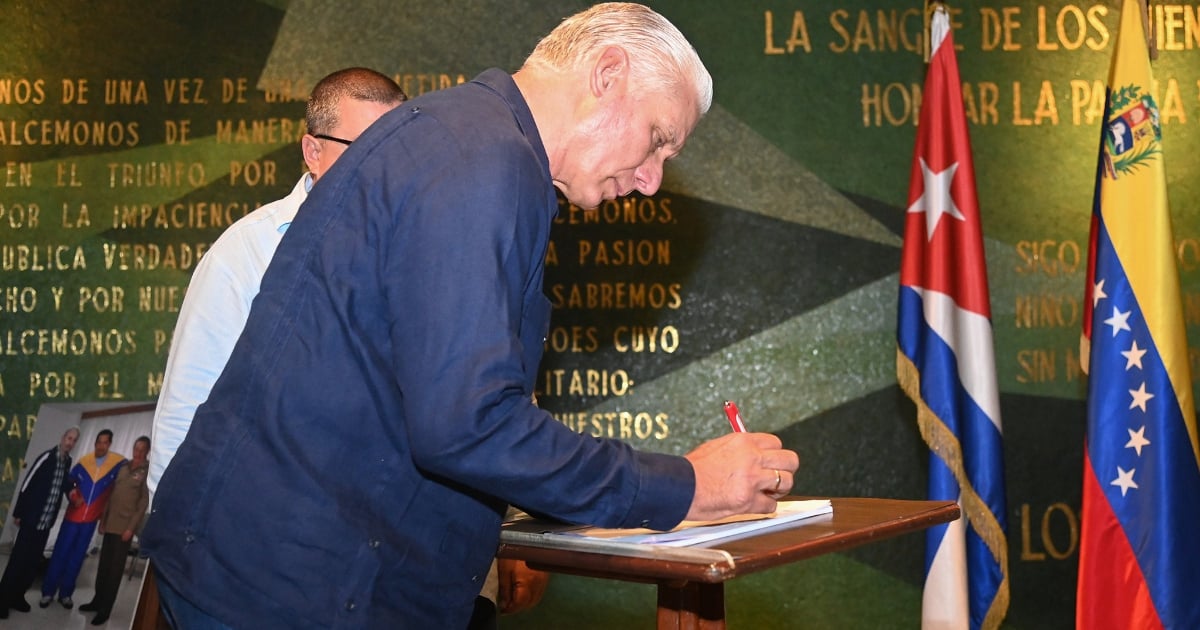
At the iconic José Martí Memorial, a site rich in patriotic symbolism, Cuban President Miguel Díaz-Canel placed his signature on a grandiose declaration titled “Urgent Need to Prevent a Military Aggression Against the Bolivarian Republic of Venezuela.” Surrounded by Communist Party leaders, with a replica of Bolívar's sword as a backdrop and the Venezuelan ambassador applauding, the event culminated with the announcement that the disciplined Cuban populace would endorse the initiative by signing petitions in workplaces, schools, and neighborhoods.
This propagandistic choreography is reminiscent of old Soviet-style pageantry: solemnity, theatrical heroics, abundant rhetoric, and a lack of substance. While the official press repeats slogans about unwavering solidarity with Caracas, the reality is starkly different. The Cuban regime confines itself to gathering signatures and, as Deputy Foreign Minister Carlos Fernández de Cossío stated, offering “full political support” to Nicolás Maduro, ruling out any military involvement.
From Rifles to Pens
The contradiction is evident. For over six decades, the Castro regime has cultivated the image of a militant revolution, prepared to sacrifice itself against imperialism. Fidel Castro, the regional anti-imperialist champion, built his leadership on bellicose phrases: “Homeland or death, we will prevail!” and “I will die fighting with weapons in hand,” or the doctrine of “people's war.” This rhetoric was not merely words. With Soviet funding, Havana exported its model worldwide: guerrillas in Latin America, advisors in Nicaragua and El Salvador, arms for insurgencies in Colombia, and tens of thousands of soldiers sent to Africa under the guise of “proletarian internationalism.”
In Angola, Ethiopia, and the Congo, Cuba became Moscow's armed pawn, sacrificing the lives of thousands in foreign wars that, nonetheless, bolstered the narrative of a “triumphant” and combative revolution. This past of militant bravado contrasts with Díaz-Canel's present, a president facing the threat of a U.S. military deployment in the Caribbean with... a pen.
Solidarity or Social Control?
The regime markets the initiative as a spontaneous gesture of support for Venezuela's “popular, military, and police fusion.” In truth, it's another exercise in social control: a mechanism to gauge loyalties, subjugate wills, and turn foreign policy into an internal spectacle of obedience. While the discourse invokes “Bolivarian brotherhood” and the defense of Venezuelan sovereignty, the campaign acts as a thermometer to see who complies obediently and who dares deviate from the script. The signatures, far from expressing free solidarity, become the equivalent of a mandatory vote of fidelity to the Party.
Venezuela: The Squeezed Ally
The irony deepens when one considers that Cuba has benefited from Venezuelan oil, soft loans, and resource transfers for over two decades, propping up the island's economy during the Chávez era. It was a marriage of convenience where Havana exported doctors, teachers, and especially intelligence and military advice, in exchange for barrels of oil that kept power plants running and transportation moving.
International organizations and investigative reports have documented the deep infiltration of Cuban advisors in Venezuelan military and repressive bodies. Maduro's intelligence apparatus bears Cuban DNA, and the suppression of dissent was nourished by manuals learned on the island. However, at the critical moment, when the ally claims to be threatened by the “empire,” Cuba stands aside. No troops, no ships, no tanks, not even a veiled threat. Only bombastic declarations, compulsory signatures, and the repeated mantra of “full political support.”
Salon Anti-Imperialism
What we are witnessing is the watered-down version of the brazen anti-imperialism that Castro sold to the world. Today, it is reduced to a propaganda ritual for domestic consumption, while the regime attempts to survive amid a devastating economic crisis. The contrast between the revolutionary epic of yesteryear and today's bureaucratic signature gathering is the perfect metaphor for the decline of Castroism: from the guerrilla in Sierra Maestra to the primary school desk where signing against the United States is mandatory; from proletarian internationalism to mere “full political support.”
The implicit message is clear: the Revolution that once boasted of rifles, heroic deaths, and intercontinental deployments no longer has the strength or will for anything beyond controlling its own population.
From Machete to Wet Paper
If anything, this signature campaign demonstrates that Cuban anti-imperialism has become salon anti-imperialism: abundant symbolism, abundant staging, abundant empty discourse, and no real capacity for response. Venezuela, squeezed for two decades, stands alone in the trench. Cuba, which boasts so much of revolutionary epic, merely passes the sheet and the pen. Meanwhile, the United States sails its ships through the Caribbean without a shot fired, and the regime repeats the old propaganda script to keep its people in line. The revolution that once presented itself as warrior and triumphant has been reduced to this: a signature form.
Understanding Cuba's Political Maneuvers
How does Cuba's current stance on Venezuela differ from its past actions?
In the past, Cuba actively supported revolutionary movements with military aid and personnel. Today, its support for Venezuela is limited to political declarations and petition campaigns, without any military involvement.
What role has Venezuelan oil played in Cuba's economy?
Venezuelan oil has been a crucial factor in sustaining Cuba's economy, providing energy resources that have supported infrastructure and transportation for over two decades.
Why does Cuba emphasize signatures and declarations instead of military action?
Cuba's emphasis on signatures over military action reflects a shift from its historical revolutionary militancy to a strategy focused on symbolic gestures and maintaining social control amid economic challenges.