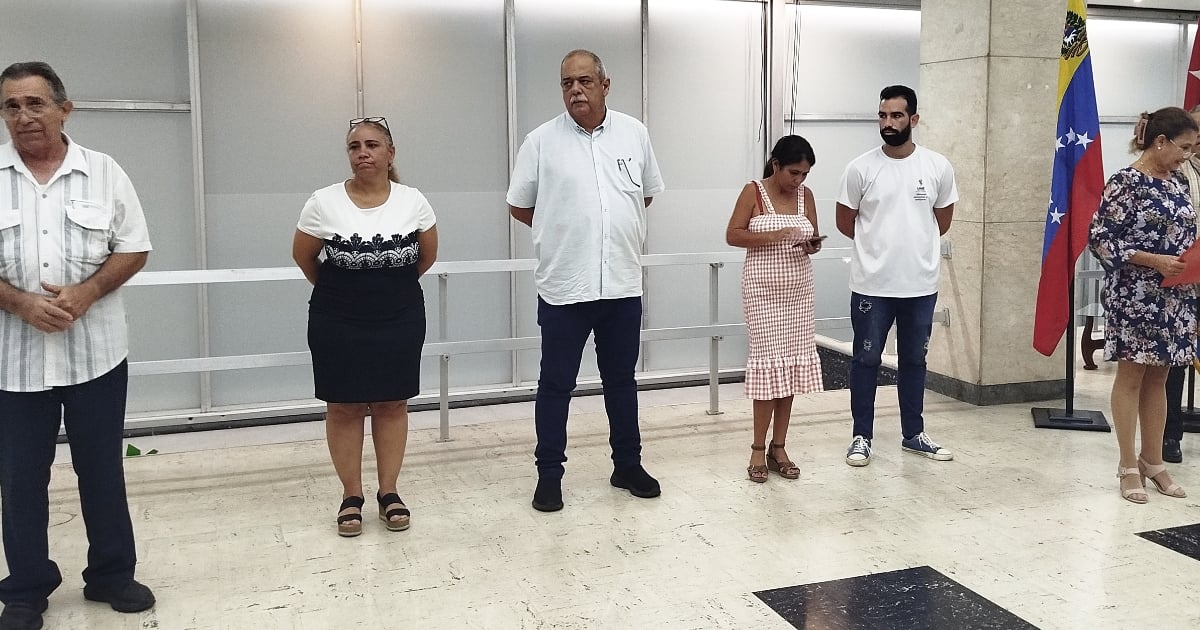
A recent political move by Cuba's regime has sparked widespread anger: workers from the Electric Union (UNE), the Ministry of Energy and Mines (MINEM), and the CUPET company, led by Minister Vicente de la O Levy, took part in a signature-gathering event to express support for Venezuelan dictator Nicolás Maduro. This activity, labeled as an act of solidarity against "imperial hostility," was shared on social media by UNE, displaying images of the event in a well-lit hall with Communist Party officials as witnesses.
The post, bearing slogans like "we embrace our Venezuelan brothers" and "our signatures will testify to our full support for the Bolivarian nation," was met with a torrent of negative comments. Many criticized the disconnect between the political campaign and the harsh national reality, characterized by endless blackouts, food shortages, and increasing social unrest.
Questions like "And what about signatures against the blackouts?" and "When will there be a signature campaign to complain about blackouts, misery, and hopelessness?" echoed the sentiments of many Cubans who decried the authorities' hypocrisy. Some users sarcastically noted that while hospitals are urged to save electricity, UNE wasted power to illuminate a political event unrelated to its mission of providing energy to the nation.
Comments such as "they use more electricity for this event than an entire province's circuit" or "sign to fix the country's dreadful energy situation" highlighted the frustration of citizens enduring daily power outages.
Coercion and Indifference
Among the feedback, several Cubans suggested that attendance at these events is not voluntary but a result of the system's coercion in state workplaces. "There goes the herd," one user remarked, while another added, "tomorrow they'll check attendance at work centers and no one will be able to refuse."
Others accused the signature collection of being a "survey" to gauge workers' loyalty, disguised as international solidarity. According to one commenter, the regime's real aim is to "determine who supports it out of conviction, who out of fear, and who opposes it."
Sarcasm and Outrage
The UNE's post became a hotspot for sarcasm and ridicule. Some questioned whether those signatures would "stop destroyers and submarines" or serve as "toilet paper." Others mocked, "Let's show we're capable of anything except generating the energy the country needs."
Amidst the frustration, insults and expressions of anger were plentiful. Terms like "shameful," "disgusting government," and "what a big farce" were directed at MINEM and UNE.
Misplaced Priorities
The public's discontent has a clear backdrop: Cuba's ongoing energy crisis. Prolonged blackouts affect not only daily life but also crucial sectors like food production, education, and health. In this context, the institution responsible for electricity allocating time, resources, and personnel for a political act in support of another country was seen as insulting by many.
"Wasting time on this nonsense instead of figuring out how to fix the electric system disaster," one user wrote. Another summed it up with a straightforward question: "What will these signatures achieve?"
Questionable Solidarity
The event also rekindled criticism of the Cuban regime's foreign policy, which prioritizes defending allies like Venezuela and Nicaragua while neglecting internal issues. "Take care of your country and your people first," several commenters insisted.
Comparisons to other political campaigns quickly arose. Many recalled how schools, workplaces, and neighborhoods have been used for decades to gather signatures, always in support of official causes, never allowing citizens to freely express their discontent.
"Collect signatures to see if the people support or despise you and want you far from this country," suggested one user, convinced the outcome would overwhelmingly oppose the government.
A Crack in Official Propaganda
Although UNE's publication aimed to display unity and political commitment, the result was quite the opposite: thousands of Cubans publicly voiced their rejection, revealing the growing divide between the official narrative and the population's real concerns. The signature campaign led by De la O Levy will be remembered as another political propaganda effort by the regime, but it exposed a significant element: more and more Cubans are using official platforms to openly question the government's priorities and denounce the island's deteriorating living conditions.
Cuban Energy Crisis and Public Reaction
Why did the signature-gathering event provoke public outrage in Cuba?
The event provoked outrage because many Cubans felt it was disconnected from their harsh realities, such as enduring blackouts and shortages, and saw it as a hypocritical political move by the regime.
What were some of the criticisms directed at the Cuban regime?
Critics highlighted the regime's misplaced priorities, focusing on foreign solidarity while neglecting domestic issues, particularly the ongoing energy crisis affecting everyday life and essential services.
How did Cubans express their disapproval of the political campaign?
Cubans used sarcasm, ridicule, and direct criticism on social media to voice their disapproval, questioning the effectiveness of such campaigns and highlighting the regime's failure to address pressing national concerns.