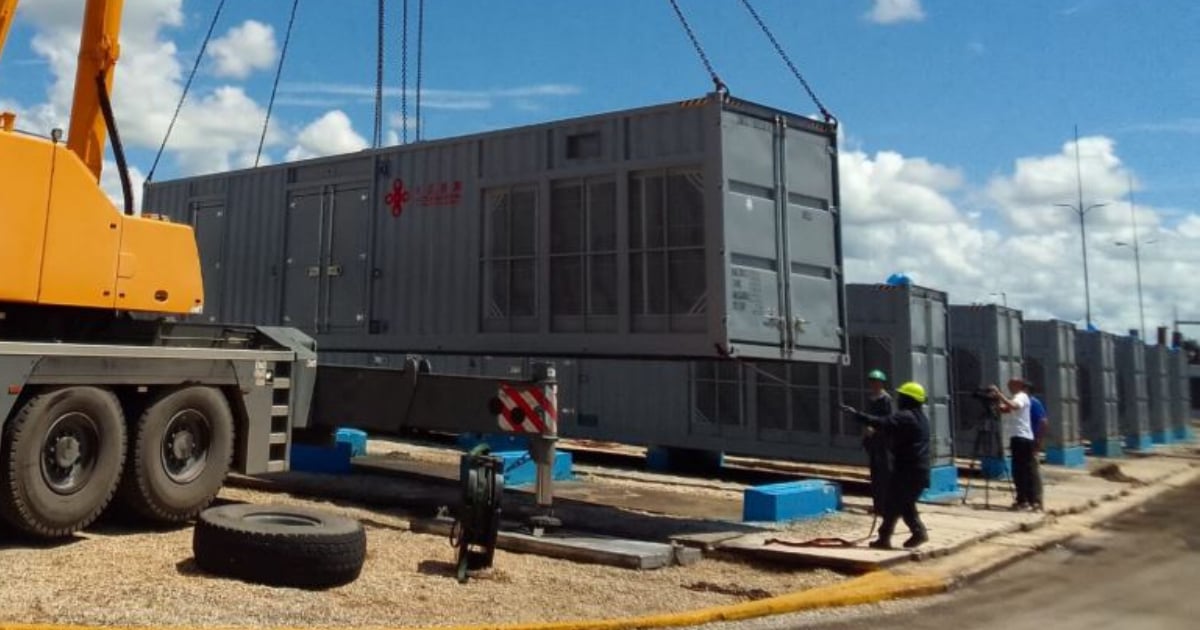
The Cuban regime has enthusiastically announced the arrival of eight power generators donated by China in Matanzas, situated at the Guanábana power plant. These units collectively produce between 25 and 30 megawatts (MW). Official media presented this as part of a "generation capacity recovery" initiative, emphasizing the swift installation of the 1.8 MW diesel engines. However, beyond the regime's propaganda, the underlying issue remains unchanged: Cuba is still grappling with insufficient fuel supplies to keep these units operational, and the energy crisis continues to severely affect the populace.
State media disclosed that these generators will support photovoltaic solar parks and distributed generation systems, enabling the creation of "micro-systems" to power specific areas when the National Electric System (SEN) fails. Since August 2024, the nation has experienced at least five major blackouts, leaving the country in darkness for days.
Mario Pedroso Caballero, the general director of Geysel, highlighted the role of distributed generation during the last SEN collapse, stating it allowed thermoelectric plants to restart and restore the system. He emphasized the importance of such initiatives, which aim to isolate and create micro-systems during crises while synchronizing with the SEN under normal conditions.
The Chinese donation is part of a growing political alliance between Havana and Beijing. In recent months, Cuba has received components, photovoltaic parks, and other equipment from China in an effort to mitigate an energy crisis resulting in blackouts lasting up to 20 hours in some provinces. In Matanzas, one of the hardest-hit regions, power outages have exceeded 24 hours, exacerbating water supply issues and increasing the spread of viral diseases.
Despite the potential relief these generators might offer, their impact will be limited. They operate on diesel, a resource Cuba struggles to import due to a lack of foreign currency and debts to suppliers. Past experiences have shown that new equipment often ends up idle due to fuel shortages or becomes inoperative due to a lack of spare parts.
Impact of Thermoelectric Plant Maintenance on Cuba’s Energy Crisis
The situation worsens with the impending shutdown of the Antonio Guiteras thermoelectric plant, Cuba's most significant, located in Matanzas. It will cease operations at the end of the year for a major maintenance overhaul expected to last at least six months. Alfredo López Valdés, the general director of the UNE, acknowledged on the Mesa Redonda program that Guiteras suffers from a "maintenance deficit" and regulatory issues, leading to frequent unexpected shutdowns and extreme vulnerability of the SEN.
Without this plant, Cuba's national power generation will rely on smaller, often unstable and outdated units, predicting even more extended and frequent blackouts. Experts caution that the government's strategy, relying on donations, renting floating power plants, and planning future solar parks, fails to address the root causes of the collapse: decades of underinvestment, technological obsolescence, and poor management.
Meanwhile, Cubans brace for even harsher times. The shutdown of Guiteras and the lack of fuel for new engines foreshadow a dire situation where blackouts will continue to disrupt daily life, directly impacting public health, the economy, and social stability.
FAQs on Cuba's Energy Crisis and Chinese Generators
What is the capacity of the Chinese generators donated to Cuba?
The eight Chinese generators have a combined capacity of between 25 and 30 megawatts (MW).
Why is Cuba struggling to keep these generators running?
Cuba faces challenges in maintaining these generators due to insufficient diesel fuel imports, a result of limited foreign currency reserves and outstanding debts to suppliers.
How does the maintenance of the Antonio Guiteras plant affect Cuba's energy situation?
The maintenance of the Antonio Guiteras plant, which will last at least six months, exacerbates Cuba's energy crisis as it is the country's most crucial power plant. Its shutdown will increase reliance on smaller, less stable power sources, leading to more frequent and prolonged blackouts.