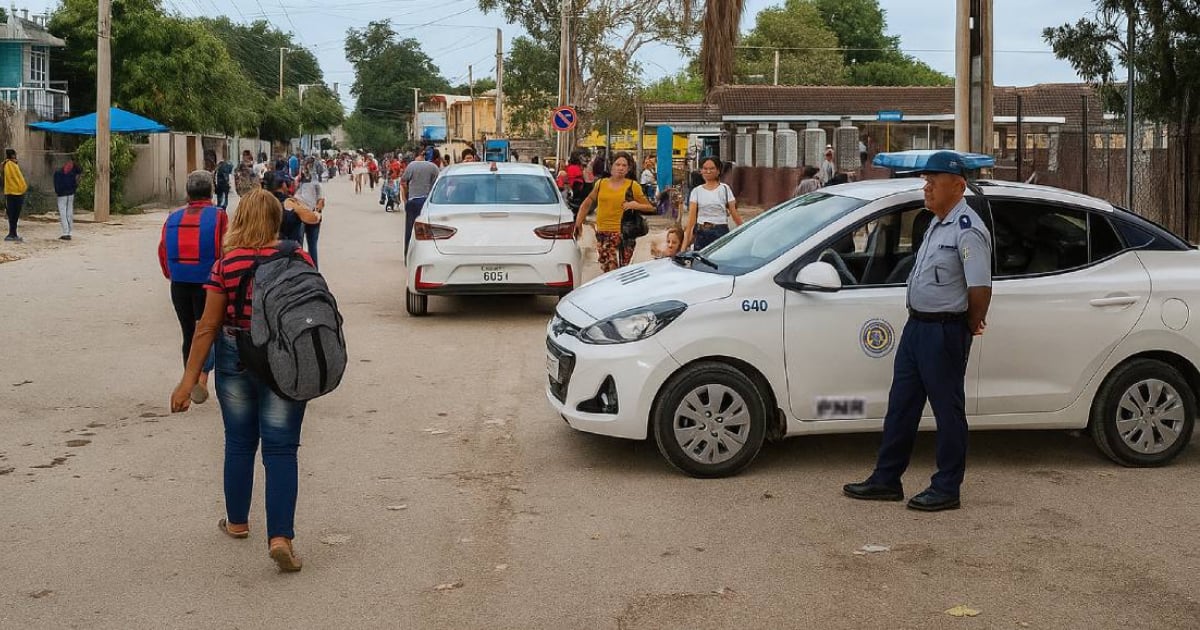
The Cuban government has launched a crackdown on street vendors in Holguín's 13th Street, aligning with its agenda to bolster "internal order" amidst widespread public discontent, frequent power outages, and demonstrations across various provinces. President Miguel Díaz-Canel has called for heightened measures to ensure "citizen tranquility" and maintain "internal order" as part of the Fourth National Exercise for Crime Prevention and Response, which is being conducted nationwide.
On Wednesday, pro-government Facebook profiles reported on the operation in the aforementioned area, known for its informal trade activities. The enforcement actions targeted 13th Street, 8th Street, and the vicinity of Las Baleares in Holguín, where officials and agents were deployed to impose fines and seize goods from informal vendors. Local residents drew parallels between the situation and Havana's infamous "Cuevita," condemning on social media what they described as a "dictatorship of corrupt inspectors and police" handing out arbitrary fines. "Today they are issuing fines on 13th Street, Holguín," one user reported.
The operation also involved workers from the Community Services and Raw Materials departments, responsible for cleaning up the affected areas. The initiative was framed as part of the fight against "illegalities" and the effort to organize public spaces. Simultaneously, the regime has intensified its response to recent protests through mass arrests and harsh sentences. In Gibara, Holguín province, at least 27 people were detained following citizen demonstrations. In Bayamo, 15 protestors involved in the March 17, 2024 protests were sentenced to between three and nine years in prison.
The charges brought against them include public disorder, contempt, resistance, disobedience, and incitement to commit crimes. Human rights organizations have criticized the proceedings for procedural irregularities, arbitrary detentions, and a systematic pattern of repression. "Confronting crime must be a daily task," cautioned Díaz-Canel, who called for updating institutional security plans and taking decisive action against issues such as cable theft, transformer theft, administrative corruption, tax evasion, and gender violence.
Nevertheless, the regime remains focused on control and repression instead of providing concrete solutions to the populace, who are increasingly suffering from shortages of food, potable water, medicine, and basic services.
Understanding the Crackdown on Informal Trade in Holguín
Why did Cuban authorities target street vendors in Holguín?
The operation was part of the government's effort to strengthen "internal order" amidst growing public unrest and protests, aiming to combat illegalities and organize public spaces.
How have residents reacted to the crackdown?
Locals compared the situation in Holguín to Havana's "Cuevita" and criticized what they perceive as arbitrary and corrupt practices by officials imposing fines.
What other measures has the regime taken in response to protests?
The regime has increased its crackdowns with mass arrests and severe sentences for protestors, citing charges like public disorder and incitement to commit crimes.