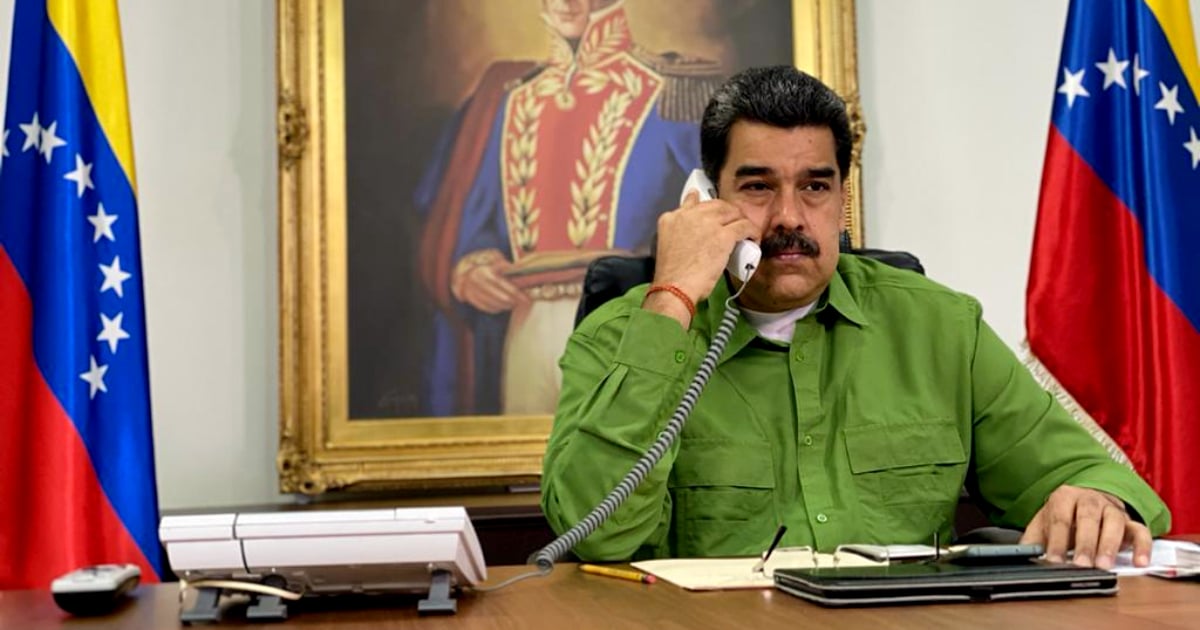
The administration of Nicolás Maduro is grappling with a heightened sense of anxiety and uncertainty from the heart of Miraflores Palace as international pressure, spearheaded by the United States, mounts. President Donald Trump’s government has ramped up its actions in the Caribbean, combining military presence with direct messages aimed at Maduro's inner circle, which has sparked internal suspicions of betrayal and fueled speculation about potential intervention.
Juan Diego Quesada, a correspondent for El País in Bogotá, detailed this tense scenario in an article for the renowned Spanish publication on Sunday, September 21, following an incident involving the sinking of a vessel from Venezuela allegedly ordered by Trump. As Quesada notes, the situation becomes increasingly volatile with each move from the Trump administration, compounded by cryptic messages from U.S. officials, such as a direct message to presidential pilot Bitner Javier Villegas, hinting at secret talks with Washington.
Maduro's response has left his supporters with more questions than answers. While his internal rhetoric attempts to project confidence and resolve, the letter sent to President Trump and subsequent reactions exposed the underlying panic at Miraflores, characterized by a subservient narrative filled with accusations of "fake news," a term popularized by the Republican leader.
The request for Richard Grenell, a former negotiator in previous exchanges, to lead any engagement between Washington and Caracas, further revealed the regime's anxious effort to exclude Secretary of State Marco Rubio, a fierce critic of the Cartel of the Suns and a close ally of opposition leader María Corina Machado, from any dialogue on bilateral relations.
Moreover, tension is rising within the chavista ranks amid rumors of military defections and alleged secret negotiations for a power transition. Although many of these rumors remain unverified, according to Quesada, they have fostered an atmosphere of paranoia within the regime, which fears a surprise operation by the United States.
"There is confusion. We have never experienced anything like this," a source close to the presidential circle told El País. Meanwhile, Venezuelan armed forces have initiated defensive drills in the Caribbean, broadcasted training images in popular neighborhoods, and reinforced the narrative of national defense.
The U.S. military deployment has been justified by the White House as part of the anti-narcotics campaign. However, analysts argue that this region does not constitute the central hub of global drug trafficking. The operation might instead support the yet unproven claims that Maduro is involved in transnational criminal networks.
With electoral support dwindling and internal trust eroding, the chavismo regime now faces not only external pressure but internal apprehension as well. The prospect of armed conflict, which seemed distant just months ago, is becoming increasingly conceivable among the regime’s key players.
Key Questions About Maduro's Regime Crisis
What actions has the Trump administration taken against Maduro's regime?
The Trump administration has intensified its pressure on Maduro's regime by increasing military presence in the Caribbean and sending direct messages to Maduro's inner circle, which has led to internal suspicions of betrayal and fears of possible intervention.
How has the internal situation in Venezuela changed due to this pressure?
The internal situation has become more unstable, with growing rumors of military defections and alleged secret negotiations for a power transition, creating an atmosphere of paranoia within the regime.
Why is the U.S. military presence in the Caribbean significant?
The U.S. military presence is said to be part of an anti-narcotics campaign, but analysts suggest it might also be intended to support allegations of Maduro's involvement in transnational criminal activities, despite these claims not being proven in court.