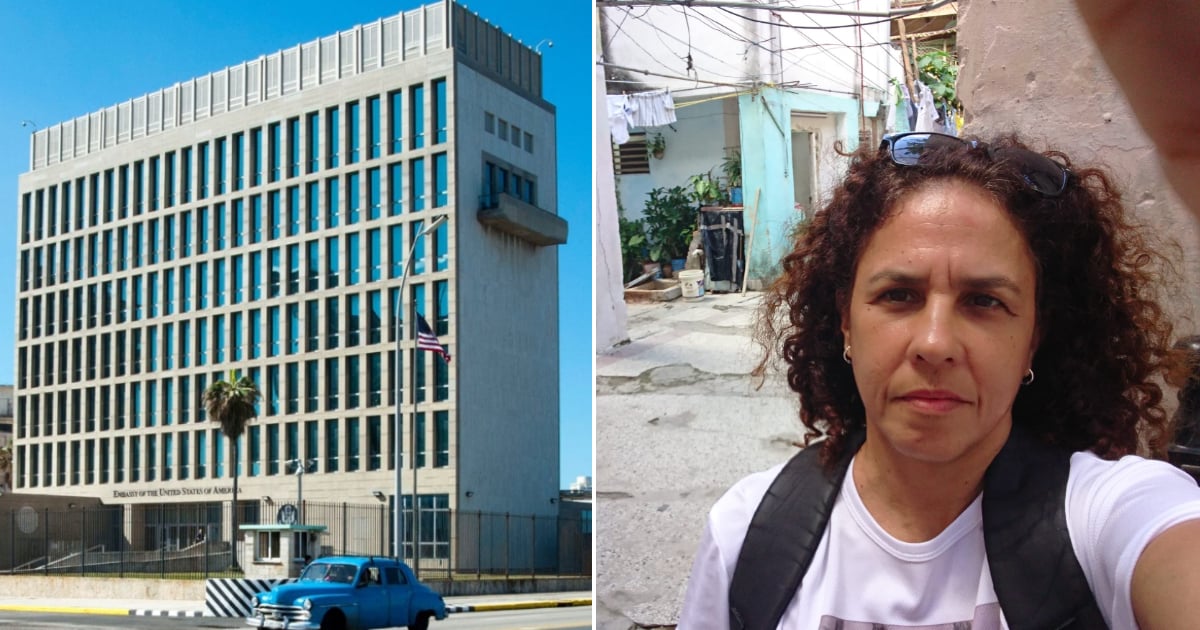
Cuban journalist and writer Yania Suárez has voiced her frustration over being denied a visa by the United States government to attend an event she was officially invited to. She perceives this as an unjust decision potentially driven by political motives. "I was just denied a U.S. visa. It was an official invitation, and honestly, I'm quite baffled. Upset and confused," she shared on her Facebook profile. According to the consular notice she received, she failed to sufficiently demonstrate the purpose of her trip and her ties to Cuba, which she deemed absurd.
Suárez believes this response is commonly given to applicants, particularly those from Cuba. "Anyone with their eyes slightly open will see that I've chosen to stay in Cuba," she added. The essayist, who has studied in Canada and received scholarships from American universities, emphasized that she has always returned to Cuba after traveling. "I live with the feeling that everyone has left except for me," she wrote. She also recounted past visa denials, including one in 2004 for cultural reasons, opting not to apply in 2009 to return to Cuba, and losing a scholarship in 2022 after a lengthy administrative process.
The Impact of Political Views on Visa Decisions
"I wonder what I've done wrong. Maybe I haven't been Trump enough lately, and we all know the direction of the new hysteria," she speculated. "Is it the usual disdain towards us?" Although she acknowledged the polite demeanor of the consular staff, she criticized what she describes as a "xenophobic trend" that disadvantages Cubans with legitimate documents. "It could be linked to the new xenophobic trend that expels Cubans with papers in order, preventing us, as long as this administration lasts, from applying for tourist or study visas simply because we live in Cuba," she noted.
Previous Obstacles: A Missed Opportunity in 2023
In 2023, Suárez missed out on a doctoral scholarship at the University of Pittsburgh after spending over two months in Haiti awaiting a visa that never arrived. The process, labeled as "administrative," drained her financial resources.
In a statement to CiberCuba at the time, she remarked, "Had I crossed the border illegally, I'd already be inside. Even better if I had been a pro-government journalist!" She further commented, "This time, I can't blame State Security, but our supposed allies."
Support, Backlash, and Polarization
Suárez's denunciation garnered a wave of solidarity from activists, intellectuals, and journalists both within and outside Cuba. However, it also sparked backlash on social media, especially after her veiled criticism of the Trump administration.
In a subsequent post, she reported a virtual lynching campaign: "I dared to speak a bit ill of Trump, and already there are cederistas ready to snitch on me," referring to users accusing her of being a communist and attacking her for not aligning ideologically with the conservative exile community. "ONCE CHIVATÓN, ALWAYS CHIVATÓN," she quipped in one of the responses.
A Critical Voice that Challenges
Yania Suárez has faced censorship on the island. In February, she was expelled from the Ludwig Foundation of Cuba after participating in a discussion about a documentary on Nicolás Guillén Landrián, where she questioned the omission of key biographical aspects related to the filmmaker's dissent.
The journalist argues that in Cuba, there have been attempts to "reinterpret" Landrián as an unappreciated artist without acknowledging his ties to opposition activism and his involvement with the Cuban Committee for Human Rights.
A Tighter Immigration Climate
The visa denial to Suárez occurs amid an increasingly restrictive U.S. immigration policy. Under the Trump administration, stricter controls have been implemented on both the granting and revocation of visas, with specific focus on Cuban citizens.
In May, Mike Hammer, the Chargé d'Affaires in Havana, confirmed that immigration laws are being enforced more strictly to prevent the entry of individuals with recent ties to state institutions or the Communist Party. "We want to avoid having oppressors on the streets of South Beach, sipping mojitos," he stated.
Meanwhile, current Secretary of State Marco Rubio has asserted that "coming to the United States with a visa is a privilege, not a right." The tightening of immigration policies also includes increased oversight of already issued visas, with the possibility of revocation for non-compliance or suspected immigration violations.
Despite these hurdles, Suárez remains resolute: "The good news seems to be my destiny: the more powers try to keep me away, the more I gain in freedom." She concluded, "So perhaps, I might even end up thanking them."
Understanding U.S. Visa Denials for Cuban Journalists
Why was Yania Suárez denied a U.S. visa?
Yania Suárez was denied a U.S. visa due to insufficient demonstration of her travel purpose and ties to Cuba, which she finds absurd and potentially politically motivated.
What previous visa challenges has Yania Suárez faced?
Suárez faced visa denial in 2004 for cultural reasons, chose not to apply in 2009, and lost a scholarship in 2022 due to a prolonged administrative process.
How has U.S. immigration policy affected Cubans recently?
Under the Trump administration, U.S. immigration policy has become more restrictive, especially for Cubans, with stricter controls on visa issuance and revocation.