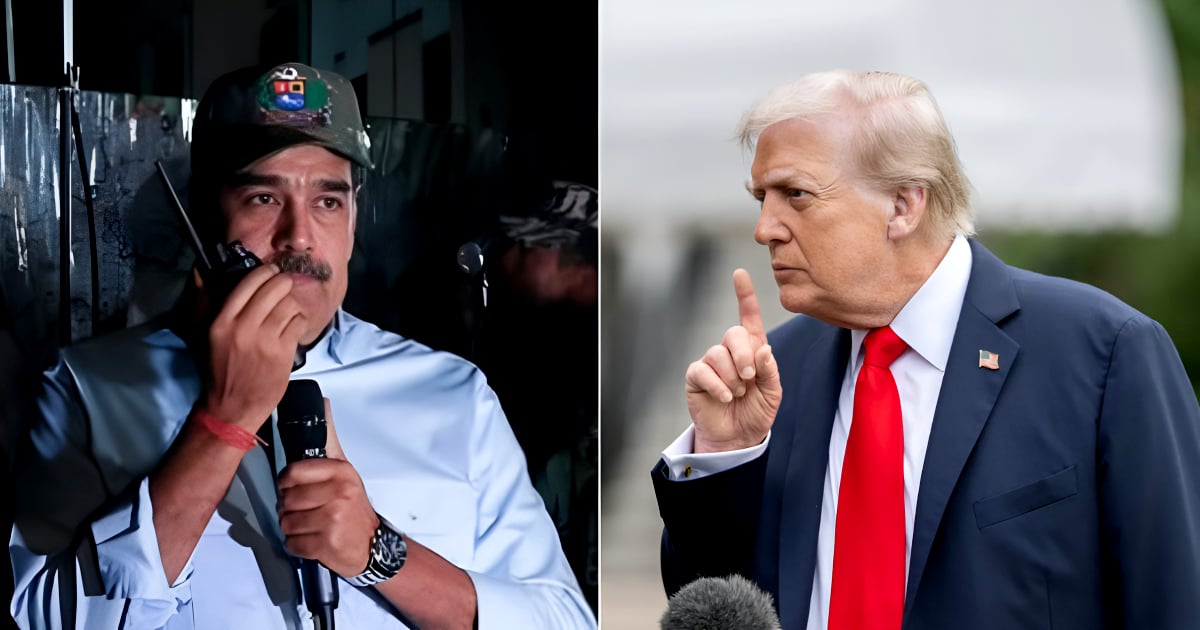
In the midst of escalating military tensions between the United States and Venezuela, Venezuelan leader Nicolás Maduro dispatched a letter to President Donald Trump, asserting that Colombia is the "true engine of drug trafficking in the region." The letter, in which Maduro denounced a "campaign of fake news"—a term he used no less than five times—placed the Colombian government of Gustavo Petro, an ally of the Chavista regime, in a challenging position.
The document, released by official media in Caracas, comes just days after Washington bolstered its presence in the Caribbean with destroyers, nuclear submarines, and F-35 fighter jets, claiming it was to combat drug trafficking and the "Cartel of the Suns," which the White House alleges is led by Maduro.
Throughout the letter, the Chavista leader repeatedly referred to the term fake news, popularized by Trump himself, to dismiss accusations of ties with criminal organizations: "In recent weeks, absolutely false accusations of links with mafias and drug-trafficking gangs have gained prominence against Venezuela's legitimate authorities. It is the worst of the fake news launched against our country," Maduro stated.
Maduro's Stance on Drug Trafficking
The Venezuelan leader claimed that his administration is actively fighting drug trafficking, offering statistics to support his claims. He stated that Venezuela has "neutralized 402 aircraft" associated with drug transportation this year and seized more than 70% of shipments trying to cross the 2,200 kilometers border with Colombia.
According to the data he cited, "87% of the drugs produced in Colombia exit through the Pacific; 8% through La Guajira; and only 5% attempt to be transported through Venezuela." Therefore, he concluded that the neighboring country, governed by Petro, is the true culprit in fueling international cartels.
Implications for Regional Alliances
Maduro also accused Washington of using "fake news" to justify a military escalation that, if realized, "would cause catastrophic damage to the entire continent." "President, I hope we can together defeat these fake news stories that cloud a relationship that should be historic and peaceful, as envisioned by our Liberator Simón Bolívar," he wrote in the letter addressed to Trump.
The White House has not officially commented on the letter. However, Defense Secretary Pete Hegseth reiterated this week that Maduro "has decisions to make" and that the United States is prepared to "destroy the narco-terrorists" sending drugs into its territory.
Backlash Against Petro, Maduro's Key Ally
Maduro's letter to Trump aimed not only to dismantle what he repeatedly termed as fake news regarding his alleged drug trafficking ties but also introduced an unexpected element: it directly pointed to Colombia and Gustavo Petro's administration as the main culprits of drug trafficking in the region.
This move has surprised analysts and diplomats, as Petro has been one of the few Latin American leaders to offer explicit support to the Chavista leader. Just days earlier, the Colombian president called the U.S. military action in the Caribbean, which resulted in 11 deaths after the sinking of a boat from Venezuela, allegedly operated by the Tren de Aragua, an "assassination."
"Those transporting drugs are not big narcos, but very poor young people," Petro wrote on X, defending Caracas' narrative against Washington. Additionally, at the end of August, Petro once again defended Maduro by denying the existence of the so-called Cartel of the Suns, which the United States has designated as a terrorist organization.
According to the Colombian leader, that cartel is "a fictional excuse by the far right to overthrow governments that do not comply." This stance has drawn harsh criticism in the U.S. Congress, where lawmakers like Carlos Giménez warned that Petro's statements were equivalent to "collaborating with a narco-terrorism cartel."
In this context, Maduro's accusations in his letter to Trump against Colombia—supported by statistics on drug trafficking routes that, according to him, prove that 87% of cocaine exits through the Colombian Pacific—come across as a low blow to his main regional ally. For some analysts, the gesture reveals the growing isolation of the Chavista regime and Maduro's willingness to sacrifice even the relationship with a key partner like Petro to bolster his narrative amid the U.S. military and diplomatic offensive.
Understanding the Tensions Between Venezuela and the United States
Why did Maduro write a letter to Trump?
Maduro wrote to Trump to assert that Colombia, not Venezuela, is the true hub of drug trafficking and to denounce what he calls a "campaign of fake news" against his government.
How has the U.S. responded to Maduro's claims?
The White House has not officially responded to Maduro's letter, but Defense Secretary Pete Hegseth stated that the U.S. is ready to combat narco-terrorists linked to drug trafficking.
What impact does Maduro's letter have on Colombia?
Maduro's accusations against Colombia strain relations with Gustavo Petro's government, despite Petro's previous support for Maduro, highlighting regional tensions and alliances.