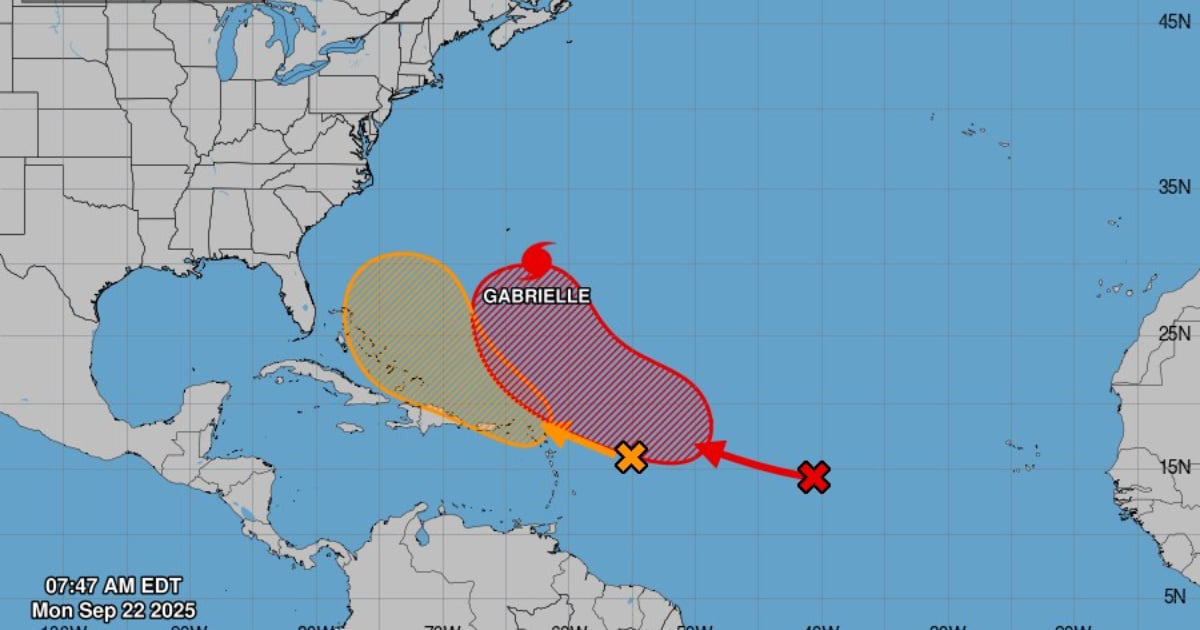
The National Hurricane Center (NHC) announced on Monday that Gabrielle has intensified into a hurricane in the central subtropical Atlantic. Currently, the system is situated several hundred kilometers southeast of Bermuda, moving west-northwest at approximately 20 kilometers per hour.
The report from the NHC highlighted that Gabrielle is sustaining maximum winds of 120 kilometers per hour, with even stronger gusts. Although it poses no immediate threat to land, caution is advised for vessels navigating the area due to the strong winds and associated rough seas.
In the same update, the NHC is monitoring two tropical waves that have the potential to develop in the coming days. The first wave, located between the Cape Verde Islands and the Lesser Antilles, is showing signs of better organization in its rain and thunderstorms. Environmental conditions are favorable for the formation of a tropical depression by mid to late this week. The agency estimates a 20 percent chance of development within 48 hours and a 70 percent chance over the next week.
Regarding the second tropical wave, positioned east of the Windward Islands, the NHC noted that showers and thunderstorms remain disorganized. Despite only marginal conditions for strengthening, there could be an increase in activity as it progresses northwest. The probability of formation here is 10 percent in the next two days and 40 percent within a week.
Cuban meteorologist Jorge Félix Hernández emphasized that while Hurricane Gabrielle currently poses no threat to land, it should still be monitored closely by maritime interests in the region. He also pointed out that the current atmospheric conditions are typical of the most active phase of the hurricane season, suggesting that more storm systems could develop in the coming weeks.
Gabrielle initially formed as a tropical storm in the central Atlantic, posing no risk to Cuba but potentially threatening areas near Bermuda. Concurrently, the NHC had begun tracking a new tropical wave emerging off the African coast, which initially had a low chance of development but has rapidly evolved in recent days.
The Atlantic hurricane season for 2025 officially lasts until November 30 and is currently in its peak phase. Authorities urge the public to stay informed through official sources and closely monitor the progress of these systems in the days ahead.
Key Information on Current Tropical Activity
What is the current status of Hurricane Gabrielle?
Hurricane Gabrielle has formed in the central subtropical Atlantic with maximum winds of 120 km/h. It is not a threat to land but poses risks to maritime activities due to strong winds and high waves.
Are there any other tropical systems to be concerned about?
Yes, there are two tropical waves being monitored. One has a high chance of developing into a tropical depression, while the other has a lower probability of strengthening in the next few days.
How is the current phase of the hurricane season affecting weather systems?
The current phase is the most active period of the hurricane season, making it likely for new storm systems to develop. Atmospheric conditions are conducive to storm formation and intensification.