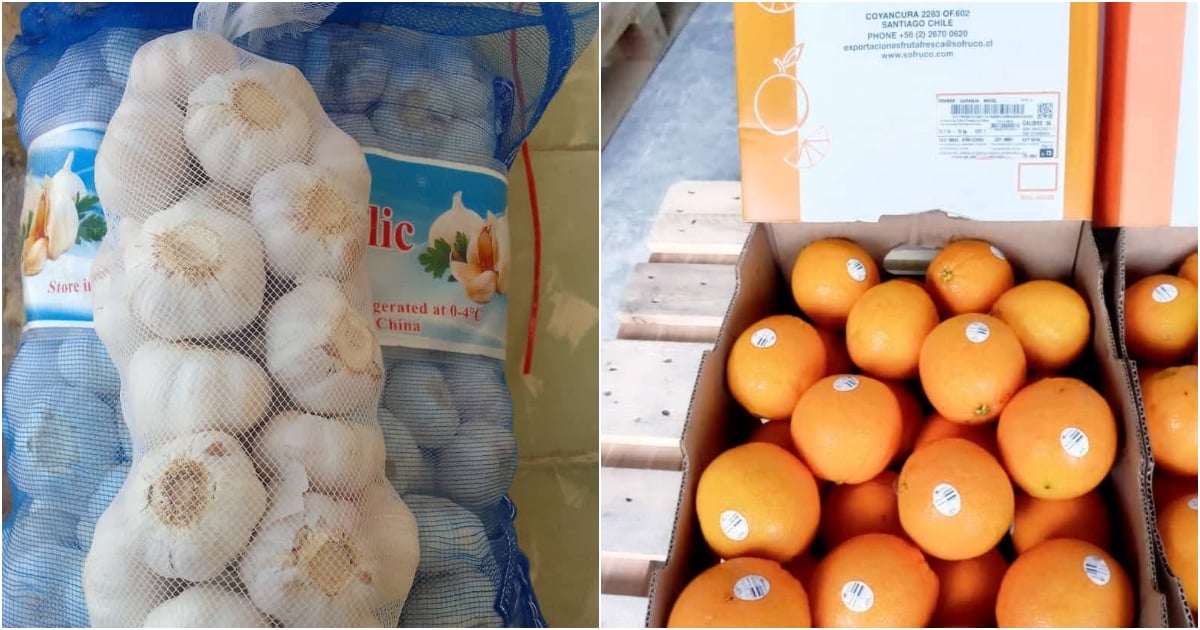
Chilean oranges, Chinese garlic and onions, and even potatoes from the United States are now commonplace in Cuban markets. Meanwhile, domestic agricultural production remains stagnant, with local farmers lacking control over their land and cooperatives unable to decide independently what to sell. Social media users have highlighted that the issue is not just economic but deeply rooted in structural problems: the land remains under state control, the state-run Acopio dictates prices and distribution routes, and private innovation is either restricted or criminalized.
Through her Facebook account, engineer Yulieta Hernández shared her observations from visiting commercial outlets in Havana, noting the presence of imported potatoes, garlic, and onions sold at high prices, often out of reach for most citizens impoverished by the government's unsuccessful centralized policies. However, beyond the cost, she emphasized the country's reliance on foreign products and criticized the lack of policies promoting national production.
Hernández pointed out that agricultural cooperatives remain constrained, farmland does not belong to the farmers, and the state entity Acopio continues to monopolize purchase and sale activities, preventing autonomous decisions regarding production and pricing. She listed an array of structural issues paralyzing Cuban agriculture: outdated machinery lacking spare parts, limited fuel, insufficient fertilizers and seeds, nearly nonexistent irrigation systems, a lack of financing and fiscal incentives, along with the penalization of private innovation and the criminalization of production associations outside the state framework.
All these challenges prevent farmers from planting and selling autonomously, creating a dependency cycle that forces the country to import food it could otherwise produce, argued Hernández, who also directs the private micro-enterprise Pilares Construcciones. Among her suggestions, Hernández emphasized the need to transfer land ownership to farmers, dismantle the Acopio monopoly, allow direct sales between producers and consumers, and legalize private agricultural businesses and independent cooperatives.
Reviving Cuba's Agricultural Legacy
In another social media post, citizen Manuel Viera highlighted another aspect of the crisis: the disappearance of the citrus industry, which once supplied the country and exported to Europe and Asia. He criticized the state's inability to sustain it, attributing the problem to decades of centralized control. For instance, he noted the sale of imported Chilean oranges at a Havana micro-enterprise for 390 pesos each, a luxury for most Cubans, reflecting how historic productive capacities have been obliterated "in a country that once exported oranges worldwide."
Viera stressed the impact on new generations, pointing out that many Cuban children are encountering foods for the first time that were once commonplace and accessible. The accounts of Hernández and Viera illustrate that the agricultural crisis is not only economic but also structural and political: the land is not farmer-owned, bureaucracy hinders progress, youth are leaving rural areas, and productive forces remain stifled.
Imports fill the gap of what the country could produce domestically, but at high costs and without resolving the long-standing dependency. The current situation reflects decades of centralized policies that stifle autonomy, limit innovation, and keep producers subordinate. Only through deep reforms — such as granting land ownership, dismantling monopolies, legalizing free cooperatives, and ensuring access to technology, financing, and youth participation — can Cuba hope to produce enough food for its population and regain food sovereignty, agree Hernández and Viera.
The Cuban government blames the agricultural sector's collapse on a lack of supplies, fuel shortages, and climatic conditions. However, these factors do not seem to affect neighboring Dominican Republic, from which approximately 16.5 million seedlings are imported monthly. Cuba also imports eggs from countries like Colombia and the United States, with the latter being sold in state-owned foreign currency stores and by micro, small, and medium-sized enterprises (mipymes).
Even online stores in the island sell eggs from the United States, despite the regime's claims that the U.S. embargo prevents them from purchasing basic food products. Although the Cuban government boasts of passing a Food Sovereignty Law, the 2023 Cuban Statistical Yearbook confirmed an unprecedented decline in the production of essential foods such as pork, rice, eggs, milk, and tubers, underscoring the severity of the food crisis on the island.
Addressing Cuba's Agricultural Challenges
Why does Cuba import agricultural products despite its farming potential?
Cuba imports agricultural products due to structural issues such as state control over land, lack of farmer autonomy, and a centralized system that limits innovation and private enterprise, leading to a dependency on foreign goods.
What structural problems are hindering Cuba's agricultural sector?
Cuba's agriculture is hindered by factors such as obsolete machinery, fuel shortages, insufficient fertilizers and seeds, lack of irrigation systems, and restrictive policies against private innovation and independent cooperatives.
What reforms are suggested to improve Cuba's agricultural production?
Suggested reforms include granting land ownership to farmers, dismantling the state monopoly, legalizing free cooperatives, ensuring access to technology, providing financing, and encouraging youth participation in agriculture.