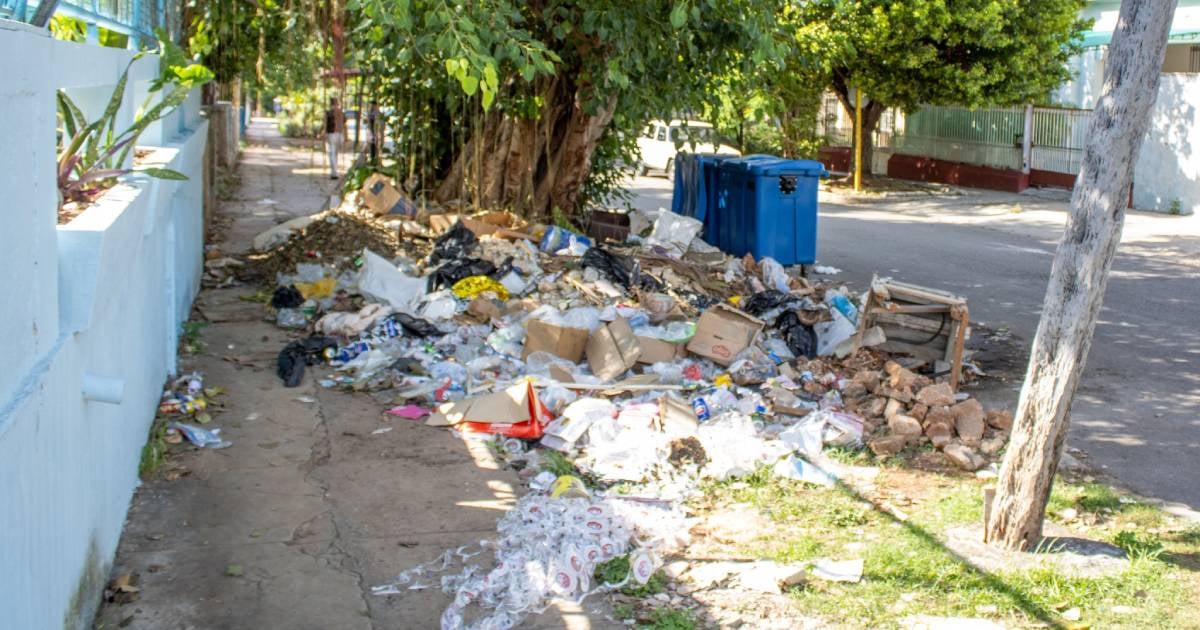
Armando Rodríguez Batista, the Minister of Science, Technology, and Environment (CITMA) in Cuba, has openly acknowledged the severe sanitary collapse in Havana. In a candid Facebook post this past Sunday, he stated, "This garbage isn't contained; it's scattered all over Havana." This declaration marks one of the most forthright admissions by a high-ranking official of the regime regarding an issue that Havana's residents face daily: the accumulation of waste on streets, sidewalks, and vacant lots, exacerbated by recent rains that have turned it into a multifaceted risk—sanitary, environmental, social, and spiritual.
Rodríguez Batista's post highlighted how recent rains have exposed "heaps of garbage that, as silent witnesses of our inertia, have piled up on corners, vacant lots, and perimeters." The minister described the floating debris, sticking to sidewalks and mixing "with mud and life," forcing a confrontation with a problem that affects everyone and cannot be concealed.
He acknowledged that merely deploying trucks, crews, and containers is insufficient; a structural change is required, involving communities, institutions, and the general public. Rodríguez Batista proposed transforming Havana into a "living laboratory for the transition to circularity," where waste is recycled and utilized rather than becoming centers of infection and urban decay.
A Threat to Public Health
The official acknowledgment comes amidst widespread public outcry, with citizens sharing images reminiscent of a horror film. In Centro Habana, a dilapidated building at the corner of Belascoaín and San Miguel has become an improvised dump, amassing trash and debris that threatens to engulf passersby.
The dire situation extends even to hospitals. Early in September, a video circulated on social media showing a massive trash heap next to the Hermanos Ameijeiras hospital, one of Cuba's most renowned medical centers, which activists described as an "open-air pathogen incubator." Other hospitals in Mayabeque and Holguín have also suffered, with overflowing containers left for weeks near maternity and pediatric wards, endangering mothers, newborns, and hospitalized children.
Garbage and Floods: A Dangerous Combination
The waste collection collapse worsens with each episode of heavy rain. Last week, torrential downpours transformed streets in Centro Habana, Diez de Octubre, and Vedado into rivers of garbage swept along by the currents, while a widespread blackout plunged the city into darkness. Residents shared images of containers adrift and contaminated waters entering doorways and homes, illustrating that the garbage issue is not merely about urban aesthetics but a direct threat to the health and safety of thousands of Habaneros.
In a country where authorities often downplay or camouflage structural problems, Armando Rodríguez Batista's words represent an unusual acknowledgment of the crisis's magnitude. "The garbage hits us, forces us as a country to confront a problem affecting many," the minister wrote, urging institutions, universities, businesses, and communities to unite in reversing the collapse.
Meanwhile, Havana remains trapped amidst crumbling buildings turned landfills, hospitals besieged by waste, neighborhoods swamped with trash, and a populace surviving amidst ever-growing heaps of refuse.
Understanding Havana's Waste Management Crisis
Why is waste management a critical issue in Havana?
Waste management has become a pressing concern in Havana due to the accumulation of garbage across the city, exacerbated by inadequate infrastructure and heavy rains. This poses significant health, environmental, and social risks.
What solutions has the Cuban government proposed to address the waste crisis?
The government, through Minister Armando Rodríguez Batista, has suggested turning Havana into a "living laboratory for the transition to circularity," emphasizing the need for recycling and community involvement in waste management.