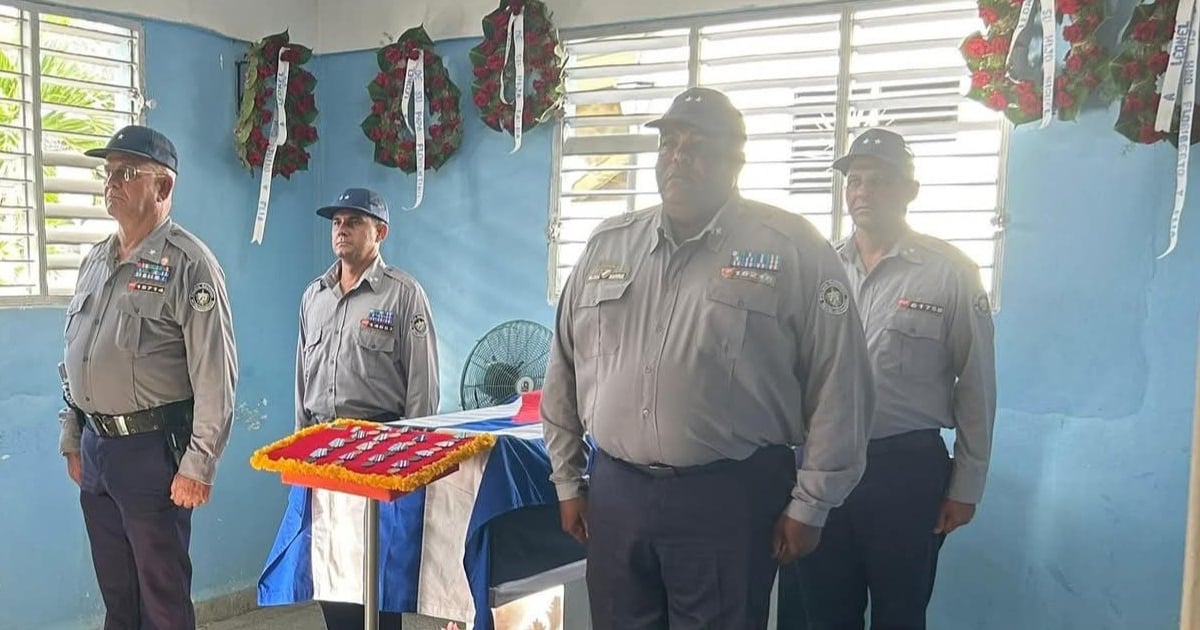
The late Captain Leonel Mesa Rodríguez of the Revolutionary National Police (PNR) received a military funeral on Saturday after being discovered murdered along a highway between Remedios and Caibarién in Villa Clara. Attendees included family members, neighbors, and his colleagues, while high-ranking officials from the Ministry of the Interior (MININT) orchestrated a ceremony laden with official symbols.
Images shared on social media depict the coffin draped in the Cuban flag, surrounded by uniformed officers standing in honor. Floral wreaths adorned the walls, and alongside the coffin lay his 12 medals. In a political gesture, General Raúl Castro and leader Miguel Díaz-Canel sent wreaths to underscore the regime's emphasis on this case.
A Confirmed Violent Crime
MININT confirmed that Mesa, aged 62, and the sector head in Caibarién, sustained six stab wounds and a gunshot to the head. His official motorcycle was found near the body. The government has labeled the incident a targeted attack and assured that specialized teams are investigating "to fully resolve the case."
Prior to the official statement, neighbors and independent media had leaked similar accounts. Witnesses informed CubaNet and La Tijera that the officer, nicknamed "Cal Viva," was found on the road with a bullet in his forehead and multiple stab wounds. The area remained cordoned off for hours, with a significant presence of police and state security, diverting traffic away from the scene.
Funeral and Propaganda
Social media posts from officials and acquaintances were abundant with epic tales of the officer's life. His rural origins in Taguasco, Sancti Spíritus, his time with the Railroad Police, and his role as sector head in Caibarién were highlighted. Speeches emphasized his communist allegiance and purported "ideological steadfastness" until the end.
The official rhetoric framed the murder as an attack on the nation itself, rather than just an individual, aiming to transform the assassination into a political symbol.
Mixed Reactions from the Community
The officer's death has sparked polarized responses. State media portray him as a dedicated and respected policeman, yet on social media, several locals recalled instances of abuse during his tenure. In particular, some described his management in La Reforma as despotic, accusing him of imprisoning individuals for their political beliefs against the regime.
Rising Violence Amid Economic Crisis
This murder takes place against a backdrop of escalating violence and crime, exacerbated by Cuba's economic and social crises. Incidents of theft, assault, and homicide are on the rise, while authorities attempt to project control through state funerals, propaganda-heavy speeches, and police displays.
The investigation into Captain Mesa's killing is ongoing, but MININT has made it clear they intend to use the incident to reinforce the narrative of "resistance" against crime. Meanwhile, the murder underscores the contradictions within a system where the police are seen as protectors of order, yet public safety continuously deteriorates.
Questions about Captain Mesa's Murder and Its Implications
What were the circumstances surrounding Captain Mesa's death?
Captain Mesa was found murdered on a highway with stab wounds and a gunshot to the head. His official motorcycle was also found nearby.
How has the Cuban government responded to this incident?
The government has labeled it as a targeted attack and is conducting thorough investigations. They also used the funeral to emphasize the political significance of the case.
What are the community's reactions to Mesa's murder?
Reactions are mixed; while official narratives highlight his dedication, some locals recall instances of abuse and repression under his command.