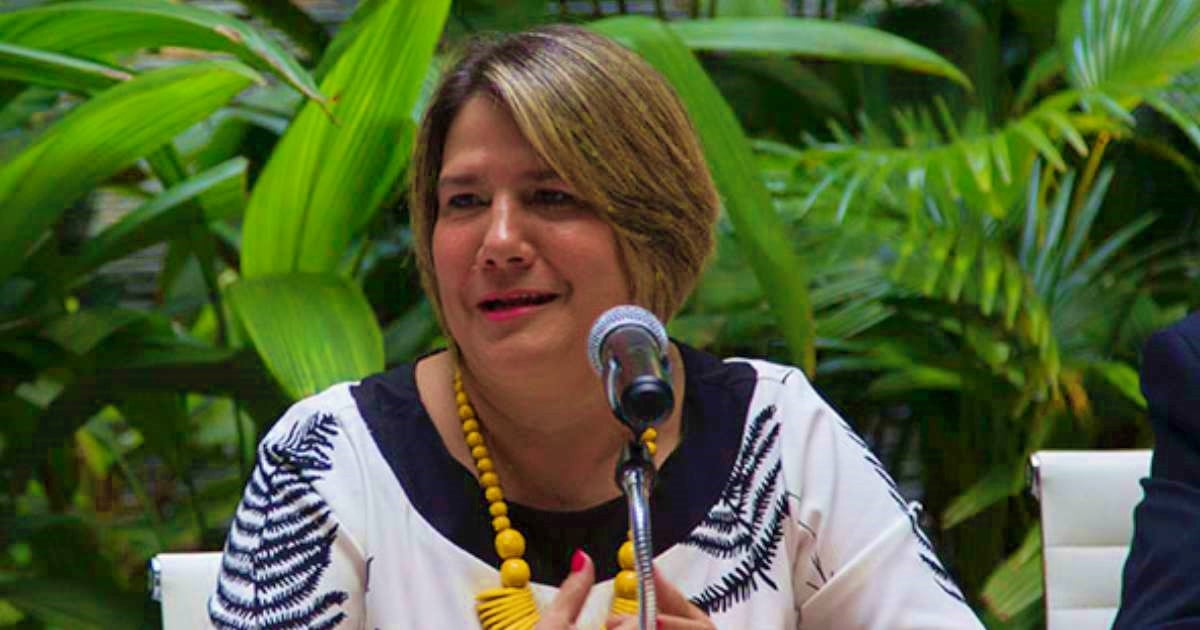
Lis Cuesta Peraza, the wife of Cuban leader Miguel Díaz-Canel, has now taken on the role of a "passionate professor" at the Instituto Superior de Arte (ISA). From her social media account, she proudly announced the start of a Cultural Management course, peppering her post with sugary phrases and smiling photos, as if her presence in a university classroom were an act of selflessness rather than a product of the privileges she enjoys as part of the ruling elite.
"Our course has begun. The ISA embraces Cultural Management. Great group, wonderful atmosphere. Nothing compares to teaching and learning with our students! I'm a professor in love," she wrote with enthusiasm. However, as she poses as a charismatic educator, millions of Cubans are struggling through power outages lasting over 20 hours, hospitals without supplies, children without milk, and families cooking with firewood.
The stark disconnect between her life and the harsh realities faced by ordinary Cubans is glaring, turning her posts into a source of irritation. Social media reactions were swift and cutting. "It must be maddening to have to take classes from this fool," one user bluntly commented. Another sarcastically noted, "Those students are lucky; they learn cultural management directly from someone who manages privileges in a country in ruins."
For many, the notion of Díaz-Canel's wife teaching "management" is seen as an act of audacity, given that her main achievement seems to be managing her own luxurious lifestyle in a nation mired in poverty. Others pointed out the hypocrisy between her words and her lifestyle: "You could teach them how to progress so they can have a thousand-dollar phone like yours." "In love with shopping with the people's money... while children go hungry," another user remarked.
Some comments tackled the lack of freedoms in Cuba directly: "You can't give what you don't have. The Cuban people can be taught anything, but without freedom, they'll always live in darkness."
The Illusion of Cultural Management
Lis Cuesta's portrayal as a university professor is not new. In August, she announced that musician Israel Rojas, leader of the pro-government group Buena Fe, would be a guest in her class for a discussion on cultural industries. This move came right after Rojas attempted a "discursive shift" by speaking about national reconciliation, without ever mentioning the July 11 protests or acknowledging political prisoners.
The strategy is transparent: revitalize worn-out official figures by giving them a platform in academic spaces. And who better than Lis Cuesta, a symbol of privilege and disconnect, to spearhead this operation?
Lis Cuesta's Journey: From Local Functionary to Symbol of Luxury
Lis's career is well-documented. From a cultural official in Holguín, she moved on to organizing events, directing local institutions, and eventually joining the state-run Paradiso Agency, where she served as the head of Academic Services. During her time there, she developed her doctoral thesis, proposing models for exporting academic services.
With Díaz-Canel's rise to power in 2018, her public appearances increased: accompanying him on tours, hosting events, and being a frequent presence at official acts, though never formally recognized as the first lady.
Far from embodying austerity, Cuesta has become an emblem of the Cuban elite's extravagance. On international trips, she's been seen with the latest smartphones, luxury watches, and accessories that starkly contrast with the country's poverty. "While she travels in air-conditioned planes, the people cook with firewood and sleep without power," a citizen lamented on social media.
The Duality of Privilege and Propaganda
Despite not holding a high-level position, Cuesta takes to social media with the authority to speak on behalf of universities and institutions, announcing connections with foreign entities as if she were an official representative. Her digital vanity, filled with phrases like "dictator of my heart" aimed at her husband, reinforces the perception that she acts more like a consort of a Caribbean monarchy than a serious academic.
The contradiction is undeniable: while independent artists are censored, jailed, or forced into exile, Lis Cuesta attempts to establish the ISA as a "space for debate." In practice, this "space" is reduced to a propaganda circle where only figures aligned with power participate.
Lis Cuesta's case starkly highlights the essence of the regime: a small group of privileged individuals preaching resistance and sacrifice while enjoying luxuries unimaginable to most. Without an official title, she is the visible face of that elite, traveling in climate-controlled flights and flaunting expensive watches, while inflation ravages wages and hospitals crumble.
By stepping into the role of professor at the ISA, Lis Cuesta merely extends the charade: disguising cultural management as a facade for the management of privileges and indoctrination.
Lis Cuesta's Role and Impact on Cuban Society
What role does Lis Cuesta play in the Cuban government?
Lis Cuesta does not hold an official government position but is influential due to her marriage to Miguel Díaz-Canel, the Cuban leader. She is active in cultural management and often represents Cuban institutions informally.
How do Lis Cuesta's actions contrast with the Cuban population's situation?
Lis Cuesta's lifestyle, marked by luxury and privilege, starkly contrasts with the struggles faced by the Cuban population, who endure poverty, power outages, and lack of basic necessities.
Why is Lis Cuesta's role as a professor controversial?
Her role is seen as controversial because it is perceived as an extension of privilege and propaganda rather than genuine academic contribution, given her association with the ruling elite and the disconnect from the general public's hardships.