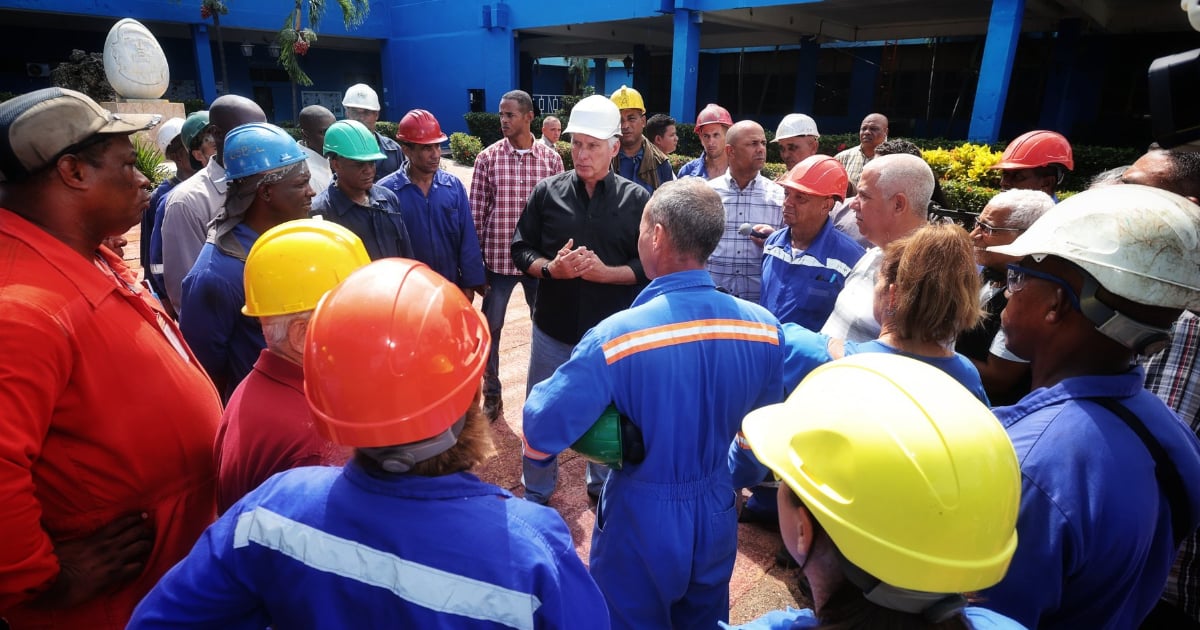
Amid escalating blackouts and growing skepticism about the government's ability to stabilize power generation, President Miguel Díaz-Canel embarked on a tour of thermal power plants located in Mariel (Artemisa) and Santa Cruz del Norte (Mayabeque). His goal was to revitalize the National Electric System.
The visit began at the Máximo Gómez plant in Mariel, where Unit 5 is expected to synchronize soon, contributing 65 megawatts. Meanwhile, Units 6 and 8 are currently generating 94 and 60 megawatts, respectively, according to the Cuban Presidency's social media updates. Plant director Roberto Pigueiras briefed Díaz-Canel on maintenance operations and the use of locally-produced spare parts.
During the visit, Díaz-Canel stressed the importance of mobilizing all available resources to restore the national grid. He also emphasized the necessity of supporting workers by providing food, hygiene products, specialized medical services, and a salary that, although deemed insufficient, exceeds 22,000 pesos.
Later, Díaz-Canel visited the Ernesto Guevara power plant in Santa Cruz del Norte. He was informed about major maintenance work on Unit 2, with its turbine and boiler undergoing repairs. The unit is expected to synchronize by October 30, boosting its output to 85 megawatts. The other two units are generating 55 and 48 megawatts, respectively, and are scheduled for maintenance soon, as per another report from the Presidency.
Officials have implemented measures to curb workforce attrition, including salary increases, food supplies, transportation, and hygiene products. Díaz-Canel praised the workers' commitment and expressed optimism that “through collective effort, the current situation will be resolved.” Joining him on the tour were Energy and Mines Minister Vicente de la O Levy and the Director General of the Electric Union, Alfredo López.
Government Strategy Faces Skepticism
Despite these efforts, the official strategy—focusing on partial repairs, major maintenance, and promoting solar farms—fails to guarantee stability for a system long plagued by outdated technology and lacking substantial investment.
On the streets, frustration grows as blackouts stretch beyond 20 hours a day in several areas. The Electric Union (UNE) reported a capacity deficit of 1,826 megawatts during peak evening hours on Friday, with no signs of relief. Projected demand for the evening was around 3,450 MW, while available generation capacity was only 1,760 MW.
Broader Implications of the Energy Crisis
In a meeting led by Díaz-Canel and Prime Minister Manuel Marrero, provincial and special municipality leaders discussed the severe energy and water supply crisis affecting the Cuban population. Held via video conference from the Palace of the Revolution, the meeting reiterated a commitment to "move forward" despite challenging circumstances and emphasized that the government is "planning for the future."
Díaz-Canel called for improvements in "electricity scheduling" to distribute blackouts more evenly across the country, acknowledging disparities between provinces, municipalities, and major cities.
The government also decided to release district delegates from their regular duties to focus entirely on assisting the public amidst the energy and water supply crisis, which has sparked protests in various regions. This community engagement initiative comes amid rising social unrest and large-scale demonstrations.
Energy and Mines Minister acknowledged the critical state of the National Electric System (SEN), worsened by the shutdown of several plants, including Felton and a unit in Mariel. He announced that "Felton should be operational by Saturday," but admitted that significant challenges remain during peak night hours.
Understanding Cuba's Power Crisis
Why is Cuba experiencing prolonged blackouts?
Cuba faces prolonged blackouts due to outdated technology, lack of significant investment in infrastructure, and recent shutdowns of key power plants. The situation is further exacerbated by maintenance issues and a shortage of necessary resources.
What measures is the Cuban government taking to address the power crisis?
The government is focusing on repairs, maintenance, and promoting solar farms. Additionally, they are implementing measures to support workers and improve electricity scheduling to distribute blackouts more evenly.
How are Cuban citizens reacting to the energy crisis?
Cuban citizens are becoming increasingly frustrated with the power outages, which sometimes last over 20 hours a day. This has led to heightened social unrest and protests in various regions.