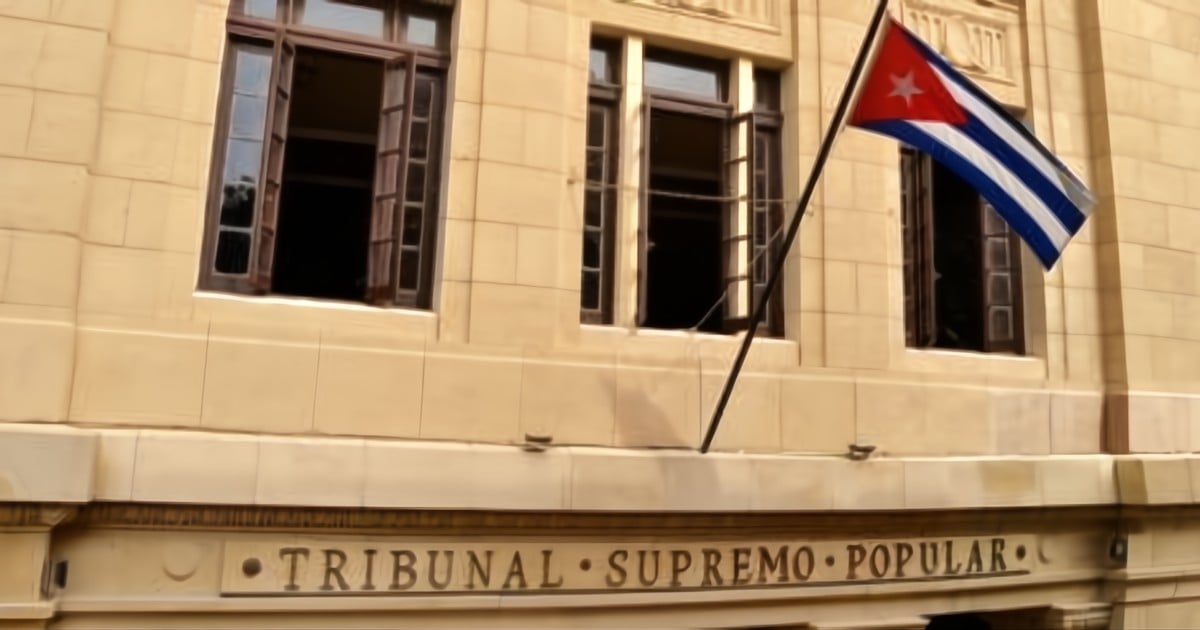
The Cuban Supreme People's Court has acknowledged a profound legal misstep where a woman was sentenced to prison for a crime she was never formally charged with. This case highlights significant breaches of due process and constitutional rights on the island.
An official statement, titled “Violation of the Charge-Sentence Correlation Principle,” revealed that the woman was sentenced to three years in prison for concealment, despite the prosecutor only seeking a one-year sentence for "failure to report a crime."
The Supreme Court noted that the prosecutor assigned two legal classifications to the same act without detailing any misappropriation actions that would support a charge of embezzlement. The prosecutor requested a sentence solely for the failure to report. Nonetheless, the court that heard the case exceeded these recommendations, convicting her of a different and more severe crime than she had faced accusations for.
In December 2024, the Second Criminal Chamber of the Provincial Court of Havana issued the contested sentence, violating articles 1 and 565.1 a) of the Criminal Procedure Law. According to the Supreme Court, this decision undermined basic principles of equality, defense, and contradiction, effectively leaving the accused without a legitimate chance to respond to charges that were never made against her.
The official note emphasizes that the woman, who was the head of inspection at a Basic Gastronomy Unit, discovered the absence of hundreds of packs of cigarettes during an internal audit. However, she did not file the necessary report nor alert authorities. This omission formed the basis of the accusation, although no evidence of property appropriation or her being a "suitable subject" for serious economic crimes was ever proven.
The Supreme Court annulled the sentence after recognizing the extent of the procedural violation, stating that the ruling "hindered the effective realization of the principles of equality of parties and contradiction," blatantly violating Article 94 of the Constitution of the Republic of Cuba.
This case not only reveals a judicial error but also underscores the fragility of legal guarantees within a system where an individual can find themselves imprisoned for a crime never charged against them. For the accused, the Supreme Court's admission comes too late, as she has already borne the burden of a process that paradoxically left her condemned without a chance for defense.
Cuban Judicial System Issues
What were the charges initially brought against the woman?
The prosecutor initially sought a one-year sentence for the woman's failure to report a crime, but she was later unjustly sentenced for concealment.
How did the Supreme Court respond to the procedural violation?
The Cuban Supreme Court annulled the sentence after realizing the significant procedural violations, recognizing that the ruling violated principles of equality and contradiction.
What constitutional article was violated in this case?
Article 94 of the Constitution of the Republic of Cuba was violated, as the ruling hindered the principles of equality and contradiction.