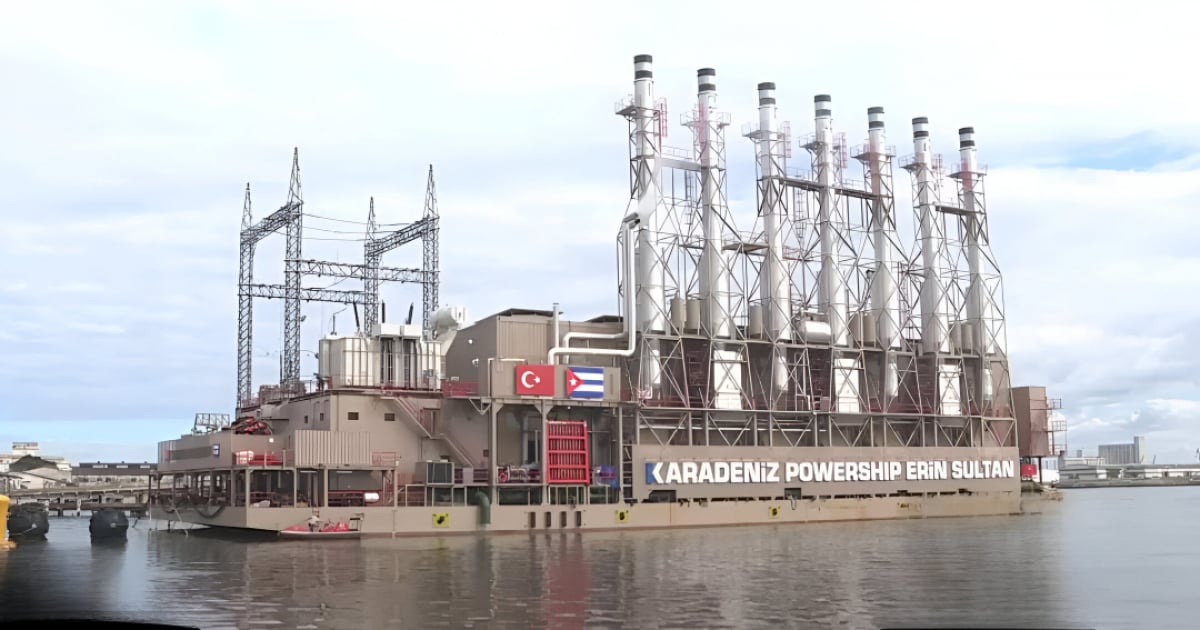
Vicente de la O Levy, Cuba's Minister of Energy and Mines, has publicly acknowledged that the worsening energy crisis in the nation is largely due to the withdrawal of power barges caused by non-payment. During a press conference on Wednesday with state media like Granma, he revealed that only two of the original eight floating power units are still operational, contributing just 70 megawatts to the National Electric System (SEN).
"Every Cuban knows, because they are smart, that the reason the barges left is because we couldn't pay," stated De la O Levy. The withdrawal of these units in August exacerbated the electricity deficit during a peak demand period. Official statements had attributed the removal to "commercial reasons."
"We might have inefficiencies, but over 95% of the real issue is a lack of funding. It's clear that workers in the electric system are tireless, and there is a genuine shortage of resources. Without $100 million, we cannot perform the necessary maintenance on the Guiteras Thermoelectric Plant," the minister explained.
Outages, Deficits, and Critical Power Generation
De la O Levy described the current operation of the electric system as facing a generation deficit exceeding 2,000 MW, leading to widespread and prolonged blackouts. An unexpected outage in La Habana this week followed the sudden failure of unit 5 at Nuevitas, prompting entire circuits to be disconnected in the capital to prevent a total system collapse.
Additionally, it was announced that unit 1 of the Lidio Ramón Pérez thermoelectric plant in Felton, Holguín, will rejoin the SEN this weekend with a capacity over 220 MW, following the completion of early repairs. Recovery efforts are also underway at Mariel, which suffered a seawater pipe rupture, and adjustments have been completed on unit 5 at Renté.
Transition to Solar Energy and Battery Storage
Amid the collapse of an outdated and poorly maintained thermoelectric system, the Cuban government is focusing on expanding solar power generation. De la O Levy reported that 656 MW out of the targeted 1,000 MW for the year are already installed, with new solar parks being synchronized weekly.
The initiative also includes acquiring energy storage batteries to regulate frequency, which are ready for shipment and installation. The minister emphasized that these technologies are crucial to prevent system failures and enhance stability.
Despite these optimistic plans, financial constraints remain a significant hurdle. The minister admitted, "This doesn't mean fuel supplies are stable," and noted severe tensions due to the lack of resources for lubricants, spare parts, and maintenance.
FAQs on Cuba's Power Crisis and Renewable Energy Efforts
What caused the withdrawal of power barges in Cuba?
The main reason for the withdrawal of power barges from Cuba was the government's inability to make payments, as admitted by the Minister of Energy and Mines, Vicente de la O Levy.
How is Cuba addressing its energy crisis?
Cuba is intensifying its focus on solar power generation and energy storage technologies to stabilize the electric system. They plan to install 1,000 MW of solar power, with 656 MW already operational, and are acquiring batteries for frequency regulation.
What are the current challenges facing Cuba's electric system?
Cuba's electric system is currently challenged by a generation deficit of over 2,000 MW, causing widespread blackouts. Financial constraints also hinder necessary maintenance and the procurement of essential resources like lubricants and spare parts.