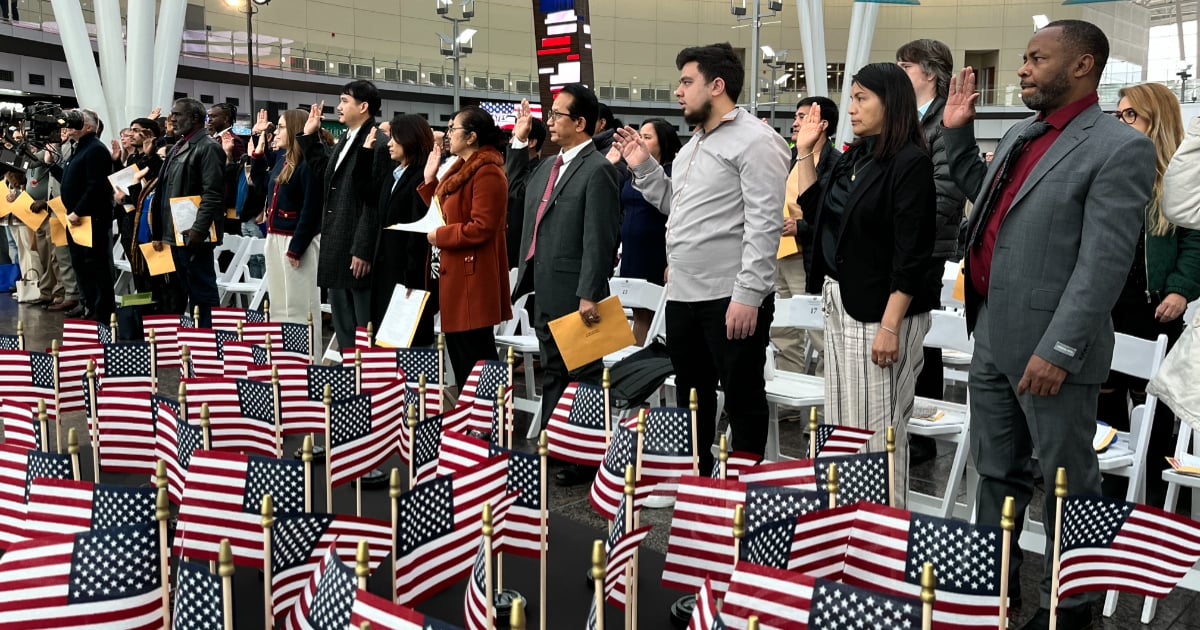
President Donald Trump's administration has announced the reimplementation of the 2020 U.S. citizenship test, a more challenging version of the civic exam assessing immigrants' understanding of American history and government. The U.S. Citizenship and Immigration Services (USCIS) reported on Wednesday, as cited by The Daily Signal, that the changes aim to "better evaluate applicants' knowledge of U.S. history and government."
The 2025 examination will once again feature 128 potential questions, compared to the 100 questions included in the version used during President Joe Biden's administration. Applicants must correctly answer at least 12 out of 20 randomly selected questions. However, if an applicant correctly answers 12 questions or incorrectly answers nine, the official may conclude the test, maintaining the same passing threshold as previous editions.
"The citizenship exam is a crucial tool to ensure that those who naturalize fully embrace our values and principles as a nation," stated USCIS spokesperson Matthew Tragesser. He mentioned that these changes are just the beginning of a more stringent immigration policy process.
Among the questions included in the study guide are: "What does the Constitution do?", "Name a war fought by the U.S. in the 19th century," and "Why did the U.S. enter World War I?" The exam is conducted orally, and applicants have two chances to pass before their application is denied.
Additionally, since Trump's return to power in January, the agency has begun implementing other changes, such as a stricter verification process, thorough reviews of disability waiver requests, and moral character evaluations based not only on the absence of criminal actions but also on the applicant's social contributions. USCIS also announced the resumption of neighborhood investigations to ensure citizenship applicants meet legal requirements and are "worthy of becoming American citizens."
The fiscal year 2024 concluded with a citizenship exam approval rate exceeding 94%, though a more selective process is anticipated, prioritizing cultural assimilation, proficiency in the English language, and respect for the nation's laws.
This Wednesday's announcement regarding the reinstatement of a more demanding citizenship exam coincides with a message from the White House on social media platform X, where President Donald Trump addressed new American citizens. "This treasured legacy now belongs to you to protect, promote, and pass on to the next generation. Our history is now your history... And our Constitution is now yours to safeguard, honor, and respect," wrote the president.
However, this news is not unexpected. In July, USCIS indicated preparations for significant changes to the naturalization process and the H-1B visa system for skilled foreign workers. In an interview with The New York Times, agency director Joseph Edlow outlined the Trump administration's vision for the future of U.S. immigration policy, marking a new phase of tightening.
Similarly, in August, the federal agency instructed officials to consider additional factors when determining if immigrants applying for U.S. citizenship possess "good moral character." A memorandum issued by USCIS expands the evaluation of "good moral character," asserting that this determination should involve "more than a superficial mechanical review focused on the absence of misconduct."
Instead, the review, as directed by the agency to its officials, should be "a holistic assessment of the foreign national's behavior, adherence to social norms, and positive contributions that affirmatively demonstrate their good moral character." Demonstrating "good moral character" has long been a requirement of U.S. immigration law, met if applicants had none of the disqualifying criminal offenses or behaviors described in the law. However, the policy published in August establishes a more rigorous standard.
Understanding the Changes to the U.S. Citizenship Test
What are the key changes to the U.S. citizenship test under the Trump administration?
The key changes include an increase in the number of potential questions from 100 to 128, maintaining a threshold of 12 correct answers out of 20 to pass, and a focus on evaluating applicants' understanding of American history and government.
How does the new citizenship test evaluate moral character?
The new evaluation includes a holistic assessment of an applicant's behavior, adherence to social norms, and positive contributions, beyond merely checking for the absence of criminal conduct.
What is the significance of the citizenship exam according to the USCIS?
According to the USCIS, the citizenship exam is crucial to ensure that individuals who naturalize fully embrace American values and principles, contributing positively to society.