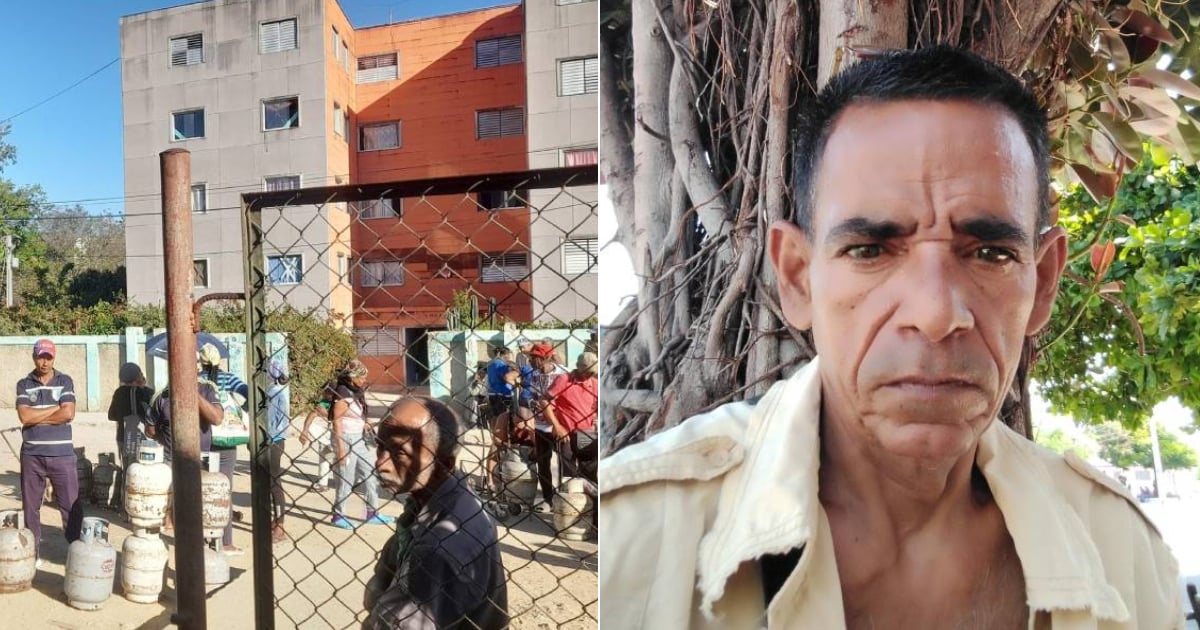
The Santiago de Cuba Municipal People's Court has sentenced Julio César Duque de Estrada Ferrer, a 56-year-old man, to four years and six months in prison for recording a line of people waiting to buy liquefied gas on his cell phone. According to the Cuban Observatory of Human Rights (OCDH), which accessed the judicial document, he was found guilty of alleged crimes of disobedience and assault.
The incident took place on September 5, 2024, at midday when Duque de Estrada was filming a crowd in a neighborhood of Santiago de Cuba. An intelligence officer, Mario Raciel Soulary Garcés, approached him, identified himself as military personnel, and ordered him to stop recording and hand over his ID. The official account in the verdict claims that Duque de Estrada refused to comply, shouted insults, and eventually struck the officer during a scuffle.
The court, presided over by judges Irina Díaz Delis, Hugo Liens Martínez, and Noelia Rodríguez Martínez, issued the ruling. The OCDH criticized the trial as a "sham," stating that "the entire judicial process was filled with human rights violations." The Madrid-based organization condemned the verdict, highlighting the "illegal and disproportionate actions of the political police officer against Duque de Estrada Ferrer."
The observatory further commented, "It's common for these agents to act with violent repression and then pose as victims." They also pointed out that Officer Soulary Garcés' identification as military personnel is problematic and that his initial intervention was questionable under international human rights standards.
Controversy Over Freedom of Expression
The OCDH emphasized, "Filming a line for buying liquefied gas does not constitute a national security threat." According to the organization, requesting Duque de Estrada to stop recording and confiscate his phone directly violates freedom of expression and information, fundamental rights under Article 19 of the International Covenant on Civil and Political Rights (ICCPR), to which Cuba is a signatory.
The group also criticized the use of force: "The arrest and application of force were disproportionate, infringing upon personal liberty and privacy rights." They added that "the officer had no legal grounds to prohibit the filming or demand an ID in the absence of a crime or infraction."
Legal and Human Rights Implications
The OCDH called the intervention an "extralegal, illegal, and unconstitutional act, beyond the officer's duties, which should not lead to charging any crime after provoking the incident." They recalled that past rulings by the Cuban Supreme Court have established that defendants should be acquitted if their actions result from the "abusive, violent, and/or illegal conduct" of a state agent.
Before the sentence, the OCDH noted that the prosecution sought a sentence of five years and six months, including charges of disobedience, assault, and resistance, as well as the suspension of civil and political rights.
Julio César Duque de Estrada, currently detained at Aguadores prison, is the father of Dairon Duque Estrada Aguilera, one of the demonstrators imprisoned after the July 11, 2021, protests. Although not affiliated with political organizations, his critical stance has made him a target of state surveillance.
The OCDH demands his immediate release and reiterated that "filming in a public space is not a crime." The organization concluded, "The Cuban regime is more focused on hiding the severe crisis than addressing the people's issues."
Key Questions About Human Rights Violations in Cuba
What led to the arrest of Julio César Duque de Estrada Ferrer?
He was arrested for recording a line for buying liquefied gas, which authorities deemed disobedience and assault, though critics argue it was a violation of his rights to freedom of expression.
Why does the OCDH criticize the legal process against Duque de Estrada?
The OCDH considers the trial a sham, filled with human rights abuses, and highlights the illegal and excessive actions by the political police.
How does this case relate to freedom of expression concerns in Cuba?
The case underscores issues of freedom of expression, as filming in public was seen as a threat, violating rights outlined in the ICCPR, to which Cuba is a signatory.