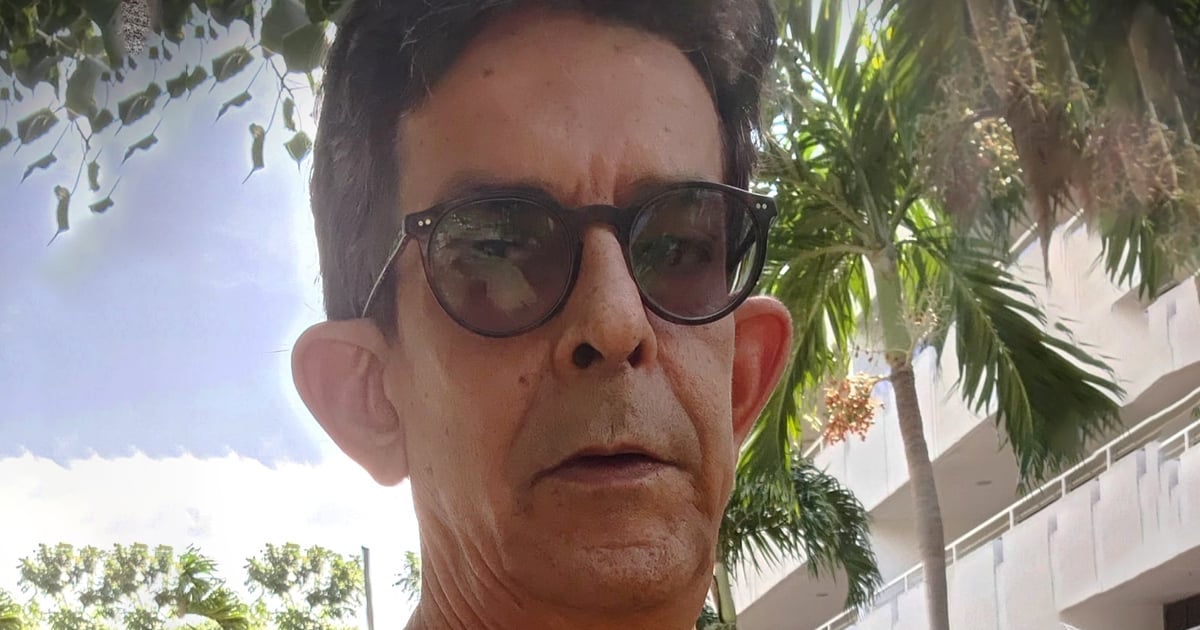
Prominent Cuban comedian Ulises Toirac has responded strongly to attacks from Roberto Herrera, a pro-regime online troll with a restricted profile on Facebook. Herrera criticized Toirac's access to medical care in Cuba, accusing him of discrediting the system while relying on it when in need. "Ulises has spent years criticizing the Cuban system, calling it inefficient, collapsed, and without future. But when his right eye started failing, he didn't seek private clinics in Miami or insurance in New York. He came to Cuba," Herrera claimed.
Toirac, who has faced censorship and professional marginalization due to his critiques of the regime, dismissed the attack as a clumsy attempt to silence his opinion and staunchly defended his career. He first clarified that he didn't "come" to Cuba for healthcare, as he resides there. He pointed out that at the Ramón Pando Ferrer 'La Ceguera' Hospital, where he receives treatment for a severe eye ailment, they haven't 'restored' his health but have made efforts to halt the disease's progression.
Reflecting on his career, Toirac highlighted his achievements as a star, director, and writer of high-rated TV shows for nearly two decades, directing over 14 record-breaking theater performances, and touring the country for 40 years. "With the work I've done, I could have bought the hospital. It's that simple," he emphasized on Facebook.
Toirac also praised the knowledge, skill, and sacrifice of Cuba's medical professionals but insisted that this shouldn't silence his criticism of the system's failings. "Being treated in a hospital (where the rest of the population is also treated, not an exclusive clinic for the elite) cannot silence my opinion or downplay the failures committed in this country," he stated, referencing how the regime uses medical care as a control and blackmail tool.
He concluded by condemning the official media manipulation and described Herrera's text as "a testament to the ineptitude in debate and the weakness of their arguments." "You should be ashamed," he concluded.
The post garnered widespread support from colleagues and friends on social media. Luis Alberto García labeled the attacker as a "left-wing fascist" and criticized the intolerance, extremism, and lack of debate in Cuba. "Anyone not adhering to the rigid, singular discourse is branded a traitor, sellout, fifth columnist, or counter-revolutionary. We have a sick nation," he wrote.
Comedian Jorge Díaz Valera remarked that those who are truly blind are the regime's trolls. "When resources to fight the truth are lacking, they resort to blackmail."
Other artists also defended Toirac. Luis Lacosta, art director at ICAIC, wrote: "Excellent piece, you must confront the trolls with everything," while musician Dagoberto Pedraja called it an act of dignity against "the bellowing of a branded fool."
Toirac's messages illustrate how attacks from the regime and its supporters are part of a systematic smear campaign aimed at silencing outspoken critics. In another post filled with irony and humor, he noted that official accounts refer to him as a "mercenary scum" and "sold-out scum" who for years has "ranted like a snake against the unstoppable advance of our Socialism."
Ulises Toirac concluded his response by reaffirming his critical stance and defending his right to dissent, while highlighting the arbitrary nature of a system that uses censorship and intimidation to control artists and citizens. His messages, which have received hundreds of supportive comments, stand as a symbol of resistance against political manipulation in Cuba.
Understanding Ulises Toirac's Stand Against Cuban Censorship
Why did Ulises Toirac respond to Roberto Herrera's accusations?
Ulises Toirac responded to defend his right to criticize the Cuban regime and to clarify misconceptions about his healthcare choices, as Herrera's accusations attempted to undermine his credibility and silence his dissent.
What is Ulises Toirac's stance on Cuba's healthcare system?
Toirac acknowledges the dedication and expertise of Cuban medical professionals but criticizes the regime for its systemic failures and using healthcare as a tool for control. He insists that his treatment in Cuba does not negate his right to voice these criticisms.
How have Toirac's peers reacted to the online attacks against him?
Many of Toirac's peers, including actors and musicians, have expressed strong support for him, criticizing the lack of open debate and the extreme measures used by the regime's defenders to silence dissenting voices.