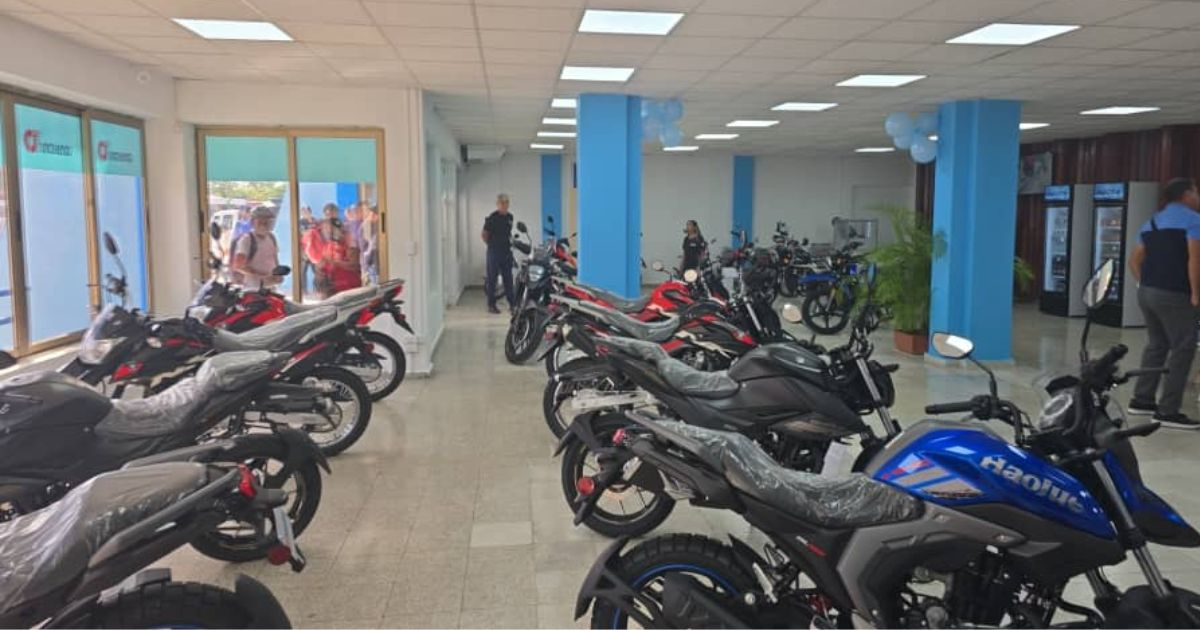
The Cuban government is pledging improvements in the sale of vehicles for foreign currency following escalating criticism over long lines, resellers, and service deficiencies at various dealerships nationwide. This announcement was shared on Facebook by the Minister of Transportation, who described his visits to several sales locations in Havana. He noted issues with customer service and purchasing processes, as well as complaints from both clients and employees.
At the 23rd and C (SASA) store, management stated they are preparing to begin motorcycle assembly, which, according to the minister’s post, could lead to reduced prices and increased availability. Additionally, the installation of a generator was recommended to prevent sales interruptions during blackouts, alongside improvements to the payment system.
In the 1st and 20th (CIMEX) outlet, the minister acknowledged that certain models, such as the “Leopardo” motorcycles, sell out swiftly, attracting street sellers. To address this, plans include boosting the supply of popular models, shifting vehicle sales to state enterprises, and enabling online recharges and payments to reduce reliance on banks.
The Dongfeng dealership at 7th and 20th revealed the upcoming launch of a parts store and direct delivery of spare parts to buyers, with intentions to expand this model to other regions. A new facility is also being developed in Playa, complete with a showroom, workshops, storage, and a Vehicle Registration office to streamline license plate procedures.
An inspection of La Copita (TRD Caribe) store showed the implementation of online presale and purchase, although challenges like the scarcity of budget-friendly models and IT system flaws persist. The minister emphasized ongoing efforts to enhance transparency in sales processes, expedite procedures, and improve customer service. He also stressed the importance of accelerating projects for renewable energy-powered charging stations for electric transportation.
Despite official assurances of “commitment and willingness to improve,” the enduring issues of scarcity, resale, and queues remain significant barriers for Cubans seeking to purchase motorcycles and cars with foreign currency. Eduardo Rodríguez, known for his active social media communication, faced a mix of praise and criticism in response to his post about motorcycles and cars.
The Infotransporte profile highlighted the need to tackle resellers and street sellers who disrupt the purchasing process. They noted persistent problems at the Cimex store in San Miguel del Padrón (Caballo Blanco), where people camp out with benches, seemingly informed about new motorcycle arrivals. They also pointed out consumer rights violations, stating that stores deflect warranty issues to suppliers instead of taking responsibility.
Elizabeth González Aznar criticized the limited access to these products, which seem designed for a privileged few: “Everything is still tailored for those who can afford it in this Cuba. What opportunities do most Cubans have? Hardly any professionals. The State excludes workers who have dedicated their lives to this country by selling only in foreign currency.”
Others focused on unmet promises. Luis Milian commented: “That's great, but what about the VAP, Minister? Many of us have used our meager resources for tires and batteries, and it's been nearly a year since approval, yet the process is still stalled.”
Some also lamented the lack of access using the national currency. Yandu Dabm suggested: “It would be beneficial to consider state enterprise workers who lack foreign currency. Motorcycles should be available in CUP through bank loans, as many buyers have no stable ties with the State.”
Yunier Ledesma Álvarez shared his experience at the 1st and 20th store, where poor queue management favored resellers: “The main allies of lists and street sellers are the terrible sales mechanisms. The IT system is outdated, everything is slow, and they even ask for photocopies of IDs and payment cards, which should be illegal. Moreover, no motorcycle is ready for actual sale: batteries are dead, there are visible defects, and customers are required to bring fuel to test the bike.”
Ledesma concluded, “The post-sale and warranty system is chaotic and completely violates the buyer’s rights.” His sentiments echo the widespread belief that real changes in sales and warranty practices, not just speeches, are necessary to address these critical issues for those who manage to purchase vehicles in foreign currency.
Understanding the Cuban Vehicle Market Challenges
What measures is the Cuban government taking to improve vehicle sales?
The government plans to assemble motorcycles locally to lower costs, increase supply, and introduce online payment systems to ease the purchasing process. Additionally, they aim to expand the availability of popular models and establish parts stores and renewable energy charging stations.
Why is there criticism regarding vehicle purchases in Cuba?
Criticism arises from long queues, the prevalence of resellers, service inefficiencies, and limited access due to foreign currency requirements. Many Cubans find it challenging to purchase vehicles, as the system favors those with financial resources.
How are customers affected by the current vehicle sales system?
Customers face long waits, inadequate customer service, and a lack of transparency in sales processes. The system often fails to honor warranties, requiring buyers to deal directly with suppliers instead of the store.