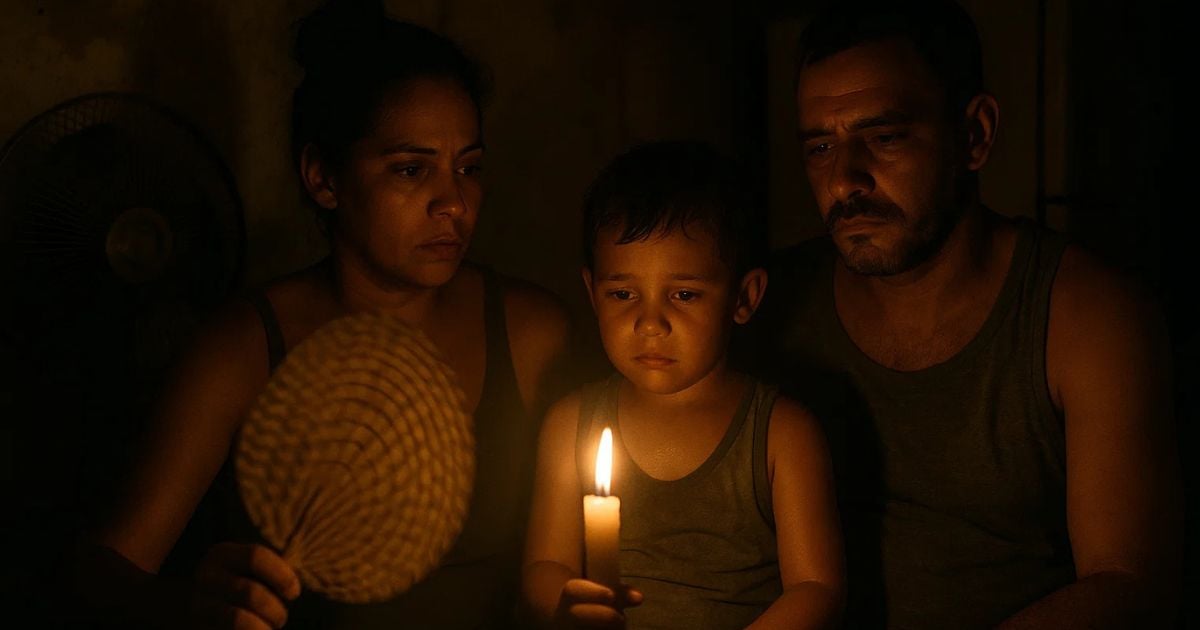
Luis, a single father from Havana, lives under the constant stress of not being able to provide the basics for his two children: a teenager in Mayabeque and a three-year-old in Havana. The Food Monitor Program, an independent initiative tracking food insecurity on the island, has captured his story along with those of other Cubans grappling with the harsh reality of daily power outages. These blackouts not only extinguish the lights but also destabilize countless households.
In Mayabeque, Luis's older son endures a grueling schedule of 12-hour blackouts followed by a mere four hours with electricity. Cooking often relies on electric pots that are useless without power, or on expensive, adulterated charcoal that fills homes with smoke. In Havana, while the outages are somewhat shorter, they strike during critical times like lunch or dinner, forcing Luis to prepare baby food at odd hours for his youngest child.
Unseen Consequences of Power Outages
The problem extends beyond material hardships: the absence of electricity also affects water access, as families need power to run pumps and turbines. The psychological toll is evident too, with the teenager resignedly muttering “no power” while dreaming of emigrating, and the little one innocently asking, “Did the power go out?” every time something shuts off.
Even those who've managed to leave the island aren't immune. Antonia, a three-year-old Cuban girl now living in Florida, anxiously asks her grandmother in Cuba, “Grandma, do you have power?” Her situation highlights how these blackouts become a trauma that crosses borders.
The Impact on Childhood Development
Prolonged blackouts force parents into midnight cooking, disrupt sleeping patterns, and spoil scarce food supplies. More alarmingly, independent organizations warn about the detrimental impact on childhood development: malnutrition, anxiety, and a pervasive sense of uncertainty that takes root from an early age. With the government failing to address these issues, emigrated family members are left to shoulder the burden of sending generators, solar panels, batteries, or food.
Despite these efforts, they cannot fill the systemic void that condemns Cuban children to grow up in darkness and hunger. Amid the widespread collapse in Cuba, prolonged outages have severely disrupted the lives of thousands of families, particularly affecting the youngest. From provinces like Mayabeque, Havana, or Santiago de Cuba, to pediatric hospitals and homes with dwindling hope, children are growing up in a reality defined by darkness, heat, and hunger.
Living Conditions in Crisis
In Santiago de Cuba, the power crisis has driven many children to sleep on porches, patios, or balconies as a means of escaping the stifling heat and mosquitoes. Independent journalists report that the blackouts not only interrupt children's sleep but also damage their mental and emotional health, plunging many mothers into cycles of anxiety, guilt, and exhaustion.
This deterioration isn't confined to urban areas. In rural and impoverished regions, parents improvise meals in the early hours, lose the few refrigerated foods they have, and must constantly rearrange their routines to maintain a semblance of stability amidst chaos. Many mothers have shared their painful experiences of raising children in scarcity, describing how heat and darkness have turned Cuban childhoods into experiences marked by fear and deprivation.
Moreover, the psychological impact extends to mothers, like one recent testimonial highlighted, who relive their own childhoods of hunger and poverty as they watch their daughters endure the same hardships today. The despair, fueled by the lack of institutional responses, has become a generational constant permeating households across the country.
Understanding the Power Crisis in Cuba
Why are power outages so frequent in Cuba?
Power outages in Cuba are frequent due to outdated infrastructure, lack of investments in energy, and mismanagement by the government, leading to an unreliable power supply.
How do blackouts affect children's mental health?
Blackouts disrupt children's sleep, create anxiety and fear, and contribute to a sense of instability, which can have long-term effects on their mental and emotional health.
What measures are being taken to address the power crisis in Cuba?
Efforts to address the power crisis include sending generators, solar panels, and other resources from abroad, primarily by emigrated families, although these measures are insufficient to solve the systemic issues.