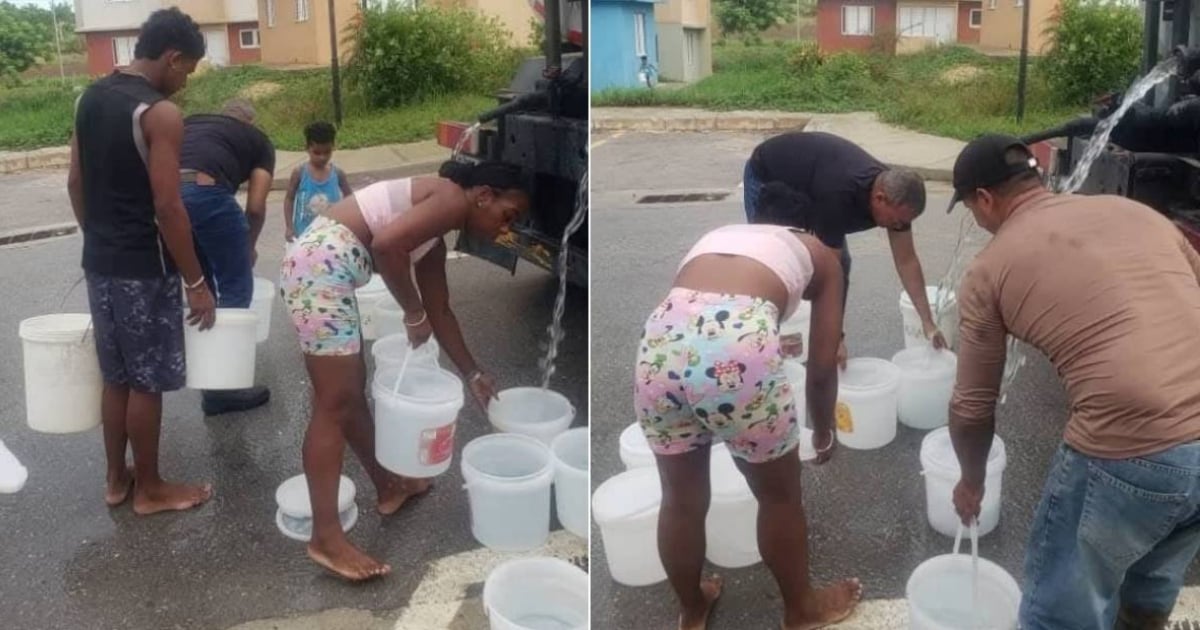
In Havana, the precarious water supply situation has worsened due to power outages, a storm, and the shutdown of a major generating unit in Cienfuegos. Aguas de La Habana announced through their official channels that the El Gato supply source, which operates with seven units from the San José line, ceased operations at 4:00 p.m. because of a power failure. Prior to this, at 2:30 p.m., the Aguacate Line was also taken offline due to a circuit trip.
This disruption impacts water availability directly in the neighborhoods of Habana del Este and San Miguel del Padrón, leaving thousands without access to this essential service. Residents in these areas are already struggling with prolonged power outages, which exacerbate their daily challenges.
The water supply interruption comes amid a national energy crisis that intensified this Friday with the shutdown of Unit 3 at the Carlos Manuel de Céspedes Thermoelectric Power Plant in Cienfuegos, caused by a malfunction in its condenser. The Unión Eléctrica (UNE) refuted rumors of a three-day nationwide blackout but acknowledged an impact of over 1,700 MW on Thursday night and more than 1,600 MW on Friday. These figures could rise with the Cienfuegos plant's shutdown.
Cubans, enduring daily disruptions in electricity and water supplies, increasingly attribute these hardships to decades of negligence, mismanagement, and a lack of investment in the national energy infrastructure.
Understanding the Water and Power Crisis in Cuba
What caused the water supply interruption in Havana?
The water supply interruption in Havana was primarily caused by power outages and the shutdown of significant power-generating units, which are part of a broader national energy crisis.
Which areas in Havana are affected by the water supply issue?
The neighborhoods of Habana del Este and San Miguel del Padrón are directly affected, leaving thousands without water access.
What is the main reason for the ongoing energy crisis in Cuba?
The energy crisis in Cuba is largely seen as a result of decades of neglect, poor management, and insufficient investment in the country's energy infrastructure.