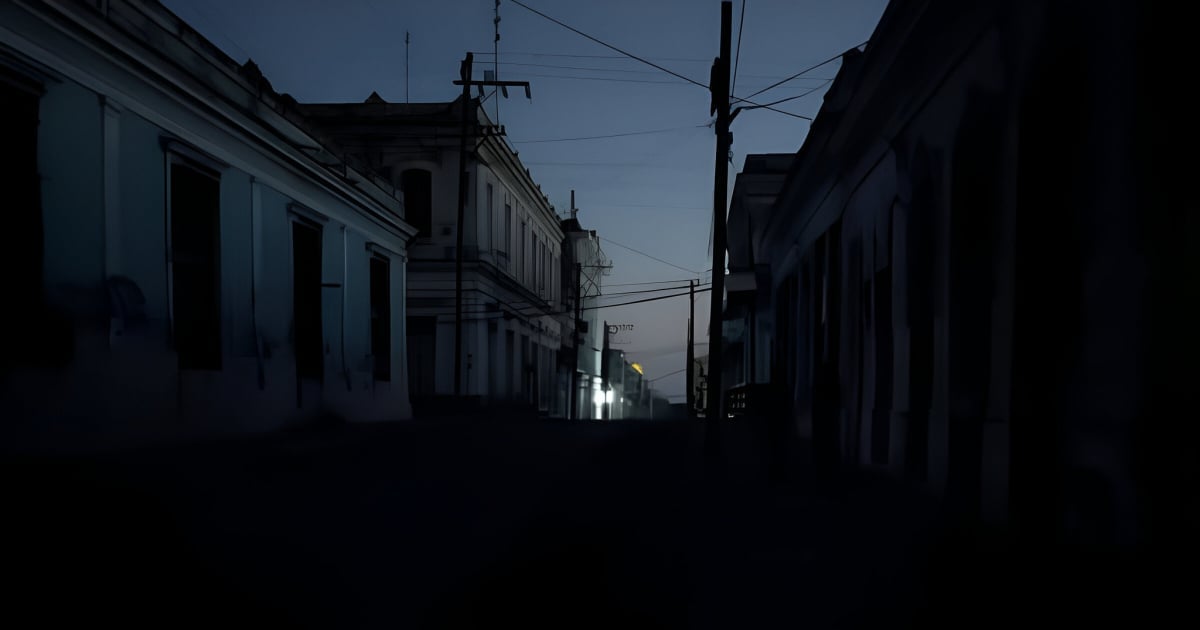
After the collapse of the National Electric System (SEN) on Wednesday morning, the state-run Electric Union (UNE) confirmed that slightly more than 5% of the national demand is currently receiving electricity. In a recent Facebook update, the company highlighted that over 200 MW are being maintained through microgrids across various provinces, primarily to ensure the operation of hospitals, bakeries, and water pumping stations.
With a planned demand of 3,500 MW for the day, as per the official daily report, the current coverage translates to just over 5% of the country. Prior to the collapse, UNE had issued a warning that the SEN's situation was critical. On Tuesday, the disruption reached 1,750 MW during the evening, and a shortfall of 1,790 MW was projected for Wednesday's night peak, with demand at 3,500 MW and available resources falling far short.
Meanwhile, Cubavisión Internacional shared provincial reports indicating a still very limited restoration. In Havana, by 3:30 PM, 4 substations and 13 circuits had been reconnected, covering merely 4.6% of the capital's consumers. In Matanzas, roughly 3% of consumers regained service, with priority given to hospitals like Faustino Pérez and the Maternity Hospital, as well as water rebumping stations.
In Cienfuegos, the reactivation of a microgrid benefitting approximately 8,000 customers, equivalent to 3% of the area, was reported. The government-aligned portal Cubadebate stated that in Pinar del Río, five microgrids were established to support hospitals and water wells. Official sources emphasized that solar parks cannot be utilized under these conditions due to the instability they cause.
The outlet detailed that in Villa Clara, partial restoration was reported in circuits for hospitals and aqueducts in Santa Clara, Placetas, Sagua, and Caibarién, via a microgrid that prioritizes essential health centers and basic services. In the central-eastern region, the UNE mentioned that Felton Unit 1 remains under maintenance, leaving Nuevitas, Moa engines, and one Renté unit available, making the recovery process slow and gradual.
In Las Tunas, power islands are supplying about 8 megawatts to the provincial capital's hospital complex, with plans to increase the load to 13 megawatts following the start-up of fuel oil engines. Although authorities insist that fuel distribution and distributed generation are being reinforced to advance recovery, the harsh reality is that the vast majority of the nation remains in darkness.
This marks the second nationwide blackout of the year, amidst an evidently collapsed infrastructure with no immediate prospects for improvement. The Ministry of Energy and Mines of Cuba assured that this widespread collapse did not cause damage to thermal power plants. Furthermore, the SEN's shutdown comes less than a week after the eastern region of Cuba experienced a massive, localized blackout.
Understanding Cuba's Electricity Crisis
Why is only a small percentage of Cuba receiving electricity?
Following the collapse of the National Electric System, only about 5% of the country is receiving power, as microgrids are being used to prioritize critical services like hospitals and water pumping stations.
What areas are prioritized during the power restoration?
Priority is given to essential services such as hospitals, bakeries, and water pumping stations across various provinces, ensuring these facilities continue to operate despite the widespread blackout.
What are the prospects for resolving Cuba's power issues?
The infrastructure is significantly deteriorated, with no immediate solutions in sight. While efforts are being made to distribute fuel and reinforce distributed generation, most of the country remains without electricity.