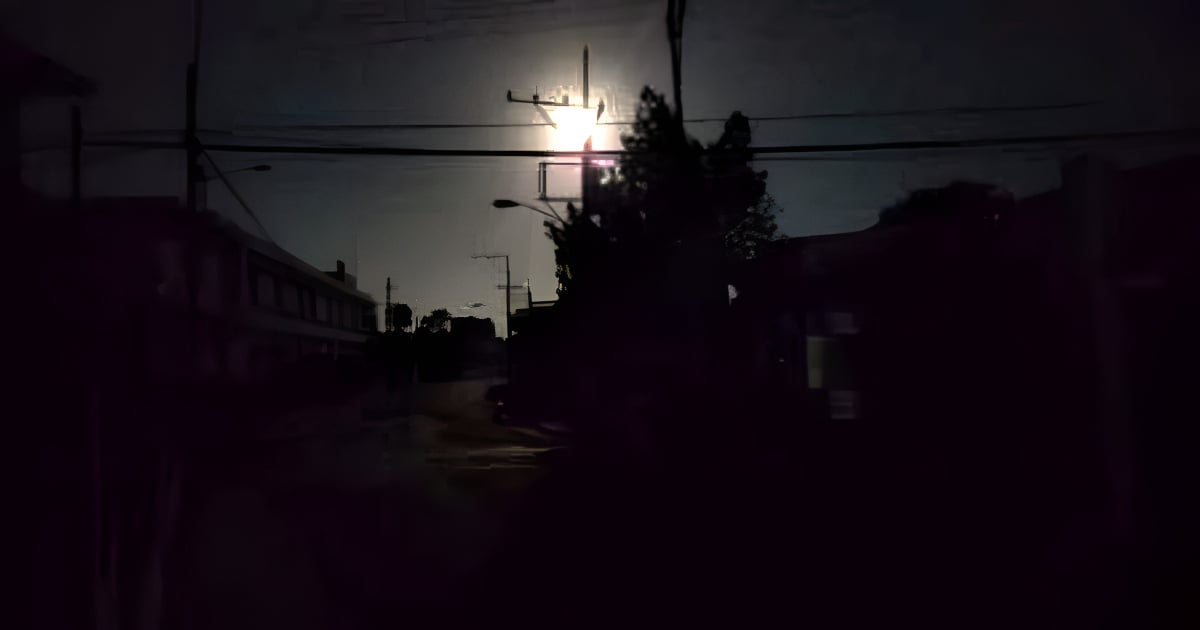
A significant breakdown in the National Electric Grid plunged eastern Cuba into darkness on Sunday, causing a widespread power outage that affected multiple provinces in the region. The western part of the island was not spared either, as Unit 6 of the Mariel power plant also experienced disruptions. According to the National Electric Union (UNE), the outage occurred at 7:37 p.m. on September 7, when a failure on the 220 kV Nuevitas-Tunas line led to a total disconnection from Las Tunas to Guantánamo.
The state-run entity stated that investigations were underway to determine the cause. However, state journalist Lázaro Manuel Alonso later reported on social media that severe weather conditions and minimal power generation in the eastern area at the time were to blame for the disconnection. The blackout also had repercussions in the west: Unit 6 of the Mariel power plant went offline, with plans for it to be back in operation by Monday, according to the same report.
Recovery efforts began promptly after the collapse. By evening, the UNE announced on social media that Las Tunas was the first province to be reconnected, initiating a phased restoration of power. Soon after, electricity reached Camagüey, Holguín, and the main substations in those areas. The company confirmed that power had also been restored to Santiago de Cuba, with the aim of progressing further east.
As part of the strategy, efforts were directed toward reaching Moa's engines and then the Renté plant in Santiago to restart Unit 6 and bolster local power generation. By early Monday morning, the Ministry of Energy and Mines officially announced that Guantánamo had been reconnected. "Power has reached Guantánamo. Restoration of the electric grid in eastern Cuba continues," the entity reported on social media.
Despite these updates, the situation remains dire. The country's power generation deficit is substantial, perpetuating prolonged outages acknowledged by both the UNE and official media like Canal Caribe. The frequent collapses of the National Electric Grid highlight the severe structural deterioration of Cuba's energy infrastructure, as well as inefficiencies in the system's planning and maintenance. Meanwhile, millions of Cubans endure daily power cuts with no permanent solution in sight.
Chronicle of an Unending Energy Crisis
The collapse of the National Electric Grid on September 7 in eastern Cuba is not an isolated incident but rather part of a relentless series of massive blackouts exposing the deep, systemic decay of the country's energy system. Despite repeated official announcements and contingency strategies, the situation not only fails to improve but continues to worsen over time.
In early September, the population was already living under constant alerts. The UNE warned that demand vastly exceeded generation capacity, key units were out of service, and the system was operating under critically unstable conditions. The national deficit hovered around 1,900 MW, nearly half of the total demand, with several power plants offline, including Mariel 6, Felton 2, Diez de Octubre 5, and Guiteras.
This latest blackout, which left the entire eastern region without electricity and affected the west, is part of a sequence of similar events that have plagued the island in recent years. In August, Havana and other cities experienced prolonged outages due to a deficit nearing 1,800 MW, while another grid collapse was reported in June, with even higher levels of impact.
Cuba's electric system has been operating under precarious conditions for years. Many of its thermal plants have been in use for over 40 years, there is a chronic shortage of fuel, a lack of spare parts, and demotivated or emigrated technical staff. Proposed solutions by the regime, like installing mobile generator groups or segmenting the system by regions, have failed to provide lasting stability.
Adding to this is the public perception that tourism and economically strategic areas are prioritized while households are subjected to daily outages lasting between 8 and 16 hours. During one of the most recent collapses, hotels remained lit while entire cities were cast into darkness.
The situation has sparked social unrest, protests in several eastern provinces, and a profound decline in the quality of life, impacting water supply, food preservation, access to healthcare services, education, and work life.
Timeline of Recent Major Blackouts and Grid Collapses in Cuba
September 7, 2025: Complete disconnection of the electrical system in the east following the Nuevitas-Tunas line failure. Services were interrupted from Las Tunas to Guantánamo. Mariel 6 also went offline.
August 4, 2025: Record deficit of 1,799 MW. Blackouts were reported in Havana, the west, and the center of the country.
June 26, 2025: The deficit exceeded 1,800 MW. Reports from all provinces confirmed prolonged blackouts lasting more than 10 hours.
May 22, 2025: Massive blackouts led to protests in Santiago and Holguín. A deficit exceeding 1,700 MW persisted. Deputy Minister of Energy and Mines Argelio Jesús Abad Vigoa claimed that the blackouts affecting millions of Cubans were not due to internal errors but the "criminal American blockade against Cuba."
March 15, 2025: General blackout across the country. Major cities and rural areas were left without service. It was reported that only hotels maintained electricity.
March 16, 2025: A survey revealed that 72% of Cubans remained without electricity following the previous day's blackout. In Santiago, only less than a third of customers were partially reconnected.
October 22, 2024: Total blackout in Santiago de Cuba. Residents reported only 3 hours of electricity daily.
November 8, 2023: A general blackout was recorded in various eastern provinces.
October 19, 2024: The Guiteras power plant went offline, causing a national blackout. Airports operated in darkness.
This timeline clearly illustrates that grid collapses are not isolated incidents but symptoms of a systemic energy crisis. While the government continues to blame external factors, the national infrastructure keeps shutting down, leaving millions of Cubans literally in the dark.
Understanding Cuba's Energy Crisis
What caused the recent blackout in eastern Cuba?
The recent blackout was caused by a failure on the 220 kV Nuevitas-Tunas line, compounded by adverse weather conditions and low power generation in the eastern region at the time of the incident.
How has the Cuban government responded to the electricity crisis?
The government has attempted solutions such as installing mobile generator groups and segmenting the grid by regions, but these measures have not provided lasting stability.
What impact do power outages have on daily life in Cuba?
Power outages severely affect daily life, disrupting water supply, food preservation, healthcare access, education, and work, while causing widespread social unrest.