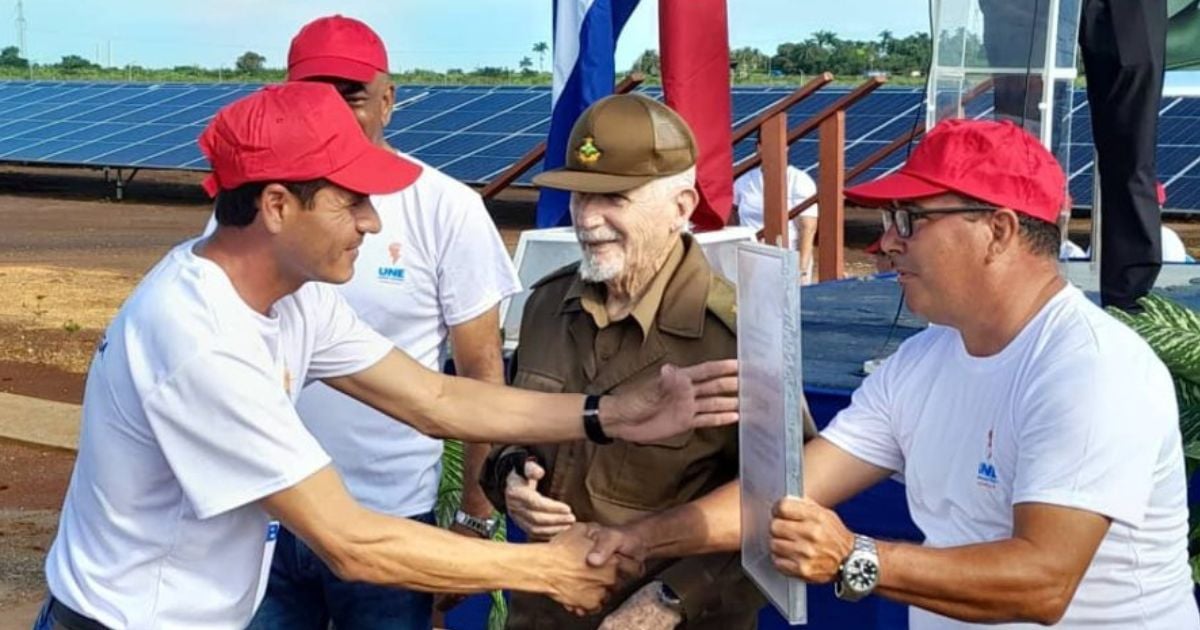
In an attempt to address its ongoing energy woes, Cuba's government unveiled a new solar power park in Colón, Matanzas, on Friday. This initiative comes during one of the country's most severe economic and energy crises, characterized by power outages lasting up to 20 hours, severely impacting citizens. The inauguration was reported by the official Cuban outlet Cubadebate, highlighting the presence of notable figures such as the Commander of the Revolution and Deputy Prime Minister, Ramiro Valdés Menéndez, along with Communist Party officials and local leaders.
During the ceremony, which seemed more like a propaganda event than a practical solution, accolades and speeches were directed at the workers and brigades who reportedly adhered to the project's timeline. The facility boasts a capacity of 21.8 megawatts (MW), a number touted by the government as a stride toward "energy sovereignty"—a claim that might as well belong in a fictional narrative titled "The Achievements of the Cuban Revolution."
This park's inauguration starkly contrasts with the harsh reality faced by Cubans enduring extended blackouts, a situation worsened by the recent shutdown of the Felton thermoelectric plant's unit 1 in Holguín. For many, these official ceremonies appear to be more about optics than genuine relief.
The addition of this solar park brings Cuba’s total to 29 similar facilities, collectively producing 632 MW. However, this output falls short of meeting national demand and offers only minimal relief to the strained electrical grid. As authorities plan further projects in Matanzas, Cárdenas, and Jovellanos, millions of Cubans continue to rely on candles and makeshift stoves, spending sleepless nights without power.
Recently, another solar park spanning 32 hectares was inaugurated in Havana, despite the persistent energy crisis plaguing the island. This second park, located in the Boyeros municipality near the national San Lázaro sanctuary (El Rincón), was opened by the aging commander Ramiro Valdés Menéndez, a stalwart of the regime. The 21.8 MW park features a statue of Fidel Castro, described by the Renewable Energy Sources Company (EMFRE) as "the greatest visionary this beautiful nation has ever had," despite Castro's wishes to avoid the use of his likeness.
In August, the Ministry of Energy and Mines (MINEM) indicated that 27 out of the 51 planned solar parks for the year were operational, constituting 53% of the projected plan. The regime announced on social media platform X that these developments are part of the National Electrical System Recovery Program, aiming to "reduce" blackout hours and "advance toward" the country's energy sovereignty with increased renewable sources. The government's claim that these solar parks are outperforming expectations seems laughable, given that not only did they fail to alleviate summer blackouts as promised, but the crisis has intensified in recent days.
Frequently Asked Questions About Cuba's Energy Crisis and Solar Initiatives
What is the capacity of the new solar park in Colón, Matanzas?
The new solar park in Colón, Matanzas has a capacity of 21.8 megawatts (MW).
How many solar parks does Cuba currently have?
Cuba currently has 29 solar parks, with a total operational capacity of 632 MW.
Why are the new solar parks not reducing blackouts in Cuba?
Despite the addition of new solar parks, the overall capacity remains insufficient to meet the national energy demand, resulting in continued blackouts.
What is the National Electrical System Recovery Program?
It is a government initiative aimed at reducing blackout hours and advancing toward energy sovereignty through increased use of renewable energy sources.