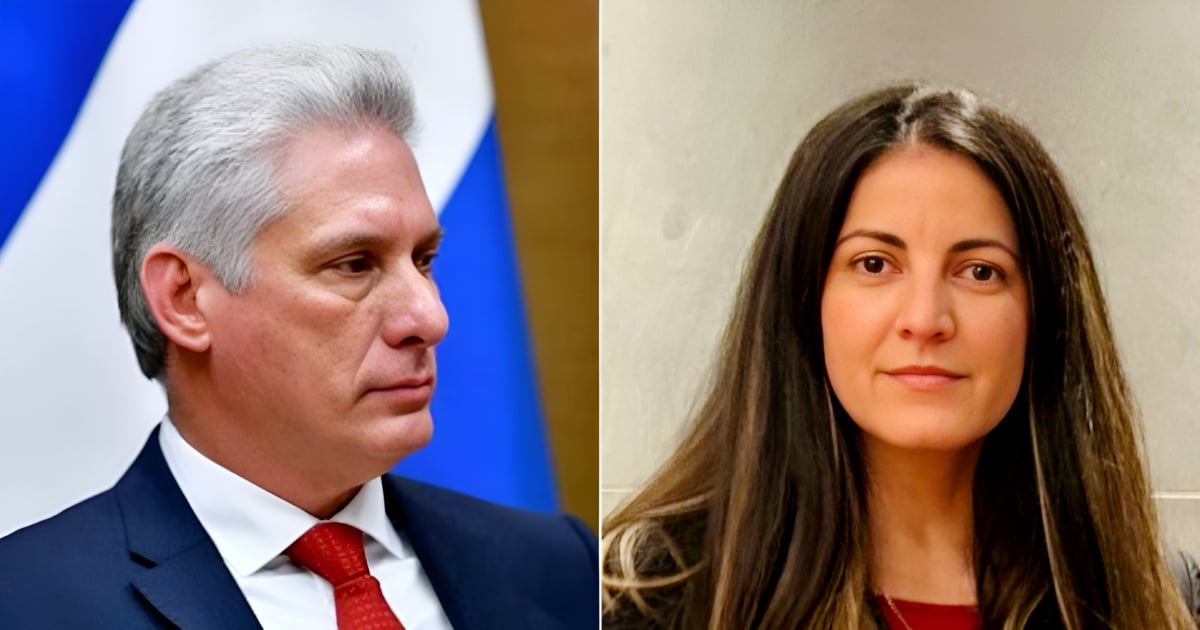
Cuban activist Rosa María Payá Acevedo has once again spoken out against the Havana regime, asserting that Miguel Díaz-Canel and other communist leaders fail to represent the Cuban people. She insists that Cubans have been denied the chance to participate in free, multi-party elections for over six decades. “That order was broken over 70 years ago; neither Canel is president, nor are you a chancellor, nor have Cubans ever voted for communism. Usurping power is not representing the people,” Payá posted on her X account, responding to comments made by Foreign Minister Bruno Rodríguez Parrilla. This statement encapsulates what many political scientists and legal experts see as the core issue in Cuba: the lack of democratic legitimacy in its political power, a critique Payá Acevedo has maintained for years.
Absence of Free Elections in Cuba
Since the revolution's triumph in 1959, Cuba has never held genuinely competitive elections. The current electoral system is dominated by the Communist Party, the “superior force” and the only legalized party on the island, effectively barring alternative political participation. Political theory posits that democracy requires party pluralism, free elections, separation of powers, and respect for civil liberties. In Cuba, these elements have been absent for over 66 years.
The model established by dictator Fidel Castro and continued by his successors is characterized by absolute control over political and social life through a one-party system. In this framework, power does not stem from citizens' votes but is instead imposed by a vertical hierarchy of leaders appointed within the communist elite. For Payá, this renders Díaz-Canel a “usurper” of his position, lacking both origin and exercise legitimacy.
The Dictatorial Nature of the Cuban System
In political science, Cuba is classified as a single-party dictatorship with totalitarian traits, especially pronounced in its early decades. Unlike classic authoritarian regimes, which might allow limited competition or tolerance, Cuba's power structure systematically excludes opposition and persecutes dissent. The state's security apparatus, media censorship, lack of judicial independence, and economic control create a closed system that sits at the most restrictive end of the non-democratic spectrum.
This structure has enabled the ruling elite to remain in power for over half a century, at the expense of denying the basic right to elect and be elected.
The Role of Rosa María Payá
In this context, Rosa María Payá emerges as a prominent voice in the international denunciation of Cuba's illegitimacy. As the daughter of the late opposition leader Oswaldo Payá Sardiñas, she has propelled the Cuba Decide movement, which advocates for a binding plebiscite to pave the way for free elections. Her approach merges direct criticism of the regime with a proposal for democratic transition grounded in civic mobilization and international support.
Many analysts view Payá as embodying the kind of opposition leadership that could be pivotal in a future democratization process. Her commitment to peaceful means, focus on human rights, and development of a concrete political agenda distinguish her as a key figure both in exile and within the island.
The Undeniable Legitimacy Crisis
The issue of legitimacy is not just a moral argument but a fundamental political challenge. A government never ratified through free elections lacks the essential principle of representation. According to Max Weber's definitions of legitimacy, authority can rely on tradition, charisma, or rational-legal grounds. Cuba's case does not fit any of these modern democratic parameters; instead, it is a power maintained through force, repression, and propaganda.
By labeling Díaz-Canel a “usurper,” Payá highlights that the regime's endurance does not rely on the consent of the governed but rather on the exclusion of any political alternative. Her message resonates both within Cuba, where citizens live under an imposed system without options, and in the international arena, where the denunciation of the dictatorship is reinforced.
A Long-Awaited Transition
The transition to democracy in Cuba remains an unfulfilled objective. Activists like Rosa María Payá suggest concrete pathways to initiate this process, even as the regime clings to its nonexistent legitimacy. The stark contrast between the denied popular will and the official discourse claiming to speak for the people underscores that without free and plural elections, a truly legitimate government will not emerge in the island.
Understanding Cuba's Political Landscape
Why does Rosa María Payá consider Díaz-Canel a "usurper"?
Rosa María Payá considers Díaz-Canel a "usurper" because she argues that he lacks democratic legitimacy, as Cubans have never had the opportunity to vote in free, competitive elections, and power is imposed rather than derived from citizen consent.
What is the Cuba Decide movement?
The Cuba Decide movement, led by Rosa María Payá, advocates for a binding plebiscite as a step towards enabling free elections in Cuba, promoting a transition to democracy through civic engagement and international support.
How does the Cuban government maintain its power?
The Cuban government maintains its power through a one-party system characterized by media censorship, lack of judicial independence, and economic control, excluding opposition and suppressing dissent.