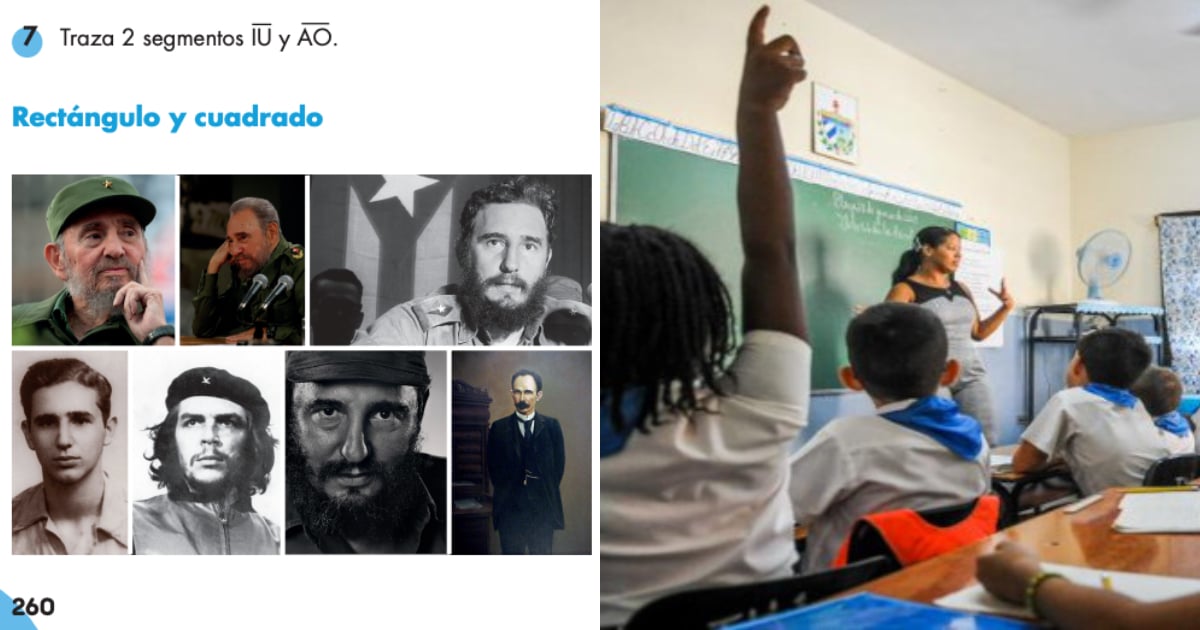
In Cuba, education remains deeply entwined with political indoctrination, starting from a very young age. Recently, images from a first-grade math textbook—published by Pueblo y Educación in 2023—have sparked outrage on social media. This was after singer Inti Santana criticized the inclusion of Fidel Castro's images in exercises meant to teach geometric shapes. "This is a MATHEMATICS book for first graders in Cuba, aimed at six-year-olds. I would love to see the equivalents in other countries and educational systems to see if they use such blatant indoctrination to teach what a square or geometric figure is," the artist remarked. "They don't want people to say that the political practice in Cuba, what they call the Revolution, is just another religion with its holy trinity, its priests, and its dogmatic system telling a five-year-old whom to believe in, who the messiah is, who is unquestionable," she added.
Beyond geometric exercises, the textbook also features political figures and slogans. What should be a resource for learning basic addition and subtraction has, according to activists and parents within the island, become a vehicle for propaganda.
Historical Context of Political Indoctrination
This strategy is not new; for decades, Cuban education has been utilized to legitimize the regime. However, the persistence of indoctrination is especially notable in today's context, as even Prime Minister Manuel Marrero has indicated that the regime's top priority for 2025 will be intensifying political-ideological work over economic issues.
During the Fourth Regular Session of the National Assembly, Marrero emphasized that political matters form the "foundation of everything," prioritizing defense, internal order, and strengthening the socialist state system over the nation's social and economic needs. "This work is essential to ensure national stability and cohesion," he stated in a speech broadcast on state television.
Challenges Facing the Educational System
The relentless focus on political indoctrination, coupled with the education system's deficiencies—such as a lack of teachers, deteriorating infrastructure, and shortage of materials—underscores how the regime prioritizes ideological control over educational quality.
School indoctrination, now visible in simple math problems, aligns with a broader strategy of social control that includes glorifying the Communist Party across all subjects, mandating political events, and integrating revolutionary slogans into daily school life. Meanwhile, growing social discontent and the deepening economic crisis are exacerbating tensions in Cuba, where more families are questioning whether their children's futures are being built on slogans rather than genuine knowledge.
Understanding the Impact of Political Indoctrination in Cuban Education
How does political indoctrination manifest in Cuban education?
Political indoctrination in Cuban education is evident through the inclusion of political figures and slogans in educational materials, as well as mandatory participation in political events and the use of revolutionary slogans in school activities.
What are the implications of prioritizing political-ideological work over education in Cuba?
Prioritizing political-ideological work over education can undermine the quality of education, leading to a focus on propaganda rather than genuine learning, and may result in a generation lacking critical thinking skills and comprehensive knowledge.