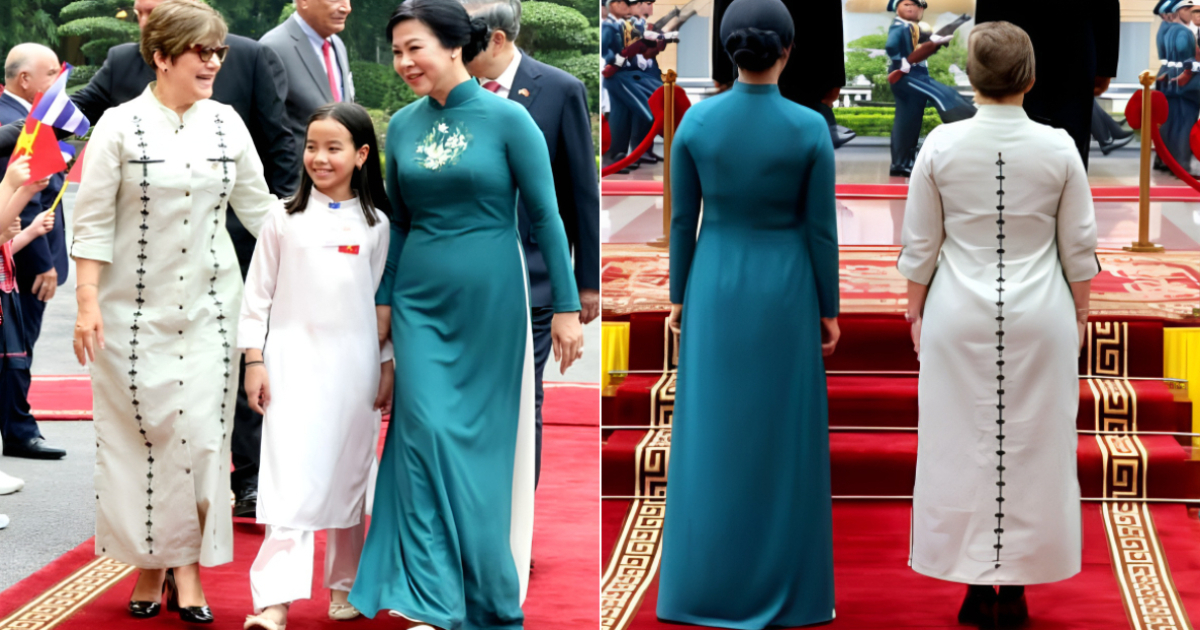
The recent public appearance of Lis Cuesta Peraza, the wife of Cuban leader Miguel Díaz-Canel, during their official visit to Vietnam, has sparked a fresh wave of controversy on social media. This time, it wasn't her speeches or her role as a constant companion of the Cuban leader that drew attention, but rather the dress she wore during the formal events in Hanoi: a creation by the fashion house Saday Modista, inspired by the traditional guayabera, a symbol of national identity.
The fashion brand proudly announced on Facebook that it was an "honor" to dress Cuesta on such a significant day for both Vietnam and Cuba, their National Day. However, what began as a promotional gesture for a small private enterprise quickly turned into a digital battleground, with hundreds of Cubans questioning the appropriateness of flaunting luxury and elegance amidst the severe crisis plaguing the island.
One of the most shared comments summarized the sentiments of many: "She should be dressed in mourning black for the people suffering from shortages, blackouts, and years of neglect. I don't understand how she can do it." Other users criticized the stark contrast between the glamour of official trips and the everyday struggles in Cuba: "The traveling First Lady showcasing new designs and Prada glasses while Cuban mothers struggle to put food on the table amid blackouts and poverty."
Public Outrage Over Extravagance
The cost of the dress also drew criticism. "How much does such a piece cost? It's important to understand how much is squandered and wasted by the so-called First Lady," one user questioned. Another was sarcastic: "I have a burlap sack at home that I could turn into the same dress with some black thread, for much less."
The debate intensified when official journalist Abdiel Bermúdez joined in praising the designer, calling the dress an example of "elegance, good taste, and Cuban identity." The public response was harsh. "This is about 24-hour blackouts, cooking with firewood, mass migration, and you’re applauding these people,” a commenter retorted. Bermúdez tried to defend it as “high fashion,” but another user sharply countered: “It’s high fashion but very low morals.”
Criticism Extends Beyond Fashion
Sarcasm was also rampant. "It's not a housecoat, it's a 400-thread count sheet," one user mocked. "Looks like a scarecrow," another added. A third cruelly jested: "Even if the monkey dresses in silk, it remains a monkey."
Criticism wasn't limited to the dress alone. Many questioned why Cuesta is part of the official entourage when she holds no state position. "Why is she part of the delegation? Every time her husband travels, she tags along. Unprecedented," one user noted. Another was more blunt: "That woman represents no Cuban identity and is extremely unpopular among the people. All she did in Vietnam was burn through thousands of dollars of national funds."
Even those who defended the designer acknowledged that associating her brand with the image of Díaz-Canel's wife was a miscalculation. "The entrepreneur destroyed her own business by bragging about dressing someone so grotesque and unpopular. A pity, because the quality of the design is evident," lamented an online user.
The controversy highlighted not only the public's rejection of Cuesta Peraza as a figure but also the Cubans' sensitivity to any display of wealth during hard times. While the regime attempts to present her as a symbol of "elegance and Cuban heritage," the public sees her as a painful reminder of the gap between the ruling elite and the nation's reality.
A final comment summed it up starkly: "The money used for that rag is stained with blood. If you dress a dictator's wife, you help polish their image on the world stage."
Understanding the Controversy Around Lis Cuesta's Appearance
Why did Lis Cuesta's dress cause an uproar?
Lis Cuesta's dress sparked controversy because it was seen as a display of luxury and elegance amidst the severe crisis in Cuba, where many citizens are facing shortages and hardship.
What was the public's reaction to Lis Cuesta's dress?
The public reacted with criticism and sarcasm, questioning the appropriateness of such a display during difficult times and pointing out the disparity between the elite and everyday Cubans.
How did the regime respond to the criticism of Lis Cuesta's dress?
The regime, through official channels, attempted to frame the dress as a symbol of elegance and Cuban identity, despite the public's perception of it as a reminder of the gap between the ruling elite and the populace.